

Spain’s Border Verges on Collapse
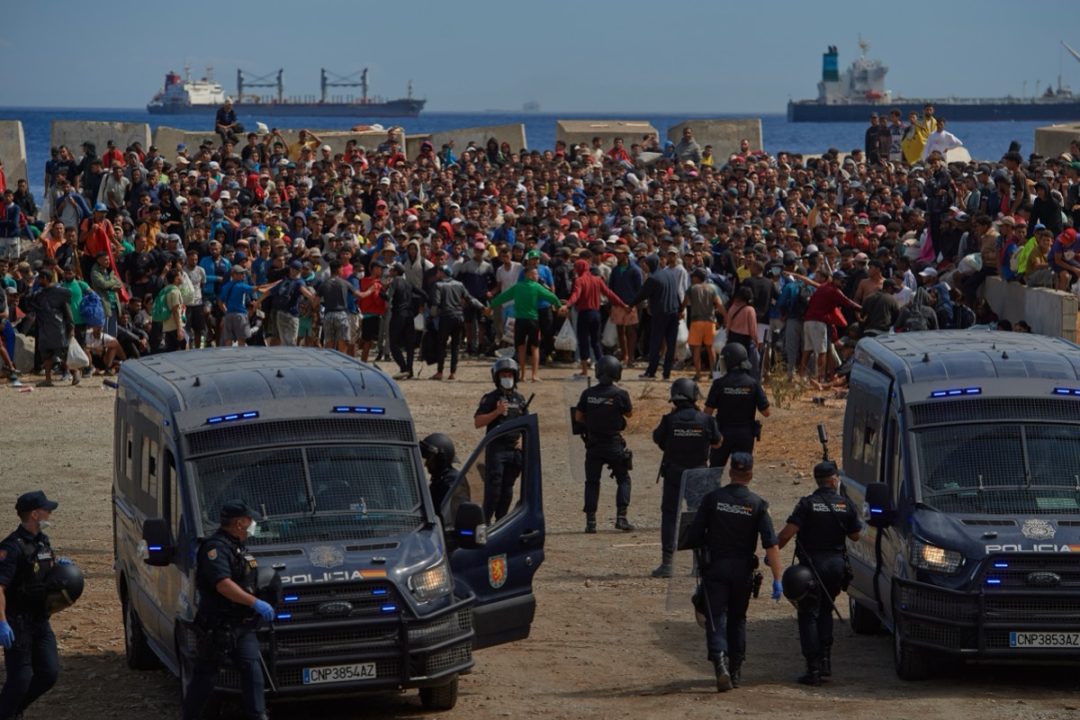
The migrant crisis in Spain’s North African exclave of Ceuta is getting worse. On August 16, hundreds of Moroccans and others staged a protest demanding asylum. This follows a massive sudden influx in late July, when more than 72,000 people surged into the tiny territory, nearly doubling its population overnight. Reports say that the invaders were planning to journey from there to Continental Europe. Spanish military forces deployed, though officials claimed that the “vast majority [of the migrants] returned voluntarily in the following days.”
A Planned Invasion
The catalyst seems to be a recent Spanish Supreme Court ruling that favors migration, but does that explain tens of thousands of people spontaneously rushing the border? The scale invites skepticism that it was purely organic. Moving vast numbers of people across a tightly controlled frontier in a concentrated window requires D-Day-level organization, logistics, and at least tacit non-interference by Moroccan authorities who normally manage the border. The numbers indicate coordinated operations rather than random individual decisions.
Possible contributing factors include the turmoil at the Strait of Hormuz choking off oil from Iran. It follows that the Strait of Gibraltar assumes a higher level of significance, and Western energy conglomerates want it. Former Pentagon official Michael Rubin has dutifully helped by publicly encouraging the invasion.
Spain’s recent diplomatic posture may also have made it a target. Madrid has deepened trade and investment agreements with China in an ongoing broader European push toward reducing dollar dependence.
Israeli Pressure
Under Prime Minister Pedro Sánchez, Spain has also taken a prominently critical stance toward Israel, recognizing the State of Palestine, supporting related international legal efforts, imposing arms restrictions, and using strong language about the Gaza conflict. Israeli Prime Minister Benjamin Netanyahu and his son Yair have vowed revenge by promising “diplomatic war” and encouraging the Muslim invasion of Ceuta.
Analysts linked to pro-Israel think tanks had earlier in 2026 openly discussed using Moroccan claims on Ceuta and Melilla as a pressure point against Spain. Several Israeli politicians and commentators expressed satisfaction at Spain’s predicament. For instance, National Security Minister Itamar Ben-Gvir sarcastically congratulated Sánchez on his commitment to immigration and diversity while urging Spain to open its doors further to Gazans. Other voices, such as neocon Max Abrahms, framed the episode as Spain “getting what it deserves.”
Morocco has long-standing territorial claims on Ceuta and a strategic partnership with the United States and Israel (formalized partly via the Abraham Accords and Western Sahara’s recognition). Meanwhile, Spain continues efforts to improve relations with Algeria, a regional rival of Morocco. Migration has repeatedly served as a tool in these North African and Mediterranean power dynamics.
An Age-old Tactic
Of course, migration has been used as a weapon of war since antiquity. It seems Spain is the latest victim of the age-old tactic of governments using barbarian hordes as bioweapons to break up civilization and plunder resources.
This article is part of The New American’s weekly online newsletter Insider Report, which is emailed to TNA subscribers each week. Click here to subscribe to The New American to receive the Insider Report and access exclusive content.