The Trump-Xi-Putin Summit: A New World Order Rebranded?
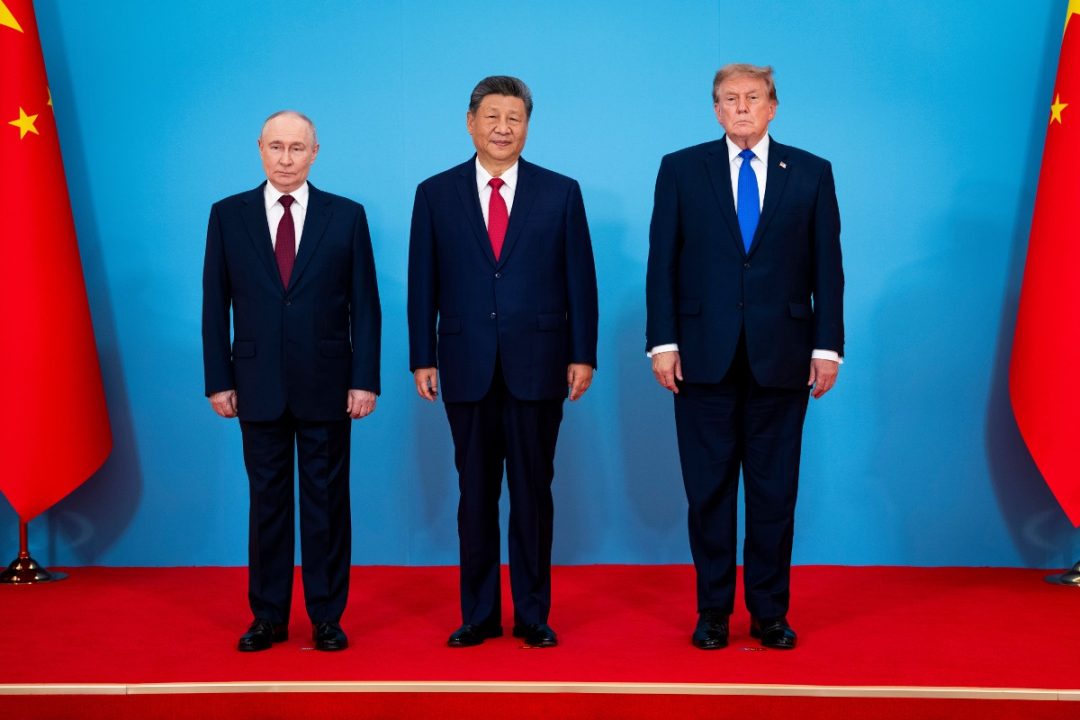
American, Chinese, and Russian heads of state met up in China to talk about world peace. U.S. President Donald Trump, Chinese leader Xi Jinping, and Russian President Vladimir Putin discussed nuclear disarmament, global oil supplies, Ukraine, and reforming the United Nations.
The historic summit came about after Putin reportedly suggested it as a way to hash out plans for ending the Ukraine war. There’s no indication of any progress on that front, and some European leaders have criticized that part of the agenda because it didn’t include the leader of the country Russia is warring against.
Replacing the U.S.-led Order?
A common mainstream talking point is that the summit is more evidence that the unipolar international order, the U.S.-led one, is being replaced by a multipolar one. The Wall Street Journal reported:
The first-ever gathering of the American, Chinese and Russian leaders was a further sign of the end of a unipolar world order dominated by the U.S. — and suggested that what might replace it is a more uncertain, and unsettled, reality.
An analysis in The New York Times framed the meeting as the autocrats taking advantage of a flailing United States. Edward Wong of the Times wrote:
[Xi and Putin] and their nations are transforming the world order by usurping the role of America as the sole superpower, the undisputed victor of the Cold War. Both Mr. Xi and Mr. Putin share a sense of historical grievance shaped by the expansion and dominance of U.S. power in the more than three decades since the fall of the Soviet Union. But from Mr. Xi’s perspective, that situation is evolving, and, rightly or wrongly, he has embraced a vision of America in terminal decline.
For the Eastern leaders, this might be an ideal opportunity to dislodge the U.S. from their neighborhood. Putin and Xi want the United States out of their sphere of influence, and Trump wants Russia and China out of the Western hemisphere. As the Journal noted:
Putin wants Washington to stay out of his way in Ukraine. Xi wants the U.S. to accept his claim that self-ruled Taiwan belongs to China. And Trump has made pushing Chinese and Russian influence out of the Western Hemisphere a central element of his so-called “Donroe Doctrine” to reassert U.S. dominance in the region.
Xi confirmed in a post-summit statement that the Chinese want complete control over their part of the world:
It is important to respect one another, seek common ground while reserving differences, and pursue shared development, including respecting one another’s sovereignty and territorial integrity, the social systems and development paths of their own choice, and their respective core interests and major concerns. It is always important not to interfere in other countries’ domestic affairs or each other’s internal affairs.
While Trump dealt a big blow to China and Russia when he conquered Venezuela, America’s top intelligence agency has only intensified the war it’s waging on Russia through Ukraine, and there is no indication whatsoever that the U.S. would ever consider abandoning Taiwan, especially given its valuable status as a leading semiconductor producer.
The Nuclear Issue
The most pressing issue the three leaders discussed was nuclear weapons. The summit didn’t yield any binding agreements; the point was to get the world’s largest nuclear arsenals talking.
The longer the Ukraine war rages on, the more people grow concerned about a nuclear exchange. The Russians have repeatedly threatened to use nukes if they deem it necessary, and the Western European powers have shown they have no intention of dialing back military support for Ukraine.
The White House said in a statement following the summit that “the three countries will conduct a dialogue on reducing nuclear risks and preventing the proliferation of nuclear weapons.”
Trump also held a chummy bilateral meeting with Putin. “We’ve had a great relationship for many years,” Trump told reporters before sitting down with Putin. “We’ve known each other for a long time, and I think a lot of wonderful things can come of this.”
Putin’s comments suggest the talks weren’t designed to generate any major decisions on Ukraine:
The mere existence of agreements is always better than having no agreements at all, even if these agreements are ultimately not fully implemented. … The [meeting] does not set any overarching goals, it does not aim to subordinate anyone to our decisions, it is a format for finding mutually acceptable solutions for the three of us, primarily in the field of security.
“Safeguarding World Peace”
World peace was the official theme of the summit, entitled “Safeguarding World Peace and Promoting Strategic Stability in Major-Country Relations.” The Chinese framed the meeting as one between nations that are not so different. “More than 80 years ago, China, Russia and the United States, the key anti-fascist forces in the world, fought shoulder to shoulder and achieved great victories, winning peace and tranquility for the world,” says a statement by China’s Ministry of Foreign Affairs. “China, Russia and the United States should be partners and friends. We should not go for conflict or confrontation among us, and should hold the line on peaceful coexistence.”
The Russian leader seconded that. “Our three nations are united not only by the status of victors in the Second World War but mainly by our responsibility for maintaining international peace,” Putin said at the meeting.
The pitch sounds reasonable. Xi is proposing mutual respect and cooperation between the power nations for the sake of global peace and stability. And the leaders say multipolarity is the way to achieve that.
A Stronger International Order
But there is also some concern that the real aim, or the trajectory that would play out, is a shift not necessarily to multipolarity, but to global order with a façade makeover. In comments on the meeting, Xi appears to imply a desire for a global order with China at the top. Per the Ministry of Foreign Affairs:
President Xi underlined the point that humanity, living in the same global village, is a community with a shared future. In this global village, major countries shoulder special responsibilities. … China, Russia and the United States, all major countries and permanent members of the U.N. Security Council, should set good examples, work together to meet global challenges, jointly uphold world peace and stability, and make greater contribution to the progress of humanity.
The United Nations, created to serve as the nervous system of an emerging world government, has suffered significant blows in trust and viability. Between the Trump administration’s persistent interruption in fee payments and decades of reports of abuse by the organization, it should’ve been disbanded years ago. But the White House reiterated that it would rather “reform the UN so that the UN can respond more effectively to global challenges and conform to its fundamental mission of international peace and security.” Putin agrees. He said, “Given that all our countries are permanent members of the UN Security Council, we naturally discussed the possibility of reforming the UN and making it work better.”
Before the summit took place, Council on Foreign Relations senior fellow Charles Kupchan suggested that cooperation between these three countries comes with the potential to create a stronger international order. He argues for a new global body, a “global concert — an informal steering group of great powers modeled on the nineteenth-century Concert of Europe.” Kupchan’s vision is essentially a different, more powerful version of the UN:
In addition to the United States, China, and Russia, a new concert would include India, Japan, the European Union, and representatives from Africa, Latin America, the Middle East, and Southeast Asia. Concerts sacrifice representation for efficacy and give only the geopolitically influential states that must be there a seat at the table. They set aside ideological differences and bring democracies and autocracies together to focus on international cooperation. Because concerts eschew binding, enforceable procedures in favor of informal consensus building, they can succeed when formal institutions such as the UN Security Council are paralyzed and when the United States wavers in its commitment to rules-based multilateralism.
Foreign Entanglements Endanger Sovereignty
Friendly relations for the sake of peace and prosperity are good, even when they involve autocrats. George Washington made this pitch in his Farewell Address, essentially saying we should strive to be at peace and do business with every nation willing to reciprocate that good will. And there was no shortage of dictators, kings, and other kinds of tyrants when he left the presidency. But Washington also warned about foreign entanglements. He understood those kinds of arrangements would dampen American sovereignty and individual liberty. The UN, the League of Nations, and the European Union have profoundly reduced the sovereignty of their member nations. The same thing will happen in any other international body with members and rules.
Xi is right: National leaders should strive to foster peace and trade. He’s also correct in saying that nations should stay out of each other’s affairs. And they should certainly talk to one another and agree on mutually beneficial policies. But this should be done through bilateral agreements, not coercive international bodies that usurp national sovereignty.