
Vol. 42, No. 12
12/01/2026
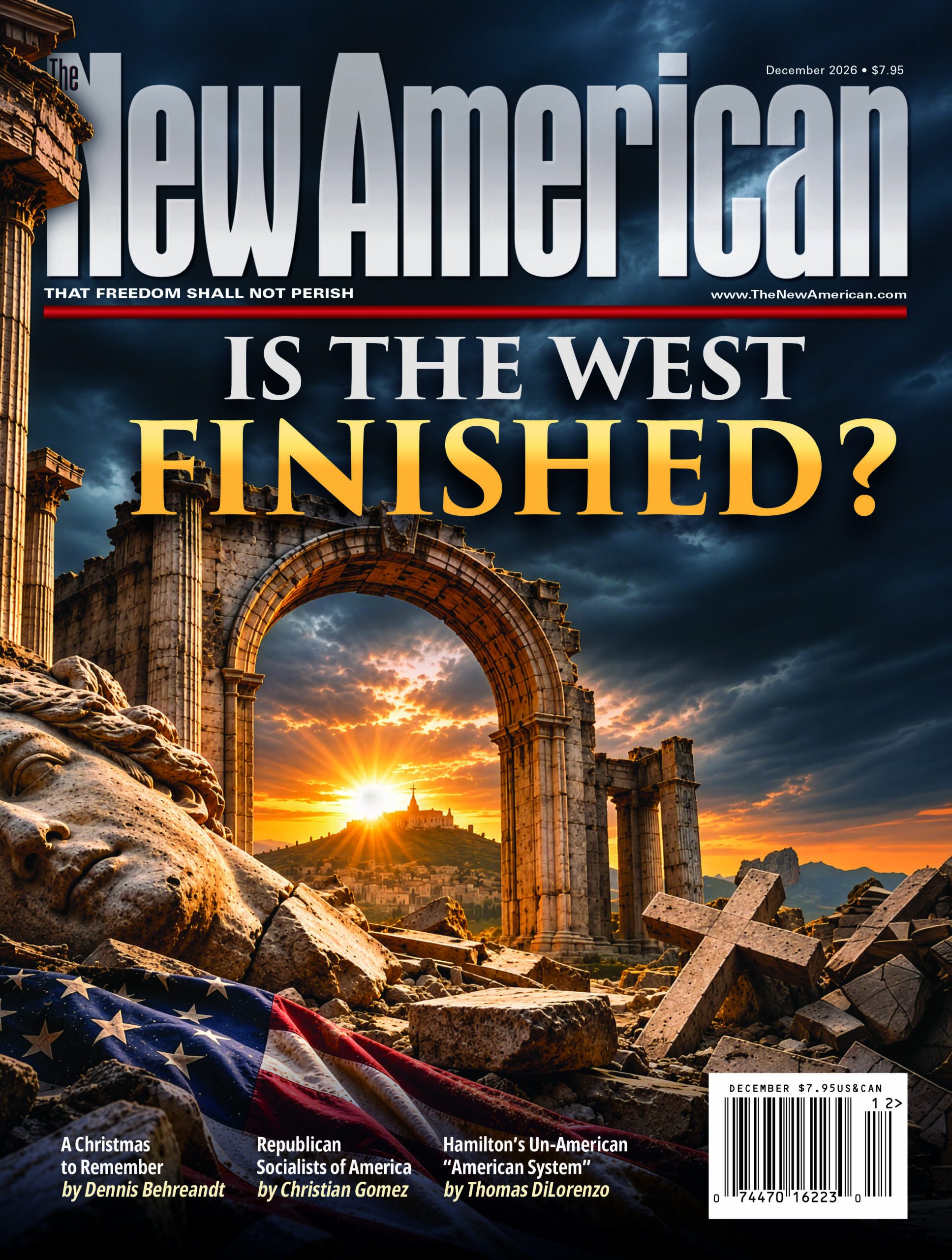
Is the West Finished?
AT A GLANCE
• The fall of Rome is considered a metaphor for our Western civilization.
• Rome and Western Christendom, however, are different.
• Western civilization has used periodic crises to rise to greater heights.
• America has faced existential crises throughout its history, and has always prevailed.
On the second day of this year, The Hill ran a bleak op-ed entitled “The American empire has entered its final act.” The author, John Mac Ghlionn, recites the usual litany of self-evident woes — economic decline, social disintegration, general anomie — and concludes that America has settled into a state of “managed decline.” It has become “a nation exhausted, indebted, aging, and divided … no longer confident in its future.” While the end may not be as imminent as some suppose, Mac Ghlionn concludes that it is inevitable.
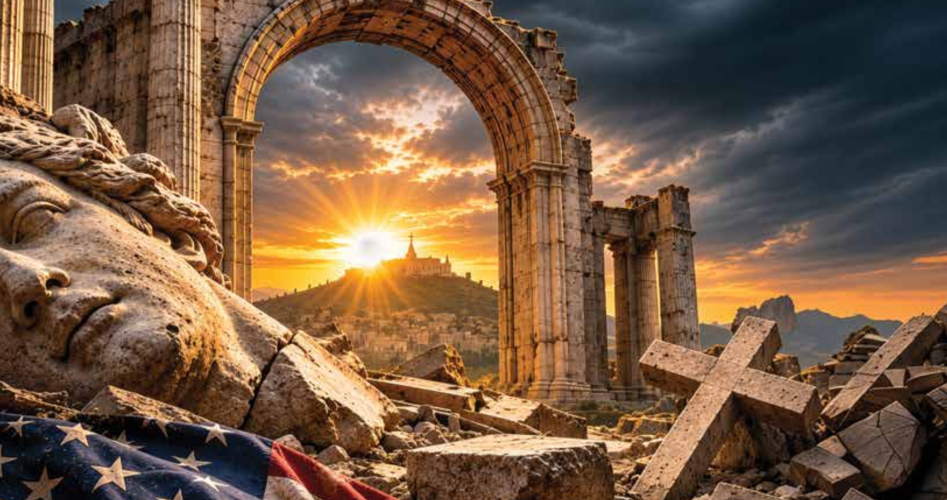
Not exactly a ringing endorsement of America’s future prospects on her 250th anniversary. And of course, additional crises have erupted since last January, the most conspicuous being the war with Iran. Add to that the results of November’s elections, and the national sense of impending doom is palpable. America seems to be caught in a triple snare of debt, political paralysis, and irreversible moral decay leading toward a sort of neo-Roman civilizational collapse.
Yet the historical record, ever nuanced, suggests that all is not necessarily lost and that, indeed, there are ample grounds for optimism. Western civilization, after all, is a story of almost unending existential crises met with extraordinary courage and resilience that, more often than not, have transformed would-be agents of destruction into platforms for reinvention and progress. Time and again, the Christian West has confronted adversaries and obstacles that would have broken lesser civilizations, only to triumph against all odds and emerge the stronger for it. It is this record that affords very reasonable hope that we will overcome the gamut of current threats and avoid the fate of lost Rome.
Aftermath of the Fall
To be sure, the fall of Rome was as great and terrible as it was inevitable. Already in the first century B.C. — the era of Sulla, Caesar, Pompey, and Cicero — Rome’s century-long transition from republic to empire was traumatic enough, entailing numerous desolating civil wars, from the rivalry of Marius and Sulla through the final contest between Octavian and Marc Antony for Caesar’s seat. That bloody period saw all of the moral ties and political restraints that held the old republic together torn asunder, never to be reconstituted. The Roman state from Julius Caesar onward was little more than a spectacle of bloodletting, in which the most ruthless prevailed. That this state of affairs was prolonged for several centuries was due in part to Rome’s having several good emperors during the first and second centuries, and in part to the inertia of its irresistible military power.
While the last century or so of the Western Roman Empire was replete with end-of-days pageantry that included an apocalyptic tsunami in 365 A.D. and two sacks of the capital city by barbarian hordes, nothing surpassed the shock of the Battle of the Catalaunian Fields and its aftermath. That vast conflict in June 451 pitted the previously invincible horde of Attila the Hun and various allied Germanic tribes against a coalition of Romans, Goths, and minor allies led by the great general Aetius. The battle, which took place somewhere near the modern French town of Chalôns, saw the Gothic king Theodoric killed, along with hundreds of thousands of others, in what is generally regarded as the greatest battle of classical antiquity and the event that ushered in the Dark Ages. Attila himself survived and withdrew under arms, only to invade the Roman Empire the following year and utterly destroy one of its largest and most commercially important cities, Aquileia. After that catastrophe, the road to Rome itself lay open, but for reasons not entirely clear, Attila withdrew, perhaps recalling with superstitious dread the mysterious death of Alaric the Goth only weeks after he sacked Rome decades before. The following year, Attila himself died suddenly, perhaps by poison. But for two parlous years, the fate of Western civilization in its infancy was at the mercy of the man who called himself “the scourge of God.” As historian John Julius Norwich observed:
In the summer of 451 and again in 452, the whole fate of western civilization hung in the balance. Had the Hunnish army not been halted in these two successive campaigns, had its leader toppled [Roman Emperor] Valentinian from his throne and set up his own capital at Ravenna or Rome, there is little doubt that both Gaul and Italy would have been reduced to spiritual and cultural deserts.
The world almost came to an end again during the following century. The reign of the Eastern Roman Emperor Justinian was as great a calamity as ever befell Christian civilization. Remembered for his efforts to reconstitute the Western Roman Empire by sending his generals to invade Italy and North Africa, as well as for his codification of Roman law and for the construction of the greatest church in Christendom, Hagia Sophia, Justinian was also one of history’s greatest monsters — although not all of the disasters of his time were caused by his policies. The first disaster befell Byzantium in 532 A.D., when Justinian had only been on the throne five years. His subjects rose up and rioted over high taxes and pervasive corruption (the famous Nika Riots), throwing Constantinople into turmoil. Justinian, on the advice of his wife, Theodora, ordered the massacre of tens of thousands of people, wiping out much of the population of the Queen of Cities in a single terrible day. Four years later, the sun itself went dark, plunging the world into an 18-month spell of gloom and cold that is still unexplained. Crops failed and people starved to death by the millions all across Europe, presumably because of volcanic upheavals elsewhere on the globe. No sooner had this disaster appeared to run its course than the Byzantine Empire was devastated by a plague, beginning in 541 and lasting for eight awful years. At its peak, the plague killed thousands of people per day in Constantinople. It ravaged every corner of the empire, and also overspread the Sassanid Persian Empire and the rest of the Middle East and Mediterranean world.
By the time these dreadful events had come to an end, the Byzantine or Eastern Roman Empire had probably lost half of its population. Many saw in the upheavals signs of the last days. Yet the Byzantine Empire recovered and became, for the next 900 years, the great bulwark that protected Christendom against invaders from the East, including Arabs, Russians, and Turks. While Western Europe struggled for centuries in the aftermath of Rome’s fall, Constantinople and Byzantium flourished, allowing Western Christendom centuries to rebuild.
The Resilience of Medieval Christendom
Yet Western Civilization was under existential threat during the entire Middle Ages, and well into the early modern period, thanks to the rise of Islamic militancy. It is difficult to comprehend, from our comfortable modern vantage point, just how terrifying the sudden rise of Islam must have been to the Christian West. Within a century, what had begun as a revolution in one of the most inhospitable deserts on Earth had swept across the Middle East, all of North Africa, and well into southern Europe. Millions of people living in what had been Christian lands, from Syria to Egypt to Libya to Morocco, were forcibly converted or killed by the armies of the crescent. The Iberian Peninsula succumbed soon thereafter, and before long, the Moorish invaders had crossed the Pyrenees and begun the process of conquering France. Only the extraordinary heroics of Charles Martel at the Battle of Tours turned the tide. But the Moors, repulsed from France, settled in for what would become a 700-year struggle for what is now Spain and Portugal, the Reconquista. Beginning with the miraculous victory of a small Asturian army over a massive Moorish force at the Battle of Covadonga in 722, the Reconquista was perhaps history’s ultimate lost cause, a back-and-forth struggle fought by a ragtag coalition of often discordant Spanish leaders against an enemy united by a fanatical creed and backed by the disciplined and well-equipped troops of a wealthy caliphate. Yet in the end, in 1492, the same Ferdinand and Isabella who sent Columbus on his fateful voyage secured the final surrender of Granada, the last Moorish stronghold, and in that very year, modern Spain was born. All of Spain’s subsequent role in the discovery, exploration, and colonization of the New World, with its immense modern-day consequences, can be traced to the outcome of that titanic struggle, a testament to the iron wills of generations of Calatrava and Alcántara knights and their allies, fighting a war that, by all rational calculus, should have been unwinnable.
Although evicted from Western Europe, militant Islam continued to press on Europe’s eastern flank, periodically menacing the Byzantine Empire and Constantinople itself. The Umayyad Caliphate had exacted a terrible toll with two sieges of Constantinople, first from 674 to 678, and then from 717 to 718. The later Abbasid Caliphate obliterated the Byzantine city of Amorion in 838, slaughtering or enslaving the entire population of what had been the empire’s second-largest city.
In the early 11th century, a new and even more formidable enemy arose to dominate the Islamic world and threaten the West: the Turks. Less than 40 years after the rise of the Seljuk Turkish empire, Byzantine forces were decisively defeated by the Turks at Manzikert, with the captured Byzantine emperor personally forced to bow and scrape before the Turkish conqueror Alp Arslan. From Manzikert onward, the Turkish power grew to hegemonic proportions, even as the Byzantines witnessed their proud Christian empire, beginning with Asia Minor but eventually including the Aegean world and southeastern Europe, overrun by Islamic forces. Even a series of crusades against the Islamic power that held Jerusalem and the Levant were only able to delay the relentless march of Islam into Eastern Europe by a few generations. In the end, Constantinople itself fell in 1453, its ancient and once-impregnable walls blasted open by modern cannon. In a single day, the city that had been the West’s bulwark against invasion from the East for more than a thousand years had become the new stronghold of Islam, and it was plain to every European Christian that much worse was coming.
The Ottoman Turks had become the superpower of the day under the leadership of Mehmet II, conqueror of Constantinople. As soon as the conquest of Byzantium was completed, Mehmet set his sights on the rest of Christendom, and, with his enormous well-equipped armies that had scarcely tasted defeat, began his press into the Balkan heartland.
Just over three years after the fall of Constantinople, in the summer of 1456, Mehmet the Conqueror arrived at the walls of Belgrade at the head of a force of up to 100,000 seasoned warriors. Belgrade, the capital of modern Serbia, lies in the northern Balkans on the Danube, and in the 15th century controlled access to central Europe. If Belgrade fell, there were no further obstacles blocking Ottoman access to Budapest, Prague, Vienna, and the rest of the European heartland.
But Belgrade’s defense was led by the fearless and immensely capable Hungarian nobleman-general John Hunyadi, who had already spent a large part of his personal fortune strengthening the defenses and enlarging the garrison of Belgrade. Hunyadi himself was not present when the siege began, having gone to obtain relief forces. The city managed to hold out under fierce Turkish bombardment for 10 days, until Hunyadi returned with a large relief force, destroyed a number of Ottoman ships on the Danube, and forced his way into the fortress to join his besieged brothers-in-arms. One week later, the Ottomans launched an all-out bombardment and assault on the city, and managed to breach its gates. Janissaries poured into Belgrade, but were unable to enter the heavily defended fortress. At Hunyadi’s direction, the defenders threw flaming pitch over the walls, starting large fires that trapped many of the janissaries against the walls of the fortress. Those were then slaughtered by the city’s defenders, and the rest of the Ottomans withdrew to their camp. A number of soldiers on crusade, going against Hunyadi’s wishes, sallied forth to raid the Ottoman camp, and the rest of Belgrade’s defenders were drawn into what became the final battle. In the end, Mehmet himself was gravely wounded and was forced to lift the siege and withdraw in a hurry, leaving behind enormous spoils for Hunyadi’s men.
So consequential was that victory for Christendom that the pope at the time, Callixtus III, ordered church bells to be rung at noon every day in commemoration, a practice that continues to this day, even if the reason is forgotten by most.
The Ottoman war on Europe continued for more than two centuries, with numerous pivotal battles — Rhodes, Malta, Lepanto, Vaslui, Mohács, and others — resulting in both miraculous victories and crushing defeats for the Christians. The Ottomans reached the walls of Vienna twice, once in 1529 under their greatest leader, Suleiman I, and again in 1683. The latter invasion led to a two-month siege culminating in an immense battle in which a huge Ottoman force was routed by a coalition of the Holy Roman Empire and Poland. The Polish hero-king Jan Sobieski, commander of the entire coalition, masterminded the victory and personally led the largest cavalry charge in recorded history, which broke the Ottoman lines decisively. After 1683, the Ottoman power went into decline, and never again threatened Europe’s heartland.
But invading armies were not the only existential threat faced by Western civilization during the Middle Ages and Early Modern period. In the summer of 1347, as the Hundred Years’ War raged between England and France and Italian city-states such as Venice, Florence, and Genoa competed for Mediterranean supremacy, Genoese galleys began returning from their trading post at Kaffa on the Crimean Peninsula with dead and dying men at the oars. In battles with the Tatars, descendants of the Mongol horde who lived in the Crimea, the Genoese had begun contracting the plague from infected cattle carcasses that the Tatars had catapulted over the city walls. Fleeing the dread disease in disarray, the terrified Genoese returned to Italy — and brought the plague with them. The Black Death that ravaged Europe and Asia over the next several years was only the onset of a pandemic that lasted for three centuries. The initial phase of the pandemic killed roughly half of the population of Europe, with some areas, such as fair Florence, suffering mortality rates as high as 80 percent. Peasant and nobility, clergy and layman alike were laid low in incomprehensible numbers. Governments were decimated and civil society ground to a halt. Even the Hundred Years’ War stopped temporarily during the depths of the plague, and, once again, many across Christendom were convinced that the world had come to an end. Even after the initial wave of plague had run its course, the disease continued to ravage Europe for centuries. There were major outbreaks almost every year until the mid-17th century, with the Great Plague of London in 1665, one of the last great outbreaks, claiming roughly 100,000 lives.
The Black Death brought medieval feudalism to an end and was a major contributing factor to the beginning of the Italian Renaissance. Several Italian men of letters, including Giovanni Boccaccio and Francis Petrarch, survived the plague and ended up inspiring the rebirth of science and letters in its aftermath. In other words, facing what we would now call an extinction-level event, Western civilization chose to reinvent itself and rise to new heights rather than be overcome. While centuries of plague certainly produced widespread social trauma — as evidenced by the obsession with morbid imagery in the arts and by bizarre phenomena such as the “dancing mania” — the pandemic seems to have imparted an urgency to the still-fragile young civilization growing up all over Europe. Most of Isaac Newton’s best work took place not while he sat at his desk in Cambridge, but while he was quarantined at home during the plague outbreak in 1665-1666. During that dark period, Cambridge University was closed and measures similar to the Covid lockdowns were imposed across England for almost two years. But it was that event that produced Newton’s “miraculous year,” when he invented calculus, optics, and mechanics, and formulated a law of gravitation that was the scientific standard for more than two centuries.
By the time of the colonization of what was to become America, Western civilization had survived the Huns, the Plague of Justinian, the Volcanic Winter that began in 536 and lasted for almost a decade, the Moors, the Mongols, the Ottomans, the Black Death, and other invasions, plague outbreaks, and disasters too numerous to mention. Whereas ancient Rome proved unable, in the end, to resist an influx of Germanic barbarians, the West resisted wave after wave of Islamic invaders and conquerors over a millennium of fighting. While one major plague (the 15-year Antonine Plague) effectively put an end to the Pax Romana — the last and most brilliant period of the Roman Empire — and sent Rome into a permanent economic, military, political, and social tailspin, three centuries of plague in the Christian West only propelled our civilization to greater heights. And while Rome, per historian Edward Gibbon, was unable to adapt to a revolution in its religious affairs occasioned by the arrival of Christianity, Western Christian civilization has endured many traumatic crises of faith, including the great schism between Catholic and Orthodox Christianity, the heresies of Bogomilism and Catharism, the Protestant Reformation, and, of course, the great rivalry with Islam. Each of these crises prompted a reinvention of Western civilization, leading ultimately to one of the modern West’s most distinctive characteristics, the notion of freedom of religion, reinforced in many countries by the formal separation of church and state.
American Travails
The United States of America has been in many ways the fulfillment of trend lines inherent in Western civilization. And we have had a slew of occasions in which the fate of the nation appeared to hang by a thread. The Continental Army’s desperate winter at Valley Forge is the best known — but far from the only — hinge of fate endured by Americans during their decade-long struggle for independence. After the initial stunning rout at Concord Bridge, followed by the successful siege of Boston that permanently ousted the Redcoats from New England, there followed loss after devastating loss, beginning with the British conquest of New York City and the surrounding territory, an engagement that nearly saw George Washington captured. Philadelphia fell soon thereafter, following the defeat at the Battle of Brandywine, and the rebel government that had so recently used the city as a base to declare independence was forced to flee inland to York, Pennsylvania. The British evacuated the city nine months later after the French entered the war on the American side, following the miraculous American victory at Saratoga. But the capable British generals simply turned their sights southward and rolled up most of the southern coastal cities with ease. Most of the Revolutionary War was a series of British victories punctuated by occasional American wins, such as Saratoga, Trenton, and Cowpens — but the outcome was decided by a single battle, Yorktown, in which the ships of our French allies ended up playing the decisive role. And besides the military setbacks, there was the economic ruin and hyperinflation that left most Americans deep in debt or bankrupt by the war’s end.
Nor did American travails end with independence. No sooner was the war over and a new constitutional government established, than a terrible yellow fever epidemic wiped out 10 percent of the entire population of Philadelphia. Less than three decades after the Treaty of Paris, we found ourselves at war for a second time with the mighty British Empire, a conflict in which Washington was occupied by enemy troops and the White House burned. Less than 40 years after the War of 1812, the country itself was torn asunder by a ruinous civil war that remains the most lethal in American history. In that terrible conflict, entire cities were razed and hundreds of thousands of Americans lost their lives. The powers of the Old World appeared poised to take advantage of the conflagration to recolonize America.
The 20th century was no less devastating, with two world wars, a desolating flu pandemic, a generational depression, and a latter-day Great Game between two nuclear-armed superpowers.
And so it has gone, with no generation spared from existential crises and civilizational angst. There is a tendency to burnish the credentials of past generations, in part because our only interaction with them is with individuals in their maturity, and in part because history and tradition tend to select and preserve only the nobler monuments. Our rising generation appears to be uniquely ignorant, apathetic, and morally compromised, with their hookups and fixation with online ephemera. But are they any less so than the vapid and often depraved youth of the Roaring Twenties or the 1960s?
The Challenges of Our Times
We live in a time when raging mobs seem to dictate policy and terrorize decent ordinary Americans. But are they more formidable than the raiding Indians that spread death and rapine across the American frontier? Are today’s Antifa more violent than the anarchist terrorists of a century ago, or the violent, communist-adjacent labor unions that once terrorized entire cities? We tremble at Black Lives Matter, but have forgotten that the likes of the Molly Maguires ever even existed. The only part of the record of our violent, mobocratic past that has survived the sanitizing process is the lynch mobs, which serve to reinforce a certain modern political narrative.
We decry the national debt and the fragile state of our economy. But we forget the havoc wrought by the Great Depression and its lesser predecessor, the Panic of 1907, not to mention the financial and economic turbulence associated with the Civil War and both world wars.
And of course there are the wars now raging across the globe, one of which has been threatening for more than four years to go nuclear, and another of which appears to be an intractable quagmire of our own making which has roiled oil prices and the world economy. In Russia, China, and the Middle East, dictators are in the ascendant as at no time since the Cold War, even as the cities of Europe succumb to raging mob violence. But are any of these conflicts comparable in magnitude to the two world wars, the American Civil War, or the French or Russian revolutions, not to mention the titanic tilts between Islam and Christianity of the Middle Ages?
This time in which we are appointed to live is indeed parlous, and the trajectory of our civilization worrisome. But these times are certainly no more severe than many eras in recorded history. And just as the faith and courage of the far-sighted and the devout in ages past has seen humanity — and Western civilization in particular — through innumerable trials, and ultimately to greater and greater heights, so too do our times call for men and women of fortitude to continue the task of building civilization, defending liberty, and upholding timeless virtues. What is needed is not corrosive cynicism, but epochal optimism, the assurance that, as with every age past, today’s crises point not to the end of everything, but the beginning of something greater.