
Trump’s Latest Crypto Dinner: Cheaper Presidential Access, Bigger Questions
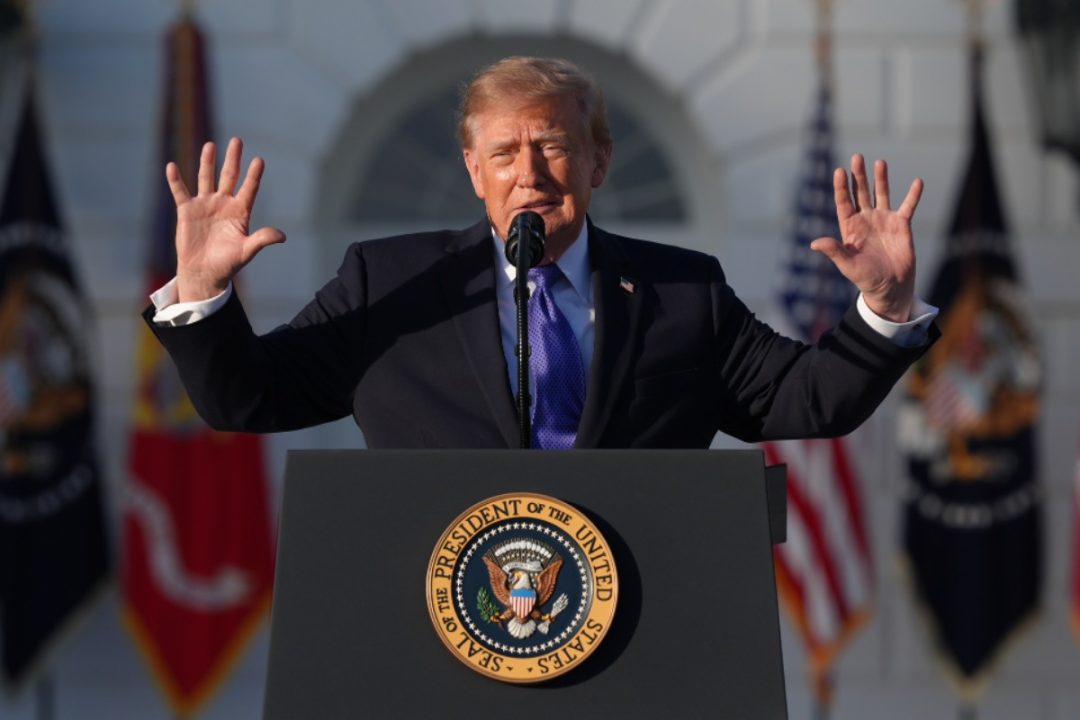
President Donald Trump promised to make America the “crypto capital of the world,” and he has taken that mission rather personally. On Sunday, top holders of his $TRUMP meme coin are invited to another exclusive dinner featuring the president.
The timing is awkward. The coin has lost nearly 99 percent of its peak value. Trump, meanwhile, reported $635 million in 2025 royalties through a company licensing meme coins and non-fungible tokens (NFTs).
Now congressional investigators are preparing to examine his cryptocurrency dealings, including the possibility that foreign investors are buying access to the American president.
The Price of Admission
The November 22 gathering at Trump’s Northern Virginia golf club is advertised as “the most exclusive dinner in the world.”
Under the official rules, the top 185 registered $TRUMP holders qualify for invitations. The top 29 are invited to a special VIP reception advertised as featuring the president, along with preferred seating at dinner. Rankings depend on how many tokens participants hold and for how long.
The advertised celebrity lineup includes boxing legend Floyd Mayweather, Shark Tank investor Kevin O’Leary, NBA champion Tristan Thompson, and Israeli “mentalist” and mind reader Lior Suchard.
Organizers explicitly rule out private meetings with Trump.
The top 120 participants are also promised gift bags containing Trump-branded fragrances, commemorative items, and limited-edition watches. The four highest-ranking VIPs may qualify for special 18-karat gold watches.
Demand, however, has collapsed.
Reuters found only 130 wallets on the final leaderboard for 185 available seats. Their combined holdings totaled $8.6 million, down 94 percent from the first contest.
The coin traded around 92 cents on November 16, compared with its January 2025 peak above $74.
Black Friday is still five days away, but presidential proximity appears to have gone on sale early.
One investor qualified after purchasing just $518 in tokens, The Washington Post found. Those holdings had already fallen to about $272 when the newspaper reported them. Last year’s dinner required holdings worth at least $55,000.
Foreign investors can also participate, with certain restrictions. The rules exclude citizens and residents of Cuba, Iran, Iraq, North Korea, Russia, Syria, and Yemen, as well as jurisdictions subject to comprehensive U.S., EU, or UN sanctions or other applicable legal restrictions. Other foreign investors face no blanket nationality-based exclusion.
Previous Dinners
The May 2025 dinner drew 220 top token holders to Trump’s Virginia golf club. An April 2026 conference at Mar-a-Lago offered another encounter with the president.
Among the first dinner’s guests was Chinese-born cryptocurrency billionaire Justin Sun. According to The Associated Press:
Sun … helped the Trumps start World Liberty Financial with an early $75 million investment.
Sun has disclosed on social media that he is the biggest holder of $TRUMP meme coins and is attending Thursday’s dinner.
Sun had another notable connection to Washington.
In 2023, the Securities and Exchange Commission (SEC) sued him, alleging securities violations, market manipulation, and undisclosed payments to celebrity promoters.
The agency paused the case shortly after Trump returned to office. In March 2026, it dismissed its claims against Sun personally. One of his companies agreed to pay a $10 million penalty without admitting wrongdoing.
According to The Washington Post, another prominent participant was Singapore-based MemeCore, a cryptocurrency collective with members in China and Southeast Asia. It accumulated roughly $18 million in tokens. A company executive acknowledged that its representative, known as “Ice,” hoped to influence Trump’s views on cryptocurrency.
Then there was “Ogle,” a pseudonymous investor and advisor to World Liberty Financial. He qualified with approximately $3 million in tokens while concealing his identity.
Roughly half of the original 220 qualifying wallets had received tokens through exchanges that prohibit American customers, per the outlet.
This Year’s Guests
The latest dinner raises similar concerns.
At the time the gala contest closed Monday morning [November 16], 79 of the top 130 wallets had used a crypto exchange that bars U.S. users. Together, they hold about $8.8 million of the board’s $9.5 million worth of $TRUMP coin.
The top-ranked wallet belongs to FastX, a Cayman Islands-registered cryptocurrency exchange with Singapore ties. Its representatives claimed to hold more than $2 million in $TRUMP tokens while promoting a “Chinese $TRUMP coin community.”
The company’s leader, known as “Addy,” celebrated the prospect of attending Trump’s VIP reception.
FastX even solicited questions from followers to put before the president. It promised to submit 10 questions, although it acknowledged that none was guaranteed to be asked.
Another wallet, identified as “trumpfan77,” qualified for both the 2025 and 2026 gatherings. According to The Washington Post, its owner had transferred $102,000 worth of tokens into the account since March. Their value had fallen to roughly $37,000.
Most wallet owners remain publicly unidentified. The arrangement allows investors to qualify for presidential access without publicly disclosing who controls their funds.
Winners and Losers
This is no ordinary political fundraiser. Trading revenue benefits Trump-linked businesses, not a campaign committee.
The project’s own disclosures identify Trump-affiliated entities and their partners as holders of 80 percent of the token supply, subject to gradual release. They also collect trading revenue. Overall, cryptocurrency has become a major source of income for Trump, whose financial disclosure reported more than $1.4 billion from crypto-related ventures in 2025 alone.
Outside investors have fared considerably worse. Reuters estimated losses exceeding $5 billion across five major Trump crypto and crypto-linked ventures.
The White House denies conflicts of interest, emphasizing that Trump’s assets sit in a trust managed by his children.
Yet delegating management does not eliminate his financial interests. The meme coin’s website likewise insists that the project has nothing to do with any political office, despite advertising the sitting president as its main attraction.
Investigations Await
Democrats, who captured both chambers in November’s midterm elections, are preparing investigations into Trump’s business interests.
On November 18, incoming House Oversight Chairman Robert Garcia (D-Calif.) sent document-preservation demands to Donald Trump Jr. and Eric Trump, citing their interests in World Liberty Financial.
Senator Richard Blumenthal (D-Conn.) separately warned Fight Fight Fight LLC, the meme coin operator, to preserve records.
Senator Adam Schiff (D-Calif.) and eight colleagues demanded answers about foreign buyers, ethics safeguards, and possible requests for official favors.
Seven anticorruption organizations also urged Trump to cancel Sunday’s dinner, and called for presidents to divest from cryptocurrency businesses.
Trump has characterized planned Democratic investigations more broadly as “Weaponization and Lawfare,” according to the Financial Times.
Federal scrutiny, meanwhile, has already stalled.
The New York Times reported Friday that Commodity Futures Trading Commission officials began examining possible fraud surrounding $TRUMP’s launch in 2025. They abandoned the inquiry after concluding agency leadership would not authorize the investigative steps needed to proceed.
Republican criticism has been less widespread, but not entirely absent.
In September, Senator John Curtis (R-Utah) called for an investigation into Donald Trump Jr.’s business dealings, specifically citing his promotion of family cryptocurrency ventures and relationships with foreign interests.
Even cryptocurrency champion Cynthia Lummis (R-Wyo.) acknowledged that Trump’s original meme-coin dinner gave her “pause.” Senator Lisa Murkowski (R-Alaska) similarly questioned the propriety of charging investors for proximity to public officials.
Crypto’s Political Reckoning
The industry’s political strategy is also facing a reckoning.
Crypto groups spent roughly $200 million on the midterms, Reuters reported. They backed winners in many races, and spent more than $60 million unsuccessfully trying to defeat Ohio Democrat Sherrod Brown.
Now industry executives are courting Democrats again.
Digital Chamber chief executive Cody Carbone called the results a “wake-up call” and urged engagement with both parties. Politico described:
The new landscape is a stunning reversal of fortune for an industry that has enjoyed extraordinary influence in Washington under President Donald Trump and a GOP-controlled Congress. Trump-appointed regulators have rewritten rules to accommodate digital assets in mainstream finance, while Republican lawmakers passed landmark legislation last summer establishing the first federal regulatory framework for stablecoins, a type of crypto token designed to maintain a value of $1.
But crypto firms are now staring at the prospect of Democratic investigations into their ties with the Trump family and a far more hostile legislative environment.
However, Democrats are hardly strangers to fiery rhetoric or generous political donors. For an industry willing to spend hundreds of millions influencing elections, the political landscape may become more challenging, but hardly hopeless.
Meanwhile, Trump’s cryptocurrency enterprise continues. And so does the extraordinary arrangement under which investors can purchase tokens that benefit the president’s businesses to secure a place at his table.