


Vol. 42, No. 02
02/01/2026
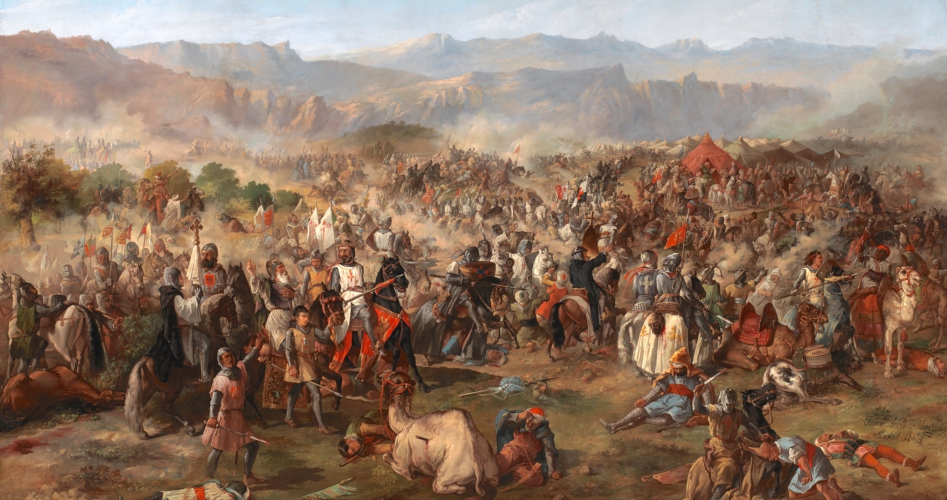
The Battle of Las Navas de Tolosa
AT A GLANCE
• The battle of Las Navas de Tolosa marked the beginning of the end for the Moorish occupation of Spain.
• It marked a reconciliation among the kings of Castile, Aragon, and Navarre, which would eventually lead to the creation of Spain.
• The leader of the coalition, Alfonso VIII of Castile, had been defeated by the Moors as a young man.
• As a result of Las Navas de Tolosa, a large part of southern Spain was permanently liberated from Moorish rule.
On July 18, 1195, a battle was underway at Alarcos Castle, not far from Toledo in what is now southern Spain. On one side was an immense and well-disciplined host led by the Almohad Caliph Yaqub al-Mansur, while on the other, a less-unified force led by 39-year-old Alfonso VIII, king of Castile, was fighting to survive. Al-Mansur’s army, fighting on behalf of the Islamic caliphate of Almohad, which controlled most of southern Spain and Portugal as well as most of the African Maghreb, included a contingent of Christian knights dispatched by a Castilian nobleman who was Alfonso’s sworn enemy. Then, as afterward, the lack of Spanish unity was a major weakness.
Following an ineffectual cavalry charge and hours of fighting in the searing heat, Alfonso’s forces found themselves hard pressed, with the king himself engaged in desperate hand-to-hand combat with dozens of adversaries. When it became clear that the battle was lost, several of Alfonso’s attendants had to drag him from the battlefield and convey him to safety, even as the lines collapsed in what became a total rout of the Christian army. Aside from Alfonso himself, few Castilians escaped, and the military force of the kingdom was virtually obliterated. Alfonso, by all accounts a gifted leader afterwards known as “El Noble,” never forgot that terrible day nor its punitive aftermath. Al-Mansur followed up his victory at Alarcos by recapturing many Christian-held towns and cities, from Extremadura near the Portuguese frontier to windswept La Mancha hundreds of miles to the east, conducting indiscriminate raids and pillage throughout. Adding insult to injury, the Almohad caliph managed to secure an alliance with another Alfonso, Alfonso IX of Leon, who was angry at the Castilian king for marching to Alarcos without him. Yet another rival Spanish kingdom, Navarre, proclaimed its neutrality.
Thus chastened by events, Alfonso VIII after Alarcos stayed in his dominion, watching and waiting for another chance. Like every other Christian on the Iberian Peninsula, he was painfully aware of the march of centuries that had consumed the region in a seemingly endless war against the Muslim invaders, known to history as the Moors. He prayed for a time when the Moors would finally be ousted. More than a century before his time, the great warrior El Cid Campeador had won a series of stunning victories against the Moorish occupiers, liberating many Spanish towns and cities. But now, it appeared, the heavens had withdrawn their favor, and the “Saracens” (as chroniclers of the time styled the Moors) were once again ascendant. Alfonso knew that the Spanish needed to unify if they were to stand any chance of driving the Muslims out; it was, after all, the fractured, tribalized condition of Iberia after the collapse of the Roman Empire that had allowed the Moors to invade and conquer in the first place.
Premium Content
Sign in with your ShopJBS.org account to read the full article, or subscribe below for unlimited digital access.
Log In to Continue Reading
- 12 Issues Per Year
- Digital Edition Access
- Digital Insider Report
- Exclusive Subscriber Content
- Audio provided for all articles
- Unlimited access to past issues
- Cancel anytime
- Renews automatically

- 12 Issues Per Year
- Print edition delivery (USA) *Available Outside USA
- Digital Edition Access
- Digital Insider Report
- Exclusive Subscriber Content
- Audio provided for all articles
- Unlimited access to past issues
- Cancel anytime
- Renews automatically