
Vol. 42, No. 02
02/01/2026
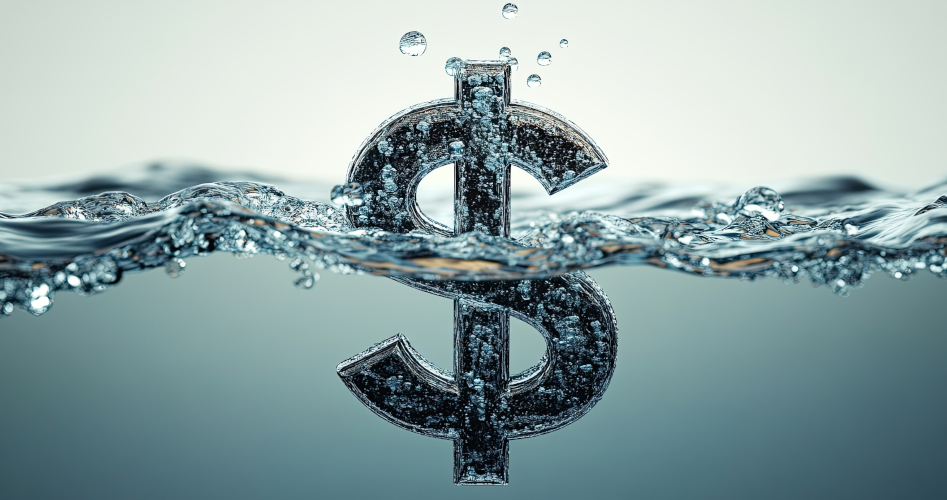
Is the Dollar Sinking?
Peter Schiff Weighs In on the State of the Economy
AT A GLANCE
• The 2007 crisis was bad; the next one will be much worse.
• Inflation is much higher than the Trump administration is claiming.
• The next economic crisis will be a dollar and sovereign-debt crisis.
• The rise of gold and silver prices is an indicator of the dollar’s weakness.
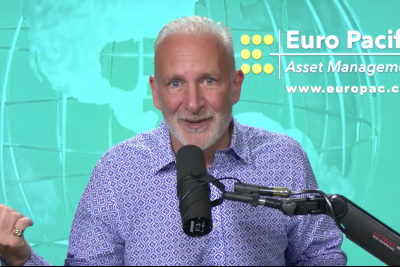
The New American publisher Steve Bonta interviewed Peter Schiff on December 18, 2025. An abridged version of their discussion follows. The full interview is available here.
The New American: He’s been called “Doctor Doom” and a lot of other things — most recently in an insult-infused Truth Social post in which President Donald Trump referred to this man as a “jerk” and a “Trump hating loser.” I’m referring to eminent financial expert and stockbroker Peter Schiff.
Those in the millennial generation may not be familiar with Peter Schiff. But a generation ago, he was the guy who was warning everybody about an impending financial collapse, even as the likes of Arthur Laffer and all kinds of other Establishment economists and politicians ridiculed him and said that there was nothing wrong with the American economy. Circa 2006 and 2007, Schiff was warning that the American economy was like the Titanic, and saying that he was trying to get people onto lifeboats before the inevitable sinking. His execrable crime, in President Trump’s view, was warning that, once again, the economy is not nearly as rosy as the current administration and many in Congress would have us believe. On a recent Fox & Friends Weekend, he warned that inflation figures and many other things being touted by the commander in chief and his epigones as evidence of a strong economy are not nearly as good as they appear.
So, Peter, how do you see the American financial and economic landscape right now? How does it compare to what you were seeing back in 2006 and 2007?
Peter Schiff: Well, it’s actually worse. I think that all the problems that concerned me back then are of even greater concern now. They say that history doesn’t repeat, it rhymes; well, here it’s more than just a rhyme. It’s very eerily familiar to me because all of the same conservatives and Republican pundits that were cheerleading the economy when Bush was at the helm are doing the same thing now that it’s Trump. I was having arguments with these guys, including Larry Kudlow, who’s now a big cheerleader for Trump, on his show…. He was talking about how we had this “Goldilocks economy,” the “greatest story never told,” and how great everything was.
And he was saying these things even in early 2008, when we were in the Great Recession, because they didn’t acknowledge it until the end of 2008. And then they backdated it to the end of 2007. So, all these Republicans, while we were in the middle of the Great Recession, were telling us how great the Bush economy was.
And I was warning that we were headed for this massive financial crisis, which, of course, was the case. But the problems that made that crisis inevitable and allowed me to forecast it years in advance are all there today, only greater. And that’s because of everything that was done in the aftermath of the 2008 financial crisis. Rather than allowing the market to solve the problems, the government prevented those forces from coming into play and pursued monetary and fiscal policy that actually made all those underlying problems even worse.
But what we did is, we postponed the consequences. We kicked that can down the road. Now, we were able to do that for a lot longer than I believed back then. I did not think we would get to 2025, and now 2026, without a more significant crisis than the one that we had in 2008, because the crisis that I thought would follow the financial crisis would be a dollar crisis and a sovereign-debt crisis. That didn’t happen, but now I think that process has begun. And I think that, just like during the Bush administration we were close to a financial crisis, now in the Trump administration we’re close to the dollar and sovereign-debt crisis, which of course will be orders of magnitude worse. And there’ll be no bailouts, because the U.S. government can’t bail itself out. Yes, it could bail out people who hold mortgages because it could substitute its own credit and print money that foreign central banks were eager to hold on to. But now that central banks are dumping their dollars and buying gold, and inflation is already well above the Fed’s so-called two-percent target, I don’t think that this is going to work again as far as kicking the can down the road.
So, I think this crisis is going to hit, and it’s going to be much, much worse because of the fact that there won’t be any way for the government to mitigate the damage. And to the extent that they try — and they probably will — it’ll just make everything worse, because when they go back to larger-scale quantitative easing, they’ll just fuel the inflation fire that’s already burning hot. They’ll accelerate the decline of the dollar and the rise in long-term interest rates, and everything will just implode. And we’re finally going to have to pay the piper for decades of monetary and fiscal excesses.
TNA: A lot of people look at inflation in very simplistic terms: We simply print money and discharge it into the economy. But of course, one of the realities of secular inflation is what’s called “financialization,” which is the over-complexification of finances. This can conceal for a while, from all but the most astute observers, the effects of inflating the money supply. And this is what happened in the run-up to the last great financial crisis; nobody knew where all that debt was, and derivatives had become fantastically complex. So what are we seeing now? What kinds of symptoms of financialization are there that are serving to conceal, for the time being, this underlying reality?
Schiff: Well, cryptocurrencies are just one of many bubbles that have been inflated during this time period when money was so cheap, and it may be the most irrational of the bubbles. The only thing rational about it is that you do need an alternative to dollars. That part of the Bitcoin narrative is correct, and a lot of the criticism leveled against fiat currency by Bitcoin pumpers is accurate. Where they diverge from reality is when they recommend Bitcoin as some kind of alternative, some kind of superior-solution safe haven, when what they should be advocating is gold. And if they like the idea of transacting on a blockchain, they could be advocating for tokenized gold. I have no issues with that. But what they’re doing is just a mania. People have, of course, gotten rich who got into this Ponzi early and who have been cashing out for the last several years…. But all this is going to end in tears, and you’re going to have millions and millions of people who are going to be completely wiped out in Bitcoin. Yes, the winners are the ones that got in and then got out. The only way to make money in Bitcoin is by selling it. You have to find a sucker to buy it from you, otherwise you’re the sucker who gets caught holding the bag.
The real symptoms of the problem are the massive budget deficits that are now approaching $40 trillion, our $2- or $3-trillion-a-year budget deficits that are accumulating in the national debt, the trillion-dollar-a-year-plus trade deficits that seem to hit new record highs every year despite the protectionist tariffs. Our trade deficits are going up. They went up every year Trump was president, even though he campaigned against the trade deficits. They got worse every year during his first term, and they’re getting worse again.
But also look at the hollowing out not only of our industry, but of our labor force. Look at all the Americans that are no longer in the labor force — and it’s not because they’re so wealthy that they don’t have to work; they are detached from the labor force because they can’t find a job. And so they’re permanently out of the labor force, or they settle for multiple part-time jobs rather than a full-time job. And they’re barely making ends meet. That’s why we keep going from one one-term president to another one-term president, because the voters constantly want to throw the bums out, because everything keeps getting worse. The same thing is going to happen in 2028. I think we’re going to get a radical-left president like an Alexandria Ocasio-Cortez, because voters are going to be very frustrated by how much worse conditions are than when Trump was elected.
Nothing irritates the voters more than to have the president brag about how great the economy is when they know how lousy it is because they’re actually living in it. Meanwhile, Trump is going to be throwing lavish balls in his brand-new ballroom, which he’s erected to turn the White House into a palace so that he can hold court as if he were royalty.
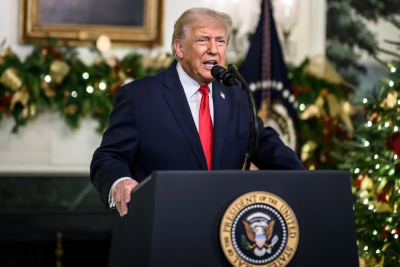
TNA: Trump addressed the nation December 17 in a Christmas address. There was a sort of perverse irony to the fact that he doled out Santa Claus-like promises while surrounded by Christmas paraphernalia in the Oval Office. He also claimed that wages are now rising much faster than inflation, that prices are falling drastically, that 100 percent of all jobs created since his inauguration this second time have been in the private sector, and that companies are coming back to the United States in record numbers. And moreover, he has inaugurated new policies that he says will reduce drug costs by up to 600 percent. That’s a sampling of what he had to say. Care to comment?
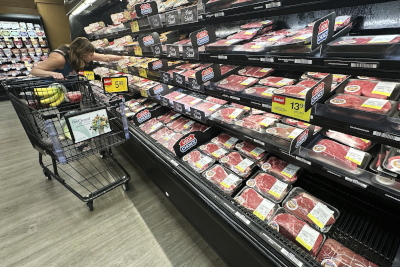
Schiff: Well, look, I don’t know if the president is just lying or if he’s delusional. But none of this stuff is true. It’s all false, whether Trump believes it himself. Obviously, prices are not coming down. You could probably point to some prices that have come down, but on balance, overall prices have gone up. Even the Consumer Price Index acknowledges that; they’re clearly not coming down if the CPI is rising by three percent a year. But of course, if the CPI acknowledges that prices are up by three percent, they’re probably up by at least five or six percent, because it understates it by a considerable margin.
I doubt you could find many Americans who would agree with the president that everything is coming down substantially. The president’s approval ratings right now on the economy are the lowest they’ve ever been. They’re even lower than they were at any point during his first term. And why would that be? If things were as great as the president claims, why isn’t he getting credit for that?
When he ran against Kamala Harris, he claimed that the economy was lousy. When Harris was saying how great it was, it was the same lie. And that’s how Trump won the first time when he ran against Hillary Clinton. She was trying to run on a continuation of the Obama economy.
And what did Trump say? “This is phony. The numbers are fake, don’t believe the unemployment numbers. They’re not real, unemployment is 15 percent, 20 percent.” Every time he spoke, the figure was higher. I think he even got up to 30 percent at one point. But when he said the government is lying to you about the economy, the voters thought, “Yeah, you’re right.”
Trump promised to drain the swamp and fix it, but the minute he became president he touted those same fake statistics as if they were real, to take credit for how great everything was. The fake jobs numbers became real jobs numbers the minute they were his jobs numbers. But when they were Obama’s, they were fake.
A lot of it comes from the marketer in Trump. He’s a promoter. If you look at a lot of the companies that he had, it was all about branding and promotion. And so, he’s branding himself. He’s the product, right? The president. And so how is he going to sell the Trump presidency to the public? Well, the same way he sold Trump Steaks. He said, “These are the greatest steaks in the world.” Do you think they were the greatest steaks? Probably not, but that’s how he sold them — they’re the greatest. So, you know, he’s the greatest, the economy is the greatest. He said that when Biden was president we had the worst economy in history. Now Trump’s been president for a year, and we have the “greatest economy in history.” How can it go from being the worst to the best in such a short period of time? In fact, he began declaring that we had the greatest economy in the history of the world within a couple of months of being elected.
So obviously he just says stuff, right? But whether he believes it himself or whether he knows he’s lying, who knows?
People don’t criticize him. People don’t call him out. The Republican Party stands behind this guy because he’s got a lot of political support, and this is going to be the ruination of the party.
TNA: Well, Peter, certainly there are plenty of intelligent people, in Washington and on Wall Street and so forth, who are aware of the things that you’re saying, aware of the debt precipice that we’re on, aware of the long-term consequences of an inflationary economy, aware of all the rest of it — and yet they persist in it because somebody is benefiting.
Schiff: Look, a big part of the reason Donald Trump got elected was Elon Musk. Not only did Elon Musk pour tens of millions of dollars of his own money into the campaign and use his platform X/Twitter to promote the president’s campaign, but he was also sold as a package deal, as in a vote for Trump is a vote for Elon, because he’s going to come in and clean up the mess. He’s going to have this Department of Government Efficiency, and he’s going to cut billions, because Elon Musk said the problem is the spending and the debt and we’ve got to control the spending and the debt. And a lot of people said, “Yes, we want that duo. We want Trump and Elon.” Initially, there was a lot of fanfare. Elon comes to Washington. He’s got his little kid on his shoulders. He’s rolled up his sleeves. He’s got all his guys at the White House. Before you know it, they’re all gone. The minute he wanted to cut anything, it was, “Okay, forget about this.” Elon Musk thought it was real. For Donald Trump it was just part of the Trump show — I’ve got to get the votes of people who want a fiscally responsible government, well I’m going to pretend I’m fiscally responsible. But the minute he gets into office, all that is gone. They didn’t want to cut anything, and they haven’t cut anything. They just lie and pretend that they’ve cut stuff.
Government is bigger today than it was under Biden. It’s more expensive today than it was under Biden. Now, obviously, the same thing would be true if Kamala Harris had won, because that’s the trajectory that we’re on, but Donald Trump has done nothing to derail this train from going off the edge of a cliff. We have bigger deficits now, and we’re going to have even higher inflation. Donald Trump says, “Look, I inherited this mess.” But Biden inherited that mess from him. I mean, Trump created the inflation that reared its head in 2021. All that inflation, that 9.1 percent? That’s on Trump, because the money that was created, that fueled that inflation, happened under his watch. He signed off on all the stimulus, the extended unemployment benefits. All the deficit spending that the Fed monetized in 2020 showed up in consumer prices in 2021. In fact, if you look at the CPI, it was the last few months of Trump’s administration where it really started to spike.

If you annualize the last three or four months of Trump’s first term in office, you get high inflation. And that trend continued throughout Biden’s first year. A lot of the big numbers happened in January, February, March, but Biden’s programs hadn’t even been passed yet; they hadn’t even taken effect. So you can’t hang all that on Biden. Not that Biden didn’t make the problem worse, but he didn’t create the problem. And Trump didn’t either. He inherited a problem from Obama, who inherited one from Bush. They’ve been passing the baton on problems.
TNA: So, Peter, our readers would like to know concretely what this coming collapse, a Great Recession 2.0, looks like. I know [real-estate website] Redfin, for example, is predicting a great reset in housing and real estate next year, although they make it sound relatively benign, nothing more than younger millennials and Gen Z types having to move home and live with their parents, and renting rather than buying houses. But I’m getting the feeling that you foresee something a good deal more calamitous.
Schiff: Yeah. Redfin is just discussing a degradation in our standard of living in that, rather than people being able to afford their own home, they’re just going to have to make do with sharing it with roommates or other families. So we’ll take these single-family homes and turn them into duplexes or quadplexes. Young children will stay living with their parents maybe up into their 30s or 40s, or maybe older parents will move back in with their grown children, so we’ll have multiple generations occupying the same housing units.
And people won’t turn the air conditioners on, they’ll just open up the windows. They won’t use their heat, they’ll just wear sweaters around the house. There are a lot of ways that we can cope with a falling standard of living. But that’s basically the reality that they are acknowledging. And this is happening because of government, because the burden of government is getting bigger and bigger and bigger.
You know, when Donald Trump said that he passed the greatest tax cut in history with the Big Beautiful Bill, that was a lie. It wasn’t a tax cut. It was a tax hike because the Big Beautiful Bill made government bigger and more expensive. And that is the tax, right? It’s what government spends that has to be paid for. It doesn’t matter what they collect officially in income taxes or tariffs or payroll taxes, the cost of government is what government spends. The way a lot of Americans are paying for bigger government is through higher inflation and higher prices. And since government is now a lot bigger, prices are going a lot higher.
But I think what this crisis is going to look like is, again, a dollar crisis and a sovereign-debt crisis. I think we’re going to see a big increase in consumer prices and a lot of upward pressure on long-term interest rates. This is going to be a huge problem for a country that is used to cheap money and cheap goods. We’re not built for expensive goods and expensive money, so this is going to be a complete meltdown.
And the problem is that the public is going to blame capitalism, it’s going to blame a lot of the things that Trump supposedly stands for, and it’s going to look to the Bernie Sanderses, the AOCs, the Zohran Mamdanis, who say, “Capitalism is bad. Look what it did. Look at the greedy businesses, how they wrecked the economy. We need government to step in here and take over and control the economy, and take out the greedy businessmen and all these evil profiteers. We need to run the economy for the benefit of everybody.”
TNA: I fear that we may have to ultimately tread the road that Argentina trod for many generations to learn these hard truths. Most people only learn from experience. Argentina, and much of Latin America, seems to be swinging around to the view that no matter what the socialists say, they’re lying; don’t believe them. I don’t think we’re anywhere near that in this country. We’re still too easily beguiled, as the recent New York City elections show, I think.
Schiff: Certainly. And also because things haven’t gotten bad enough. Yes, things have gotten worse for the average American. They’re struggling to pay the bills. They’re in debt. Maybe they’re working multiple jobs. But, you know, in the scheme of things, life is still not that bad. But it can get so much worse, and it will get so much worse.
And I think it has to get a lot worse in order to have a real revolution, like they have in Argentina, and reject those empty promises. Because the Argentines have been spoon-fed those promises for generations, and at this point, they don’t want it anymore. They’re done. There’s nothing that they haven’t heard before, and they know that it’s an empty promise. And they’re willing to try the alternative.
TNA: The amazing thing about Argentina is, it’s all ages that support President Javier Milei. It’s not just idealistic youth that support him and his libertarianism. It’s people in their 70s and 80s who’ve never known anything else, who are also saying, yeah, this is what we need, because they’ve lived through multiple economic collapses, like the one in 2001, where the whole country fell apart and it was virtual anarchy.
Schiff: And, you know, the thing is, a lot of people think that Trump is like our Milei, but he’s not even close. Initially, when he first came in, I think Milei gave him a chainsaw, so he could take a chainsaw to government. He didn’t take a chainsaw to anything. And so, even though there’s some mutual respect there — Trump tries to champion Milei and Argentina, and the other way around — they’re not the same. They’re very different. You could say they were both outsiders, although Trump, when he ran for reelection, wasn’t really an outsider because he had already been the president. But when he ran the first time, he was trying to drain the swamp and clean stuff up. And that’s what Milei was elected to do. But the difference is that Milei actually did it. And Milei actually has a philosophical alignment with free markets and libertarians. Trump doesn’t have any of that. Trump philosophically is probably more of a Democrat than a Republican anyway. But he’s very much a populist. People say, “Oh, Trump is pro-business.” Well, in a way, but he’s not pro-free-market capitalism. He wants to have a heavy hand in business. He wants to help micromanage companies. He wants to direct capital to the industries or the companies that he thinks are important. And somebody who understands capitalism doesn’t want to do that. Even if you think you’re smart, if you’re the president you still don’t make those decisions, because you can’t make decisions with other people’s money the way you make them with your own money.
In capitalism, if I invest my own money, I bear the consequences if the investment goes bad. But if I’m the president and I direct taxpayer money to something, it’s no skin off my behind if the thing goes bust. Plus, the president could be motivated by political things. He might think, “I’m going to fund this company because of some deal that I made, to get some kind of cut or to pay back somebody.” So, you have so much graft and corruption when you have government involved in business, which is why government needs to stay out. But Trump is more involved in private business than any president ever, I think.
TNA: Trump is claiming — and he claimed again December 17 — that many American companies are rushing to re-shore because of the tariffs and other things.
Schiff: They’re not rushing to do anything. He threw out a number. He said that he’s already secured like $17 trillion in investments. That’s like two-thirds of our GDP. He hasn’t secured anything. People tell him stuff that he wants to hear, so he can tout it. There was that one clip where he was sitting at a table with Mark Zuckerberg, and Zuckerberg whispered, “How much do you want me to say? What’s the number you want me to use?” So it’s all B.S. The reason that we don’t have factories in America right now is because it’s not competitive. It would be too expensive to make the stuff here. And so, if they’re not going to build the factories here … even if the tariffs made it more economical to build stuff here, it still wouldn’t be viable, because the prices would be too high for the consumers to buy. Why would you put a factory in America where you can’t export anything? Because the only place the stuff would be viable is in America, where it was protected from competition. It makes no sense for foreign companies to invest, especially since the factories that they would build could take two or three years to construct. Who knows if the tariffs will still be here? There’s a good chance the Supreme Court strikes them down anyway, because they are unconstitutional. But even if the tariffs stay for a few years, who knows what the next administration is going to do? Who wants to take that chance? Are you going to build a factory and invest billions or trillions of dollars collectively in a factory that could be rendered completely useless by the change of a tariff? Because Trump could back away from the tariffs at a moment’s notice — all of a sudden he changes his mind. So this is not going to happen.
Manufacturing jobs continue to go away; we’ve lost manufacturing jobs since Trump was elected. We haven’t gained more manufacturing. This is all part of the lie that he spreads when he’s trying to fool everybody into thinking that we’ve got this great, great economy, when the factories aren’t going to come back. In fact, if anything, we’re making what’s left of our manufacturing even less competitive, because a lot of the parts that they have to import are now tariffed, so they’re more expensive. So, the finished product is more expensive. And of course, not only would foreigners have to deal with all these costs of building a factory here, but what about the workers? Who’s going to train the workers? And who wants to hire Americans anyway when you can get sued eight ways from Sunday? You think they want to come over here and risk getting sued for discrimination or sexual harassment or who knows what? Why would you want to do that to yourself? We have some horrible laws that allow just about anybody to shake down his employer, and other high regulatory burdens and taxes. And what about the supply chains? What about all that distribution? None of that stuff exists. How are you going to re-create that stuff? Because if you just have a factory, what’s going to supply it?
So, this is just a pipe dream. Now, yes, I would like to see industry come back to America, but it needs to come back for the right reasons, and it needs to come back over time. It needs to come back because we make dramatic cuts to government spending and regulation, because Americans save again, because we have higher interest rates and because we have savings so that we can afford to make the capital investments to build the factories that no longer exist.
We have to turn all of our strip malls into factories, because otherwise there’s going to be nothing to sell when we can’t import, which is going to happen.
I think the dollar is in the process of losing its reserve status, and that’s why gold is soaring. And it’s going to keep going up, and the dollar is going to tank, and then we’re going to lose access to all these products. They’re going to be out of reach, they’re going to be unaffordable for most Americans.
TNA: Well, Peter, we’re running short on time. Just one more question: In practical terms, what should people be doing to prepare for this eventuality?
Schiff: Well, they should be doing what I’m doing, and what I’m advising my clients and my customers to do. One thing is to buy gold and silver. I’ve been buying gold for clients since it was under $300 an ounce; it’s now over $4,000. I’ve been buying silver since it was under $5; it’s now over $65. Gold has outperformed the S&P 500, including dividends, over the last 25 years. That’s telling you that the stock-market gains are an illusion created by inflation. If you measure stock prices in real money, they’re going down, they’re not going up. So people should own gold and silver, and I help them buy it at a good price, at a low price above spot, at my company Schiff Gold.
The other thing that I’m doing personally and with my clients at my company Euro Pacific Asset Management is investing abroad. I’m investing in international dividend-paying stocks in emerging markets, and in companies that own a lot of resources, whether it’s the precious-metals mining companies, or industrial metals — copper, nickel, and zinc — or oil and gas companies, or agriculture companies; companies that are going to benefit from inflation, that have pricing power, that sell the goods and services that people really need and that they’ll pay higher prices to get; and companies that earn money and pay good dividends. And more importantly, where the dividends are coming in currencies that are going to gain purchasing power that the dollar loses. Those are the companies you want to invest in.
This is going to be a massive transfer of wealth and purchasing power from Americans to the rest of the world. Now, the rest of the world is not going to benefit equally. Some countries will benefit a lot more than others, and that’s where we want to concentrate our investments. We want to own the assets that will gain the most as the dollar assets lose.
We want to own the currencies that will gain the most purchasing power as the U.S. dollar loses. We want to align ourselves with the winners, and, unfortunately, it’s not the U.S. Now, politically I can root for the U.S., I can try my best to help solve the problems. But I don’t want to go broke as I’m rooting for the loser and the politicians continue to implement policies that I know are destructive.
And it’s not just the politicians, it’s the central bankers; they’re the prime architects of this, the Fed. And now Trump wants to put an even worse guy at the helm of that. He said, “I want somebody who likes low interest rates.” Well, what if we need high interest rates? But we’re going to have low interest rates. Trump wants to put an inflationist in charge, he wants somebody who will crank the printing presses. That’s not what Americans should want, but, unfortunately, that’s what we’re going to get. And that’s why you’ve got to get out. You’ve got to get out of the currency that they’re printing, and you’ve got to get into what they can’t print. And that’s gold and silver and these dividend-paying foreign stocks.
TNA: Thank you so much, Peter Schiff. It’s been very luminous and informative, and I really appreciate your taking the time with us today.
Schiff: My pleasure; thanks a lot.
Publisher’s Note: In addition to saving and investing prudently, Americans should support efforts to restore the gold and silver currency standard required by our Constitution, and should encourage their legislators to co-sponsor legislation to end the Federal Reserve system.