



Vol. 42, No. 06
06/01/2026
The AI Prison Planet: The Dangers of AI and Data Centers, and Why Americans Are Turning Against Them
AT A GLANCE
• Artificial intelligence enables surveillance-state control.
• Data centers consume massive resources and threaten food security.
• AI and data centers are linked to globalist agendas that threaten private property rights.
• Communities nationwide are pushing back to control unchecked AI development.
A low hum from server buildings carries across the Columbia River in The Dalles, Oregon, where residents are battling plans to transfer public lands in Mount Hood National Forest for more private data-center development. Across the United States and beyond, communities are beginning to push back against the rapid expansion of these facilities that have become essential to the growth of artificial intelligence (AI).
In Northern Virginia, home to one of the world’s largest concentrations of data centers, residents have packed public meetings and posted “No Data Center” signs in their yards, voicing frustration with what one report describes as a constant industrial presence encroaching on residential life. In some neighborhoods, the concerns are frantic; NBC News reports that locals describe a persistent mechanical noise “like a helicopter hovering … all day and night.”
Far from an isolated phenomenon, resistance is spreading as quickly as data centers are popping up. A 2026 industry analysis found that community opposition has already helped block or delay tens of billions of dollars in projects, with protests and local organizing reshaping development plans nationwide. In some cases, the backlash has been strong enough to halt projects entirely or force developers to withdraw.
The pattern extends well beyond the United States. In the Netherlands, residents of Zeewolde rallied against a proposed hyperscale facility, with thousands signing petitions, turning the project into a political crisis. According to Wired, locals argued the development was “too big for a small town,” reflecting a broad apprehension about the scale and purpose of such projects. Similar tensions have surfaced across Europe, where farmers and local groups have protested the conversion of agricultural land into sprawling server complexes.
What unites these disparate scenes, from town halls to roadside demonstrations, is not a single grievance, but a growing sense that something significant is happening, often with little public visibility until construction is already underway. As a national report published at DataCenterWatch.org put it, what was once “quiet infrastructure is now a … flashpoint,” drawing organized resistance from communities that are only beginning to grapple with its implications.
What exactly is driving this backlash requires a closer look.
Artificial Intelligence: Friend or Foe?
First, let’s briefly consider what artificial intelligence is. AI is a system designed to perform tasks that typically require human intelligence. Promoters say it will make our lives easier and more efficient, doing everything from managing daily calendars to driving cars. Convenience is the main selling point.
There’s no question that AI can provide amazing benefits in our lives, particularly in such fields as healthcare, transportation, and the military. However, there are many reasons to be concerned about this technological explosion that is prompting a societal upheaval. AI can be a foundational tool for building a government system that will control every facet of our lives. Therefore, each aspect of it must be examined, considered, questioned, and controlled. After all, this isn’t a harmless tech upgrade.
AI systems are inherently shaped by their creators. Even leftists in academia recognize that developers and data scientists inject noticeable biases into their algorithms and training datasets. Essentially, when AI systems are trained on data reflecting specific, non-neutral worldviews, they tend to reproduce and amplify these ideological stances, often presenting them as objective fact. This foundational bias dictates the direction of AI-generated content, influencing everything from research reports to information synthesis, which in turn sways public opinion and impacts political policy.
It’s simple to see how this helps usher in the globalist plot about which I’ve spent decades sounding the alarm. It is a scheme repeated in United Nations (and UN-inspired) programs such as Agenda 21, Agenda 2030, the Green New Deal, and the Great Reset. President George H.W. Bush ensnared our country in the first of them, signing Agenda 21 at the UN Earth Summit in Rio de Janeiro in 1992. In the subsequent book Agenda 21: The Earth Summit Strategy to Save Our Planet, its radical promoters wrote that “effective execution of Agenda 21 will require a profound reorientation of all human society, unlike anything the world has ever experienced.”
A major step toward this “profound reorientation” occurred in 2015, when the United Nations adopted Transforming our world: the 2030 Agenda for Sustainable Development, a framework featuring 17 Sustainable Development Goals (SDGs) intended to guide global, national, and local policy through 2030. This process is a continuation of “Local Agenda 21” (LA21), a mandate from the 1992 Rio Earth Summit encouraging local governments to develop action plans. The goals are already integrated into municipal, county, and regional planning throughout the United States and the world. You’ll find them in your own area under the deliberately opaque names of comprehensive plans or smart growth strategies that focus on resource- and land-use regulations. The lead advisor to then-U.S. President Bill Clinton’s Council on Sustainable Development, J. Gary Lawrence, in the September 1998 issue of the Millennium Papers, explained the intentional use of those titles to obscure their relation to LA21. “Participating in a UN advocated planning process would very likely bring out many of the conspiracy-fixated groups and individuals in our society,” he admitted. “So, we call our processes something else, such as comprehensive planning, growth management or smart growth.”
Of course, AI data centers are not officially part of the original 1992 LA21 framework, but they are increasingly critical to modern, localized, sustainable-development planning. In truth, AI provides the globalists who planned LA21 with the main ingredient necessary to achieve control: total surveillance. Below are some examples of how they are achieving that objective through AI.
Digital ID
Digital ID is an identification document stored on a device. It replaces physical documentation such as a driver’s license, and can store much more information, such as biometric data (e.g., voice and facial-recognition) and behavioral analytics (e.g., personal habits and patterns). Proponents such as Bill Gates argue that AI-enhanced digital ID is a humanitarian necessity for financial inclusion. The Bill & Melinda Gates Foundation has committed more than $200 million to initiatives such as the Modular Open Source Identity Platform. Such systems use AI for advanced biometric authentication and real-time liveness detection, which industry players such as Microsoft and Okta claim are essential to detecting sophisticated fraud and deepfakes that supposedly evade traditional systems.
But the integration of AI into digital public infrastructure (DPI) has accelerated surveillance-state encroachments and represents a dangerous consolidation of power. The World Economic Forum’s push for a unified digital identity framework promises creation of a centralized digital panopticon in which access to basic societal functions — banking, healthcare, transportation, spending, communication, etc. — is gated by opaque AI algorithms and the Deep State operatives who control them. There is significant concern that the behavioral analytics used to verify identity will instead be used for social-credit monitoring or automated exclusion.
If that sounds far-fetched, consider that digital product passports (DPPs) are increasingly being used in the retail world for supply-chain control. DPPs are digital IDs for physical items, and are embedded in products, with retailers such as Target implementing them to comply with regulations such as the EU’s Ecodesign for Sustainable Products Regulation. Furthermore, researchers at the University of Washington have demonstrated that conductive threads can be magnetized to store digital data directly within fabric, enabling clothing to function as a password storage device. In parallel, advancements in vaccine delivery include research from North Carolina State University on vaccine-coated dental floss designed to trigger an immune response, as detailed in a July 2025 study in Nature Biomedical Engineering. This needle-free method is touted to enhance ease of administration and overcome patient hesitancy regarding traditional injections.
Public Safety
Public safety is another promise offered by AI proponents. However, the rapid proliferation of AI-enhanced surveillance is fundamentally altering the nature of public space, moving beyond simple recording to active, real-time behavioral analysis. Industry leaders are increasingly transparent about this shift; Oracle Chairman Larry Ellison recently predicted a future of constant monitoring, stating during a 2024 meeting that AI-managed camera networks will ensure that “citizens will be on their best behavior because we are constantly recording and reporting everything that’s going on.” Traditional closed-circuit television requires manual review. However, promotional materials from firms such as Flock Safety and Veritone highlight the “force multiplier” effect of AI, which can automate facial recognition, track “co-appearance” (those with whom you interact), and even utilize “predictive policing” algorithms to identify potential threats before they manifest.
While these systems are marketed under the banner of public safety, critics argue they create a pervasive “digital dragnet.” Data from these cameras does not exist in a vacuum; it is often aggregated with information from data brokers and corporate entities. As documented by the Electronic Frontier Foundation, this “surveillance capitalism” enables the fusion of physical location data with digital records of financial transactions, health metrics from wearables, and even political affiliations gleaned from social media. This convergence effectively eliminates the expectation of privacy, as the government increasingly bypasses traditional warrants by purchasing this granular data directly from private tech companies, a practice recently scrutinized in reports by the Brennan Center for Justice.
Voting Systems
AI cheerleaders are also framing its integration into the electoral process as a solution to voter apathy and accessibility barriers. The World Economic Forum (WEF) suggests that AI-driven civic assistants could provide personalized information on candidates, while blockchain-integrated AI could enable remote voting from home computers or mobile devices. Proponents, such as Voatz co-founder Nimit Sawhney, argue that digitizing the ballot empowers the citizen by removing the “physical friction” of polling places.
Once again, we see “convenience” as the excuse for control. Remember, that was the purported reason for transitioning from paper ballots to voting machines. However, J. Alex Halderman, a leading computer science professor at the University of Michigan and a frequent expert witness on election security, has warned that moving toward internet-based or AI-managed voting creates systemic vulnerabilities in which a single digital exploit could alter thousands of votes without a physical audit trail. Another consequence of this “convenience” is the potential erosion of the secret ballot; as AI systems link biometric identity to a digital vote, the anonymity that has protected voters for more than 250 years could be technically compromised. Furthermore, the shift to home-based voting risks “coerced voting,” in which a voter could be pressured by others in the household — a social dynamic that the physical privacy of a traditional voting booth was specifically designed to prevent.
Banking
The global financial sector is accelerating the transition toward digital currencies, with AI acting as a core technology for managing transactions, as noted by the International Monetary Fund. IBM Research tells us that AI algorithms enable real-time fraud detection and enhanced security. These arguments for streamlined digital payment infrastructures and improved operational efficiency are also used to promote central bank digital currencies (CBDCs).
Yet CBDCs would grant governments unprecedented surveillance powers and the ability to “de-bank” citizens based on political activity. The Cato Institute warns that a CBDC could become a financial panopticon, allowing bureaucrats to monitor every transaction in real time and even impose programmable restrictions on how money is spent. Your account could be frozen or closed, and your money confiscated. When the electricity is out, you will have no access to your money. Tellingly, even U.S. Federal Reserve Governor Christopher Waller has expressed skepticism, stating that the purported benefits, such as faster payments, are already being achieved through private innovations, making a government-run digital dollar unnecessary and potentially risky to the private banking sector.
Employment
Not only is AI poised to replace your money, it also has the potential to replace you. The transition to an AI-driven economy is fundamentally reshaping how wealth is generated and distributed, leading many economists to warn of a future in which human labor is no longer the primary driver of profit. A 2023 report from Goldman Sachs estimated that generative AI could automate the equivalent of 300 million full-time jobs, starting with white-collar administrative and legal roles before moving into blue-collar sectors through advanced robotics. This displacement has led tech leaders such as Sam Altman, CEO of OpenAI, to advocate for a “universal basic income” (UBI), suggesting that as AI creates immense wealth, a government-funded stipend will be necessary to meet basic needs. Altman has noted that in a world where AI produces most goods and services, focus must be placed “on taxing capital rather than labor, and we should use these taxes as an opportunity to directly distribute ownership and wealth to citizens.” Similarly, Elon Musk told attendees at a 2024 tech summit that we are headed toward a “universal high income” because “AI will be able to do everything.”
However, this shift toward a cashless society dependent on a state-provided UBI presents an obvious threat to human agency and freedom. The Cato Institute argues that decoupling income from work removes the incentive for individual innovation and grants the state unprecedented control over a person’s livelihood. In a report for The Heritage Foundation, analysts expressed concern that a “programmable” digital currency — linked, of course, to a UBI — would allow the government to monitor and restrict spending based on social behavior or political alignment. From this perspective, the “convenience” of an automated, cashless economy could lead to a loss of private property and personal dreams, as the primary means of earning a living is replaced by a state-managed distribution system.
We are already starting to see the employment effects of AI in real time. Oracle recently sent an email to 30,000 employees telling them they no longer have jobs. The savings in payroll, says the company, will supply it with $8 billion to $10 billion to build data centers.
The Growing Threat of AI Data Centers
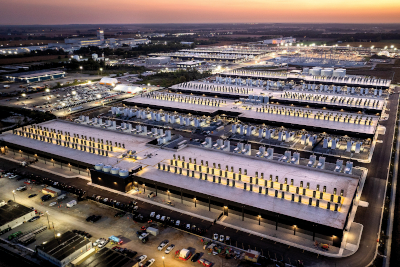
Data centers themselves present myriad dangers, which explains the examples of community opposition detailed at the beginning of this article. Those are hardly isolated examples or one-offs. We are witnessing an explosion of AI data centers being built across the nation. According to the James Madison Institute, “the United States maintains clear dominance in this sector, housing approximately 5,300 operational data centers, representing 45% of the global total of 11,800 facilities.” The Washington Examiner reports that in the United States, Virginia leads the pack, with 320 in operation, followed by Texas, Georgia, Pennsylvania, Illinois, and Ohio.
These numbers are set to skyrocket once the data centers currently planned and under construction are complete. If you don’t already have one in your backyard, the likelihood is high that you soon will. Now is the time to prepare to push back. Let’s look at the reasons to oppose them.
Water
Data centers tap into both surface and underground aquifers to cool their facilities. “A typical data center uses 300,000 gallons of water each day,” reads a 2025 Brookings Institution report, “but large data centers can use an estimated 5 million gallons of water each day.” To put those numbers in perspective, a small data center’s water use equals the approximate volume of a full Olympic-sized swimming pool every two days; hyperscale data centers gulp down roughly eight of those pools daily. In terms of equivalent use, these numbers equal the demand of 1,000 and 50,000 households, respectively.
To make matters worse, many data centers are located in water-stressed regions. The World Resources Institute highlights that two-thirds of new facilities are in areas such as Arizona and Texas, risking aquifer depletion, and experts are already warning that aquifers are not an infinite resource. Peter Colohan of the Lincoln Institute of Land Policy describes data centers as “a giant soda straw sucking water out” of local basins that cannot replenish as quickly as they are depleted. With about 80 percent of data-center water evaporating, there is real risk of freshwater bankruptcy, sinkholes, and seismic disruptions, as well as cost-prohibitive energy prices for pumping water from ever-deeper wells.
Energy
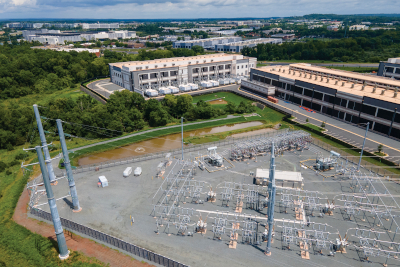
Speaking of energy, the rush to construct data centers is colliding head-on with limits of the American power grid, as data centers’ high-performance processors consume energy at a rate far outpacing traditional computing. Industry promoters acknowledge that AI models involve analyzing massive datasets, a process requiring specialized hardware that runs hot and hungry. Goldman Sachs analysts project that data-center electricity demand will surge by up to 165 percent by 2030.
Based on current demand, these numbers are conservative at best. Take Amazon’s $11 billion campus in New Carlisle, Indiana: Project Rainier. At full capacity, the data center draws 2.2 gigawatts of power, equivalent to the energy needs of more than a million homes. The local utility already phased in a residential rate hike of 16.75 percent between July 2025 and June 2026. The Citizens Action Coalition found that the utility’s average residential bill had already jumped 26.7 percent in the 12-month period ending July 2025. Meanwhile, individual residents have reported their monthly utility bills nearly doubling over the past year.
Land Use
Project Rainier sits on 1,200 acres of what was flourishing cornfields less than two years ago, a hint of the vast amounts of land being gobbled up in the AI boom. According to TechTarget, average sites now span 224 acres (a 144-percent increase since 2022), and hyperscale facilities often exceed 1,000 acres. Many campuses are strategically positioned for expansion space in the future. Hines Research estimates that an additional 40,000 acres of “powered land” will be needed globally over five years to meet projected growth through 2030.
Protesters complain of the industrial blight of these sprawling, windowless warehouses, frequently sited in rural or semi-rural areas where land is cheaper and power access is available, converting open spaces into impermeable surfaces of steel, concrete, and pavement. Critics argue that the massive facilities not only disrupt rural character and scenery, but also generate disruptive noise — often at levels that can harm hearing (85 to 100 decibels). Citizens of Loudoun County, Virginia, addressed a recent congressional roundtable with reports of sleep disruption, headaches, and other adverse effects. Residents also fear negative effects on local property values, with concerns that proximity to data centers can deter homebuyers due to aesthetic and quality-of-life impacts. In places such as Ohio, Indiana, and Wisconsin, proposals to rezone hundreds of acres of farmland have sparked backlash, with some projects withdrawn due to public pressure.
The most significant cost of the physical footprint comes in lost agricultural land and production. Once converted to data-center use, the land is no longer fit for farming. The American Farmland Trust has highlighted ongoing losses of U.S. farmland to non-agricultural development (e.g., solar, wind, carbon capture, green/blue hydrogen, etc.), and data centers compete directly for large, flat parcels ideal for crops. In regions such as Virginia and the Midwest, offers reaching millions of dollars per acre have tempted some owners. But some farmers reject multimillion-dollar bids, emphasizing the irreversible impact on food-production capacity.
Farm Equipment recently put the gravity of the situation into perspective for urban dwellers, writing that “we’re losing 2,000 acres of farmland each day to non-ag uses with a 75 million acres loss from 1997-2022, says USDA. At a time when 39% of all U.S. farmland is rented, every acre of fertile farmland lost has a cost that most aren’t comprehending — even ... ag economy stakeholders. Most working farmers won’t find the economies of scale needed on their ‘own’ acres; they need access to more land to shoulder the full breadth of their investments.”
The solution to this coming food crisis is waiting in the wings, where UN and World Economic Forum bureaucrats have been aggressively promoting a no-meat, insect-ridden diet for years. The UN website informs us that insects are a “food rich in protein” with a smaller carbon footprint than livestock, while WEF provides “5 reasons why eating insects could reduce climate change” and assures us that “we must eat less meat” to save the planet from catastrophic global warming. With their massive land-use footprint, AI data centers are helping pave the way to that irrational, dystopian future planned for us.
How Do We Stop the Insanity?
We must stop or vigorously control the relentless progress of AI; our individual freedom, free enterprise, and private property rights are at stake. Fortunately, the solution is within our reach, as residents of Ohio can attest.
Ohio is a hotbed in the battle over AI data centers. The state’s efforts in this sector have been significantly shaped by billionaire Leslie Wexner, founder of L Brands (parent of Victoria’s Secret) and owner of The New Albany Company, a major real-estate development firm. Wexner, a business associate of Jeffrey Epstein in the 1980s and 1990s, has helped transform the formerly rural area of New Albany, near Columbus, into a hub for corporate and industrial growth, including data centers.
Wexner and his partners began acquiring farmland in New Albany in the late 1980s. They worked to change zoning and established a public-private partnership with the village of New Albany. Over time, this arrangement granted The New Albany Company significant influence over development, taxation, and infrastructure decisions in the area, effectively creating a monopoly of privately led community planning.
Today, the New Albany area hosts dozens of data centers operated by companies including Amazon, Google, Meta, and Microsoft. Reports indicate more than 40 data centers in or near New Albany, with the broader central Ohio region seeing more than 100 such facilities. The New Albany Company has profited from land sales and development deals tied to this growth. Wexner himself has benefited from related investments, including in AI infrastructure firms.
Wexner’s heavily subsidized development model has residents concerned about impacts on farmland, energy use, water resources, and local governance, but copycats threaten other rural Ohio communities. Local activists opposing unchecked data-center expansion face challenges from these established public-private frameworks. However, resistance has grown across Ohio and other states, and several planned projects have been paused or scaled back as officials review potential effects on infrastructure, electricity rates, and community character.
In March, St. Albans Township in Licking County (adjacent to the New Albany area) became the first township in its county to effectively ban new data centers. Trustees removed data-processing facilities from permitted conditional uses in the zoning code. Trustee Mike Washington stated that the board was carrying out “the will of the people” to preserve the rural character of the township.
At least three other townships near Columbus and New Albany have taken steps to temporarily halt or restrict data-center construction. Meanwhile, a statewide effort is underway to place a constitutional amendment on the November 2026 ballot that would prohibit construction of large data centers (those with power demand exceeding 25 megawatts). Organizers with Ohio Residents for Responsible Development must collect approximately 413,500 valid signatures from voters in at least 44 of Ohio’s 88 counties by July 1 to qualify the measure.
Other states are experiencing similar success. Denver is planning a one-year moratorium on new data-center construction over concerns about high water use and energy consumption. Citizens of Peculiar, Missouri, have successfully blocked a $1.5 billion project due to noise and impacts on property values. And roughly $14 billion in projects in Arizona have been withdrawn, stopped by resident pushback over blight, noise, and resource-strain concerns.
It might seem tempting to implore the federal government to come to the rescue and slam the brakes on the proliferation of new AI data centers. But the last thing we need is more unconstitutional federal interference in our lives. The solution is at the local level. Here’s what to do:
First, research actions currently before your local city or county government. Distribute known information (such as this article) to your elected officials and community influencers.
Second, attend public meetings held by data-center promoters. Plan specific questions about water and electricity use. When representatives claim jobs will be created, ask how many, and for how long. Be prepared for them to say that everything is wonderful, and be prepared to show that the facts prove otherwise.
Most importantly, prepare a system of communication with residents of the entire community so they will know how plans will affect them. Local newspapers, radio, and social media are important tools. Recruit volunteers to help. You will see your movement grow. Remember that your local and state representatives are being vigorously lobbied by the pro-AI crowd, but these data-center advocates’ greatest fear is a dedicated and well-organized force of local opposition armed with truth. They know we can win, and are fighting back. Uncontrolled AI may be the greatest threat to our freedoms today, and it’s up to us to stop it.