


Vol. 42, No. 06
06/01/2026
The President vs. Congress: Who Possesses What War Powers?
AT A GLANCE
• The Founding Fathers did not want one man to decide when to take the country to war.
• The Constitution granted Congress the power to declare war.
• The Founders preferred the word “declare” to “make” because they recognized the president may need to repel a sudden attack.
• When Trump attacked Iran without seeking a declaration of war, there was no “imminent” threat.
Under the U.S. Constitution, who possesses the war-making powers? Is it the president, the Congress, or a shared responsibility between these two branches of government? If the latter, how are the powers divided?
How about the Iran war?
According to President Donald Trump, he possessed the constitutional authority to launch the war without congressional approval. And he did not seek congressional approval. Two days after launching Operation Epic Fury on February 28, he informed Congress in a letter: “I directed this military action consistent with my responsibility to protect Americans and United States interests both at home and abroad and in furtherance of United States national security and foreign policy interests. I acted pursuant to my constitutional authority as Commander in Chief and Chief Executive to conduct United States foreign relations.”
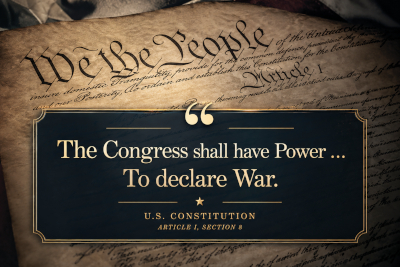
He added, “I am providing this report as part of my efforts to keep the Congress fully informed, consistent with the War Powers Resolution (Public Law 93-148).” Under this resolution, the president “shall terminate” the use of U.S. armed forces against a foreign nation within 60 days if there is no congressional declaration of war or authorization. (No such time frame for unilateral military action on the part of the president is specified in the Constitution, which grants to Congress the power “to declare war.”)
On May 1, when the War Powers Resolution’s 60-day time frame expired, Trump informed Congress that his military operation against Iran was already terminated. In a letter, he reasoned: “On April 7, 2026, I ordered a 2-week ceasefire. The ceasefire has since been extended. There has been no exchange of fire between United States Forces and Iran since April 7, 2026. The hostilities that began on February 28, 2026, have terminated.”
Meanwhile, as of this writing, the U.S. is continuing its blockade of the Strait of Hormuz. In his May 1 report to Congress, Trump explained, “I have and will continue to direct United States Armed Forces consistent with my responsibilities and pursuant to my constitutional authority to conduct United States foreign relations and as Commander in Chief and Chief Executive.”
Thus far, most congressional Republicans have agreed with Trump, though there have been notable exceptions such as Senator Rand Paul (R-Ky.) and Representative Thomas Massie (R-Ky.), two of the most constitutionalist-minded lawmakers in Congress according to this magazine’s Freedom Index. Congressional Democrats, on the other hand, have opposed Trump on his unilateral military actions against Iran. This Republican/Democrat dichotomy has caused many MAGA conservatives to support the president’s unilateral action, although others have broken with Trump on this issue.
And temperatures are running high. When Secretary of Defense Pete Hegseth appeared before the House Armed Services Committee on April 29, he did not mince words regarding his disdain for congressional opposition to the president’s war policies. “The biggest challenge, the biggest adversary we face at this point are the reckless, feckless and defeatist words of congressional Democrats, and some Republicans,” he said. Later in the hearing, he told Representative John Garamendi (D-Calif.), “Your hatred for President Trump blinds you to the truth of the success of this mission.”
Certainly, abhorrence of Trump causes many Americans to blindly oppose whatever he says or does, just because it’s Trump. This phenomenon has even been given a name: Trump Derangement Syndrome. But there are also Americans who blindly support whatever Trump says or does, just because it’s Trump. Regardless of what one thinks of Trump, all of us should evaluate his military actions in Iran based on principles, not personalities or parties. Let’s now take a hard look at the principles, particularly the constitutional principles, and apply them to the Iran war.
The Founders’ View
It should go without saying that America’s Founding Fathers did not believe that a single person should be entrusted with the power to decide when to plunge the country into the crucible of war. In fact, when they wrote the Constitution, they assigned the lion’s share of war powers to Congress.
Under the Constitution, the president is “Commander in Chief of the Army and Navy of the United States, and of the Militia of the several States, when called into the actual Service of the United States.” But his powers as commander in chief are restricted by the following congressional powers: “To declare war”; “To raise and support Armies”; “To provide and maintain a Navy”; “To Make Rules for the Government and Regulation of the land and naval Forces”; “To provide for calling forth the Militia to execute the Laws of the Union, suppress Insurrections and repel Invasions”; and “To provide for organizing, arming, and disciplining the Militia.”
In The Federalist, No. 69, Alexander Hamilton contrasted the president’s war powers with those of the British king: “The President is to be commander-in-chief of the army and navy of the United States. In this respect, his authority would be nominally the same with that of the king of Great Britain, but in substance much inferior to it. It would amount to nothing more than the supreme command and direction of the military and naval forces, as first general and admiral … while that of the British king extends to the declaring of war and to the raising and regulating of fleets and armies — all which, by the Constitution under consideration, would appertain to the legislature.” (Emphasis in original.)
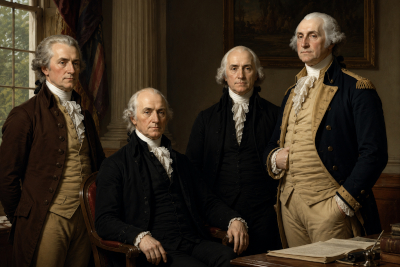
James Madison, whose role at the Constitutional Convention was so great that he became known as the Father of the Constitution, agreed that Congress, not the president, should be the decider when it comes to going to war. In a letter to Thomas Jefferson in 1798, he observed, “The Constitution supposes, what the History of all governments demonstrates, that the Executive is the branch of power most interested in war, and most prone to it. It has, accordingly, with studied care, vested the question of war in the Legislature.” Abraham Lincoln, the first Republican president, made a similar observation in 1848: “Kings had always been involving and impoverishing their people in wars, pretending generally, if not always, that the good of the people was the object. This our [1787] Convention understood to be the most oppressive of all Kingly oppressions; and they resolved to so frame the Constitution that no one man should hold the power of bringing this oppression upon us.”
But how about a good man? Not according to the Founding Fathers, who recognized the corruptive influence power can have on imperfect human beings. Thomas Jefferson warned in 1798, “In questions of power then, let no more be heard of confidence in man, but bind him down from mischief by the chains of the Constitution.” And Madison put it this way in The Federalist, No. 51, “If men were angels, no government would be necessary. If angels were to govern men, neither external nor internal controls on government would be necessary. In framing a government which is to be administered by men over men, the great difficulty lies in this: you must first enable the government to control the governed; and in the next place oblige it to control itself.” The internal controls on the government include the division of war powers, with the Congress possessing the lion’s share, including the power “to declare war.”
But, it is reasonable to ask: Is the power to declare war equivalent to the power to make war? If it is, then why didn’t the Founders use the word “make” to avoid any ambiguity in the language of the Constitution? Actually, they initially used the word “make” — before changing it to “declare” — for a very good reason. Madison reported the discussion in his Notes of Debates in the Federal Convention of 1787:
Mr. Madison and Mr. [Elbridge] Gerry moved to insert “declare,” striking out [the congressional power to] “make” war; leaving to the Executive the power to repel sudden attacks.
Mr. [Roger] Sherman thought it stood very well. The Executive should be able to repel and not to commence war….
Mr. Gerry never expected to hear in a republic a motion to empower the Executive alone to declare war….
Mr. [George] Mason was against giving the power of war to the Executive, because [he is] not safely to be trusted with it…. He was for clogging rather than facilitating war; but for facilitating peace. He preferred “declare” to “make.”
The Senate Foreign Relations Committee accurately summarized in its February 9, 1972 “Report on War Powers”: “The Constitutional Convention at first proposed to give Congress the power to ‘make’ war but changed this to ‘declare’ war, not, however, because it was desired to enlarge Presidential power but in order to permit the President to take action to repel sudden attacks” — without violating the Constitution.
The Constitution is clear that Congress possesses the power to “declare war,” but it does not address the question as to when Congress should exercise that power. During the early years of the Republic, the understanding was that the United States should mind its own business and follow a noninterventionist policy in foreign affairs, not going to war unless necessary to defend the American people. In his Farewell Address to the nation, George Washington said, “It is our true policy to steer clear of permanent alliances with any portion of the foreign world.” And John Quincy Adams, America’s sixth president, observed in his 1821 Independence Day Address that America “goes not abroad, in search of monsters to destroy. She is the well-wisher to the freedom and independence of all. She is the champion and vindicator only of her own…. She well knows that by once enlisting under other banners than her own ... she would involve herself beyond the power of extrication, in all the wars of interest and intrigue, of individual avarice, envy, and ambition, which assume the colors and usurp the standard of freedom.”
Over time, that policy of noninterventionism eventually gave way to globalism. But even after two world wars and the founding of the United Nations, Americans still called for putting their country first. In 1951, Senator Robert Taft (R-Ohio), whose stature in the Republican Party was so great that he was known as “Mr. Republican,” advocated “A Foreign Policy for Americans” in his book of that title: “No foreign policy can be justified except a policy devoted without reservation or diversion to the protection of the liberty of the American people, with war only as the last resort and only to preserve that liberty.”
When Trump ran for president in 2016, he called for putting “America first.” Later, in his 2019 State of the Union address, he reminded Americans about the costs of the “endless wars” he had opposed under past administrations: “Our brave troops have now been fighting in the Middle East for almost 19 years. In Afghanistan and Iraq, nearly 7,000 American heroes have given their lives. More than 52,000 Americans have been badly wounded. We have spent more than $7 trillion in the Middle East. As a candidate for President, I pledged a new approach. Great nations do not fight endless wars.” His “new approach” did seem to be moving America away from the “endless wars” of the past. And in his election-night victory speech for his second term as president in 2024, he promised, “I’m not going to start a war, I’m going to stop wars.”
Trump’s Military Interventionism in Iran
President Trump’s decision to join Israel in going to war against Iran is certainly not what noninterventionist-minded Americans expected based on his past America First statements and his first term in office. This raises two related questions: Why did he do so; and why did he do so without first seeking and obtaining congressional approval?
One argument for bypassing Congress is that the threat was so imminent that there was no time to get congressional approval prior to being hit. When Trump launched Operation Midnight Hammer on June 21, 2025, Speaker of the House Mike Johnson (R-La.) supported his unilateral decision, saying, “The President made the right call, and did what he needed to do. Leaders in Congress were aware of the urgency of this situation and the Commander-in-Chief evaluated that the imminent danger outweighed the time it would take for Congress to act.” But was the threat that imminent? Not according to the 2025 Annual Threat Assessment of the U.S. Intelligence Community, which was released just three months prior to Midnight Hammer. The report said, “We continue to assess Iran is not building a nuclear weapon and that [now-deceased Iranian leader Ali] Khamenei has not reauthorized the nuclear weapons program he suspended in 2003.”
In any event, Operation Midnight Hammer obliterated Iran’s nuclear capabilities, according to Trump and others. On June 21, 2025, the very day of the attack, Trump told the American people, “Iran’s key nuclear enrichment facilities have been completely and totally obliterated.” Three days later, he posted on Truth Social, “It was my great honor to Destroy All Nuclear facilities & capability, and then, STOP THE WAR!”
And then, on February 28 of this year, Trump launched Operation Epic Fury, now often referred to as the Iran war. In his announcement on that day, Trump explained to the American people, “Our objective is to defend the American people by eliminating imminent threats from the Iranian regime, a vicious group of very hard, terrible people.” (Emphasis added.) Later in his announcement, he said, “They rejected every opportunity to renounce their nuclear ambitions, and we can’t take it anymore.” (Emphasis added.)
“Nuclear ambitions” and “imminent threats” sound like two very different things so far as justification for a preemptive strike is concerned. So how imminent was the threat, particularly the nuclear threat, on February 28? At the time, Trump was vague about how imminent the threat was. But he was very clear later. On March 23, before boarding Air Force One, a reporter brought up former Director of the National Counterterrorism Center Joe Kent’s assertion that Iran was not an imminent threat. “I think it was an imminent threat,” the president responded. “I think that Iran, if they — if we didn’t bomb them with the B-2 bombers, now that set them back, but if we didn’t hit them with the B-2 bombers, they would have had a nuclear weapon within two weeks to a month. And if they had a nuclear weapon, they would have used it as soon as they got it.” If the “two weeks to a month” claim were true, then that meant that Iran would have been able to deploy a nuclear weapon by the end of March if Trump had not militarily intervened to prevent it from happening.
How believable is that claim? If accurate, it means that Iran was able to rebuild its “obliterated” nuclear program in less than a year — assuming, of course, the program really was obliterated on June 21, 2025. But an Iranian regime being able to have a nuclear weapon by the end of March of this year also clashes with findings in the 2026 Annual Threat Assessment of the U.S. Intelligence Community. Using information available as of March 14, it states: “Prior to Operation Epic Fury, Iran was pursuing increasingly capable missile systems, was non-compliant with its Chemical Weapons Convention obligations, had not abandoned its intention to conduct R&D of biological agents and toxins for offensive purposes, was intending to try to recover from the devastation of its nuclear infrastructure sustained during the 12-Day War [June 2025], and refused to live up to its nuclear obligations with the IAEA [the International Atomic Energy Agency], including refusing to allow IAEA access to key nuclear facilities.” Of course, “intending to try to recover from the devastation of its nuclear infrastructure” is far different from being just two weeks to a month away from having a weapon when Operation Epic Fury was launched on February 28.
Principles First
Trump is not the first president to decide to go to war without the constitutionally required declaration of war from Congress. Nor is he the first president to overblow a threat to justify a war. (Remember the claims about Iraq’s reputed “weapons of mass destruction” that were used to justify U.S. military intervention in that country?) But the fact that past presidents have transgressed the Constitution when it comes to war powers (and other policies, too) does not justify Trump’s doing so.
It is true that Iran under the ayatollahs is an oppressive, terroristic regime. No sane person would want to see it possess nuclear weapons. (No sane, freedom-loving person wants the tyrannical regimes of North Korea, China, or Russia to possess nuclear weapons either — but they do.) But does this justify launching a war against Iran? Does it justify a president — any president —taking matters into his own hands, even if he sincerely believes it is the right thing to do? If the answer is yes, then the ends justify the means. Moreover, if the answer is yes, then the Founding Fathers were wrong in their belief that no single man should possess the power to decide when to go to war, and that America should avoid interjecting itself in foreign quarrels. Whether the president is Trump or someone else should not change the answers to these questions.