
Report: Trump Sons Build Defense Portfolio as Pentagon Billions Flow
President Donald Trump’s sons have built a broad portfolio of defense technology investments as their father’s administration directs more money toward drones, robotics, artificial intelligence, and other new weapons systems.
Funds linked to Donald Trump, Jr. and Eric Trump have invested in at least 15 companies seeking business from the Pentagon and other federal agencies, according to a Washington Post analysis. Most of the investments came after Trump won reelection.
Since the sons invested, says the report,
The companies have collectively generated at least $3.2 billion in direct government business since the sons invested and an additional $3.1 billion in future contract options. Some have gained coveted spots on shortlists of preapproved contractors that can bid exclusively on up to nearly $200 billion in future work.
The explosion of the family’s financial wealth does not stop with the sons. A disclosure filed in 2026 showed that Trump himself reported at least $2.2 billion in income for 2025, up from about $600 million the previous year. That works out to roughly $6 million per day. His accounts also made thousands of securities trades across the economy, including investments in defense companies and other industries heavily regulated by, or dependent on, federal policy.
The Money Trail
The Trump sons’ investments reportedly flow mainly through two firms.
Donald Trump, Jr. joined venture-capital firm 1789 Capital as a partner within days of his father’s 2024 election victory. The firm promotes what its partners call “patriotic capitalism.” It invested in 11 of the 15 defense, robotics, and AI companies identified by The Post.
Meanwhile, Eric Trump has invested primarily through American Ventures. The firm operates through Dominari Holdings, a small investment bank based in Trump Tower. Eric Trump told the outlet that he was “one of several passive investors.”
Neither brother holds a government position. Neither had notable experience in defense technology before the investment drive began. Both remain executive vice presidents of the Trump Organization.
The Companies
The companies that the Trump-linked firms invested in range from industry giants to little-known startups.
Elon Musk’s SpaceX accounted for about $2.1 billion in direct federal business after the investment and another $1.2 billion in potential commitments, according to The Post. Musk was also Trump’s largest financial backer in 2024. He spent nearly $300 million supporting Trump and other Republicans.
SpaceX was already deeply dependent on Washington. As of February 2025, it reportedly held about $22 billion in government contracts, including roughly $15 billion from NASA.
Its military role has since expanded sharply. This May, SpaceX won a $4.16 billion Space Force contract for satellites designed to track and target airborne threats. Days earlier, it secured another $2.29 billion to build a military satellite communications network.
Those systems could form important parts of Trump’s controversial Golden Dome missile shield. SpaceX was previously identified as a leading contender for the program, alongside Anduril and Palantir (all run by Trump’s mega donors).
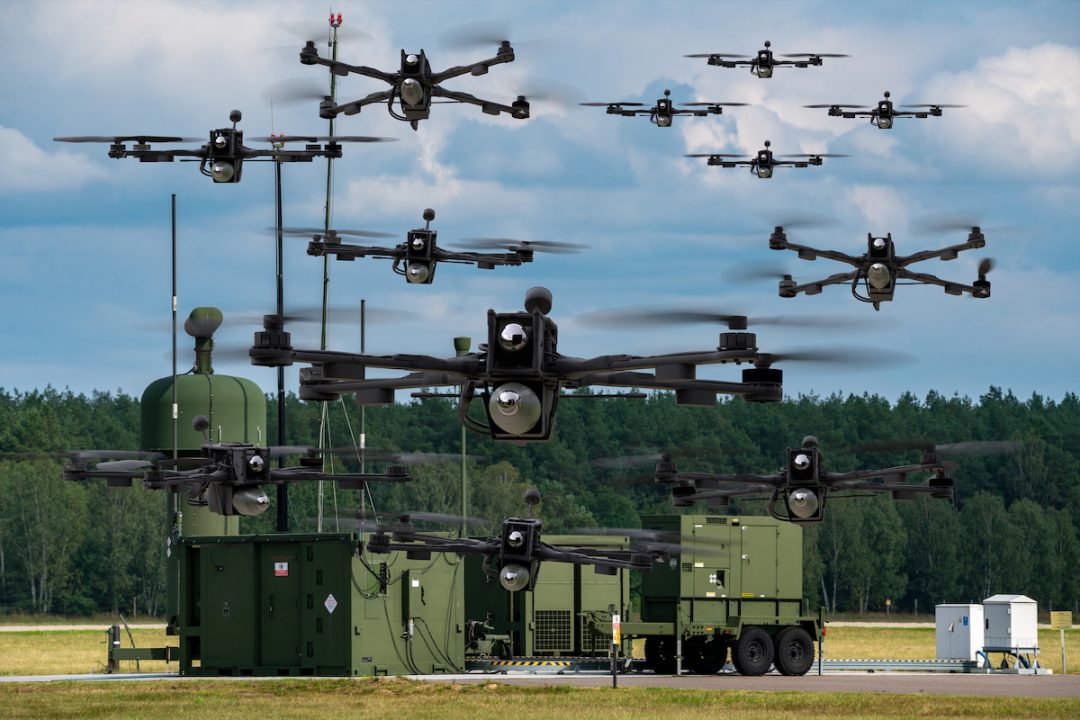
Anduril ranked second in The Post’s tally. It accounted for about $1 billion in direct government business and another $122.9 million in potential work. The company builds autonomous drones, surveillance systems, missiles, and counter-drone technology.
Together, SpaceX and Anduril accounted for 97 percent of the direct federal money identified by The Post.
The remaining investments covered automated weapons factories, rare earth magnets, quantum computing, humanoid robots, drones, rocket fuel, and targeting software. Hadrian and Vulcan Elements secured the largest potential commitments among the smaller firms. Other companies included Databricks, Foundation Future Industries, Unusual Machines, Firehawk Aerospace, Perplexity AI, PsiQuantum, and Aeon Industrial.
Policy Meets Portfolio
The investments closely track the administration’s military priorities.
For example, the Trump brothers have invested in or advised at least four drone manufacturers. All four have secured federal business in 2025 and 2026. Two have already worked with the government before.
The opportunity has grown dramatically. In June, Defense Secretary Pete Hegseth placed nearly all Pentagon drone and autonomous weapons programs under a powerful new office. It will oversee how the military develops, buys, and deploys drones, ground robots, unmanned boats, counter drone systems, and the artificial intelligence that controls them.
The Pentagon’s latest budget request included $53.6 billion for autonomous platforms and counter-drone systems.
Besides Anduril, one of the potential beneficiaries is Powerus, a drone company partly owned by the Trump sons that plans to seek Pentagon contracts.
“I am incredibly proud to invest in companies I believe in,” Eric Trump told the Associated Press in early April. “Drones are clearly the wave of the future.”
At the same time, AI became another priority. In a January 9 memorandum, the DOD ordered the military to become an “AI-first” force, declaring that “AI-enabled warfare … will re-define the character of military affairs over the next decade.” Once again, the Trump-linked investment portfolio closely tracked the administration’s policy.
The Post quotes Trump, Jr.’ claims of having a direct role in shaping defense policies,
At an investment conference last year, Trump Jr. described his involvement in Defense Department decisions, saying he “helped craft some of [the department’s] messaging.” On his podcast, he said that in assisting … Hegseth with personnel decisions, he was looking for candidates who wanted to spend more money on drones.
The Vulcan Deal
The Vulcan Elements loan has drawn the sharpest scrutiny.
1789 Capital invested in the young company about three months before the Pentagon announced the $620 million loan, per the Post. The award was twice the company’s previous estimated value, according to the Democratic lawmakers who questioned the deal. Estimates of Vulcan’s valuation later rose from about $200 million to roughly $2 billion.
ProPublica reported that White House advisor Peter Navarro initiated the request.
Pentagon employees then moved the application through the process in weeks rather than months, according to the report. One person involved recalled the instruction: “The call came from the White House: We have to get this done.”
Trump, Jr.’s spokesman said he never discussed Vulcan with Navarro. He also said Trump, Jr. “has no knowledge about how this deal came together.”
Vulcan denied seeking help from its investors. It said it “did not ask or solicit its investors to facilitate the Pentagon loan.”
The Pentagon said it moved quickly while maintaining proper review. It said officials balance “lightning speed with rigorous diligence” when financing projects important to national security.
The Democrats demanded an investigation.
“If this report is accurate, it reveals a staggering level of corruption and influence peddling,” they wrote on June 3. They said the intervention may have enriched the president’s son “at the expense of U.S. national security and taxpayer dollars.”
The Defense
The evidence does not show that every company received special treatment.
Ten of the 15 already had federal business before the Trump sons invested. Eight held contracts under President Joe Biden. Five entered the federal market only after the investments and Trump’s return to office.
Company representatives told The Post that they won contracts through normal processes and received no help from the Trump family.
The White House rejected the conflict claims. “There are no conflicts of interest,” spokeswoman Anna Kelly said.
Pentagon spokesman Joel Valdez said political ties “play absolutely no role” in funding decisions. A spokesman for Trump, Jr. said he “does not interface with the Federal Government” for companies he backs.
Still, ethics experts say direct intervention is not required.
“Government decision makers will feel pressure to use contract awards to enrich the president’s family,” ethics professor Kathleen Clark told the Associated Press.
Trump’s Old Warning
In September 2020, Trump described the core financial logic of the defense industry in blunt terms:
The top people in the Pentagon probably aren’t [in love with me] because they want to do nothing but fight wars so all of those wonderful companies that make the bombs and make the planes and make everything else stay happy.
He went on to blast the scheme as “one cold-hearted globalist betrayal after another.”
Six years later, the warning points back at his own family.
Trump built his political brand around ending “forever wars.” Yet he now presides over an unconstitutional war on Iran. His administration also continues to support weapons programs for Ukraine and Israel. Meanwhile, his sons hold stakes in companies positioned to benefit from the Pentagon’s new “wartime footing.”
Again, no public evidence proves that every award resulted from favoritism. But it does not need to. The glaring conflict lies in the arrangement itself. The administration chooses the technologies, sets the priorities, and awards the contracts while the president’s family owns part of the marketplace.