

Vol. 42, No. 08
08/01/2026
Principles… Not Personalities
AT A GLANCE
• We should evaluate politicians based on principles — not personalities, and not parties.
• Officeholders take an oath to uphold the Constitution, and we should support them only to the degree that they abide by that oath.
• This constitutional litmus test should be applied to every politician, regardless of who he may be.
• Herein we take a look at President Trump and his actions, using as our standard the Constitution and its underlying principles.
The Democratic Party is no longer your granddaddy’s Democratic Party. It has moved so far to the left that it has become the party of wokeism, welfarism, and progressive socialism. Its nationally recognized leaders include New York City Mayor Zohran Mamdani and Representative Alexandria Ocasio-Cortez (D-N.Y.), both of whom are avowed socialists. In fact, the Democratic Party’s socialism has become so overtly Marxist that it is increasingly indistinguishable from communism. Compared to the left-wing radicalism of the Democratic Party, the Republican Party appears to be strongly conservative.
But how conservative is the Republican Party? How conservative is it with President Donald Trump as its standard-bearer? One measuring stick shedding light on this question is The New American’s Freedom Index, which rates every member of the U.S. House and Senate based on the Constitution. According to this metric, Republicans as a whole score well compared to their Democratic counterparts, but poorly with respect to their oaths of office to the Constitution. (See our most recent Freedom Index on page 40.)
The scores in the Freedom Index may surprise many conservative-minded Americans who, based on media characterizations and campaign rhetoric, believe that Republicans as a whole are far more conservative than they actually are. In fact, this is particularly the case when Republicans are smeared by the left-liberal media as extremists; when they lock horns with the Left; and when they say many of the right things and even accomplish some great things (from the conservative/constitutionalist perspective).
In the current political milieu, it is easy to look at the great divide between conservative Republicans and liberal Democrats as black and white, when it is not. It is also easy to place unwarranted faith in our favorite political personalities, when in fact it is principles, not personalities, that truly matter. We should support our politicians only to the degree that they adhere to the Constitution, campaign promises and even past performance notwithstanding.
Trump and the Exercise of Power
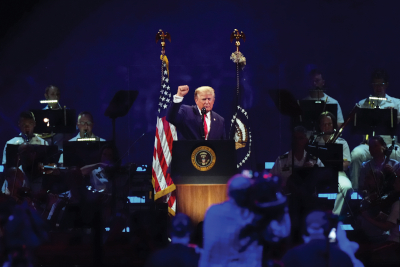
For a case in point, consider Donald Trump, who has as big a personality and public persona as one might possibly imagine in America today. And that personality, both supporters and critics agree, includes a large ego. Should MAGA and other conservative-minded people put complete faith in him?
The political Left and Right are poles apart in their perceptions of Trump. MAGA has viewed him as a champion of “America First” who is battling the Deep State to reverse the American decline and make America great again. The liberal Left, on the other hand, has maligned him as a racist, antisemite, neo-Nazi, etc., who aspires to become a modern-day Hitler. Though such scurrilous accusations have been based on emotion, not evidence, the target of these smears did not help himself when in a June 17 Truth Social post, he wrote, “Presidential Historian Dave King — Sounds good to me!” — followed by King’s piece comparing the power Trump wields to that of Hitler and other despots. King began:
Donald Trump is, without question, the most powerful man that the planet has ever known — by a long way.
Historically, powerful people were characterised by brutal conquest and the fear that they instilled in the populations that came under their influence. Common names that would come to mind are Alexander the Great, the Caesars, Genghis Khan, Attila the Hun, Tamburlaine, Napoleon and, more recently, Hitler, Mao, and Stalin.
Of course, King pointed out, there are differences too:
The overwhelming difference between each of the above when compared with President Trump is their lack of global reach. Their power was limited to restricted local areas (even though some of these areas were quite large in a local context). They had nowhere near the control over modern logistics, manpower, technology, and the global economic muscle that President Trump can enforce…. Mao and Lenin had access to immense power within the Chinese and Russian populations and some of their satellite states. They maintained this power through fear and authoritarianism. But, they lacked the economic and technology resources of the new industrial power, the USA, which resulted in the Cold War and prevented them from ever having a meaningful global reach.
The collapse of Communism … has seen the USA emerge as the first truly global superpower. Additionally, President Trump is the first leader to be willing to use that power on a global scale. That makes him by far the most powerful person that has EVER walked this planet.
Wow! What in this assessment, it is reasonable to ask, sounds so good to Trump that he’d favorably post it? Trump was not suggesting that he would use his political power to wreak the horrific human death toll and misery that Hitler, Mao, and Stalin did. But that said, it does seem reasonable to conclude that Trump does view himself as “the most powerful man that the planet has ever known,” that he is willing to “use that power on a global scale,” and that this (in Trump’s words) “sounds good” to him. In fact, Trump’s willingness to exercise political power to accomplish his global objectives is one of the few things that his supporters and critics would agree on. However, his supporters would say that his intent is to make the world, and America in particular, a better and safer place, while many of his critics would claim he has darker and more sinister motives.
Motivations aside, there is no doubt that President Trump’s political friends and foes alike should keep a close eye on his words and actions to make sure that he is doing the right things for the American people and not overstepping his proper authority. This should be true for all politicians, including members of Congress and others, Democrats and Republicans alike. And it should be true even when our thoughtful observations lead us to believe that a politician really is intending to do what is right and true, even if he may stumble here and there. As a well-known proverb warns, “The road to hell is paved with good intentions.”
Principles First
Good intentions or not, America’s Founding Fathers certainly believed that we should not blindly trust our rulers. As Thomas Jefferson famously warned in his Kentucky Resolutions of 1798, “In questions of power … let no more be heard of confidence in man, but bind him down from mischief by the chains of the Constitution.”
The U.S. Constitution framed a government based on the timeless principles of the Declaration of Independence. Those principles include the “self-evident” truths that all men “are endowed by their Creator with certain unalienable Rights”; that those rights include “Life, Liberty, and the Pursuit of Happiness”; and that “to secure these Rights, Governments are instituted among Men, deriving their just Powers from the Consent of the Governed.”

To prevent the government from exceeding its proper role and devouring the God-given rights it is supposed to protect, the Founders specified the few powers the new national government could exercise (all other powers were left to the states and the people), divided those limited powers among three branches of government (the legislative, executive, and judicial), and interwove into the Constitution a system of checks and balances intended to keep all the branches within the limits of their delegated powers.
The president, members of Congress, and other public officials take a solemn oath to uphold the Constitution, and it is the principles of the Declaration and the strictures of the Constitution that should determine our evaluation of them — regardless of their intentions or what we might think of them personally. Yet in the case of Trump, such an evaluation is difficult, in large part because he has become such a polarizing figure. Strong emotions on both sides — fueled by incessant attacks from the liberal media — have made it exceedingly difficult for those with opposing views to talk to each other about him.
On the Left, the hatred against Trump has become so virulent that it is hardly hyperbolic to observe that many liberal-left Americans have “Trump Derangement Syndrome,” a phrase/condition that has been part of the political lexicon/landscape ever since Trump came down the escalator to announce his first bid for the presidency in 2015. TDS victims hate Trump to such an extent that they irrationally reject whatever he says or does simply because he says or does it, even in cases where they might otherwise agree.

On the other hand, some MAGA conservatives have grown to love Trump to such an extent that they tend to support whatever he says or does simply because he says or does it. A few even reflexively dismiss anyone who criticizes Trump as just another leftist or RINO (Republican in Name Only) spewing anti-Trump propaganda, without first considering whether there are merits to the criticism from a conservative/constitutionalist point of view.
Nevertheless, we should always evaluate our politicians based on principles — not personalities, and not parties. Principles are immutable, whereas personalities imperfectly represent those principles (all of us are flawed human beings), may be corrupted by power, and may be deceptive; and political parties can and do change.
Let us now take a look at some of Trump’s policies, using as our standard the Constitution and its underlying principles.
Usurpations of Power
When President Trump walked in late to take his seat among the other world leaders at the G7 Summit meeting in June, he paused to remark, “I’m the boss.” When later asked on The Axios Show how many world leaders believe he’s the boss, he said, “All of them,” before immediately adding, “But I was just being funny.” He also said, “I wasn’t trying to be the boss.”
Of course, though Trump’s public persona may convey that he is the boss, in reality he is not the boss — not of the G7, and not of the United States. Under the Constitution, the president’s powers are more limited than those of Congress; Congress possesses all legislative powers, while the president is entrusted with faithfully executing the laws. Even when it comes to the power of the sword, the president’s role as commander in chief is a limited one, as Alexander Hamilton explained in The Federalist, No. 69:
The President is to be commander-in-chief of the army and navy of the United States. In this respect, his authority would be nominally the same with that of the king of Great Britain, but in substance much inferior to it. It would amount to nothing more than the supreme command and direction of the military and naval forces, as first general and admiral … while that of the British king extends to the declaring of war and to the raising and regulating of fleets and armies — all which, by the Constitution under consideration, would appertain to the legislature. [Emphasis in original.]
Yet Trump launched a war against Iran on February 28 without first asking Congress “to declare war,” as required by the Constitution. In the House, Representative Thomas Massie (R-Ky.) responded to Trump’s executive action by introducing a resolution to direct “the President to terminate the use of United States Armed Forces from hostilities against the Islamic Republic of Iran or any part of its government or military, unless explicitly authorized by a declaration of war or specific authorization for use of military force against Iran.” On March 5, this resolution was rejected by a largely party-line vote of 212-219. Massie was one of only two Republicans who voted for his resolution, while 215 Republicans voted against it. The Democrats supported his resolution by a vote of 210 to 4, though it is reasonable to assume that they would have voted very differently if a Democratic president had decided to launch the war unilaterally.
In reality, all members of Congress, both Republican and Democratic, should have voted for this resolution, irrespective of their position on the war, because of their oaths of office to the Constitution. (This vote is included in our latest Freedom Index) If Congress agreed with Trump that America truly needed to go to war against Iran, then it should have exercised its constitutional power to declare war. The fact that other presidents have also usurped war powers belonging to Congress is no excuse for Trump to do so.
What did Trump hope to accomplish by going to war? On March 2, two days after launching “Operation Epic Fury,” he summarized, “First, we’re destroying Iran’s missile capabilities … and their capacity to produce brand new ones…. Second, we’re annihilating their navy…. Third, we’re ensuring that the world’s number one sponsor of terror can never obtain a nuclear weapon…. And finally, we’re ensuring that the Iranian regime cannot continue to arm, fund, and direct terrorist armies outside of their borders.”
On June 17, Trump signed a 14-point “Memorandum of Understanding” (MoU) with Iran that declared “the immediate and permanent termination of military operations on all fronts, including in Lebanon,” and outlined the framework for the still-to-be-negotiated “final deal.” Here are several highlights:
- In point 8 of the MoU, Iran “reaffirms that it shall not procure or develop nuclear weapons” (Iran has said this in the past). Moreover, Iran and the United States “have agreed to resolve the disposition of stockpiled enriched material pursuant to a mechanism that will be mutually agreed upon … with the minimum methodology to be down blending on-site, under the supervision of the IAEA [International Atomic Energy Agency].”
- In point 5, Iran “will make arrangements using its best efforts for the safe passage of commercial vessels, with no charge for 60 days only, from the Persian Gulf [through the Strait of Hormuz] to the Sea of Oman, and vice versa.” (The Strait of Hormuz was open prior to the war, and there was no charge for the transit.)
- In point 6, the United States “undertakes, with regional partners, to develop a definitive mutually agreed plan with at least USD 300 Billion, for the reconstruction and economic development of the Islamic Republic of Iran.”
As we write, hostilities have flared up again despite this MoU’s declaration to permanently end hostilities, and it is unclear what is going to happen next. But what should be clear is that wars do not always go as intended, and do not always accomplish the original objectives; and what should always have been clear, and what was certainly clear to the Founding Fathers, is that no one man should make the decision to take the country to war. Too much is at stake — including, most importantly, lives — not to make the people’s representatives the deciders.
In addition to usurping war powers belonging to Congress, Trump has also usurped tariff powers belonging to Congress, resulting in the Supreme Court’s February 20 ruling that his “emergency” tariffs were unconstitutional. On the other hand, if Trump had asked Congress to approve his tariffs — as he should have done — and if they had done so, then there would have been no constitutional transgression. In fact, tariffs were once the primary way by which Congress funded the federal government. Moreover, a good case can be made that tariffs are the least objectionable form of taxation — certainly, we believe, less objectionable than the obtrusive federal income tax. In our May 26, 2025 issue, prior to the aforementioned Supreme Court decision, we published a cover story headlined “Trump’s Tariffs: The Right Thing, The Wrong Way.”
One may agree with the president on the need to go to war against Iran or ramping up our reliance on tariffs without approving his usurpation of power to carry out these actions.
Shifting Positions
Politicians are wont to shift their positions over time, and Trump is no exception. The president’s military interventionism in the Middle East during his second term, as compared to his relatively noninterventionist approach during his first, is a case in point. When he ran for the presidency the first time, he promised no more endless wars, and during his first term he moved the nation away from war, as promised. On June 13, 2020, he told the graduating class at West Point, “We are ending the era of endless wars. In its place is a renewed, clear-eyed focus on defending America’s vital interests. It is not the duty of U.S. troops to solve ancient conflicts in faraway lands that many people have never even heard of. We are not the policemen of the world.” Four years later, when he gave his election night victory speech after winning his second term, he recalled, “We had no wars. Four years, we had no wars, except we defeated ISIS…. They said, ‘He will start a war.’ I’m not going to start a war. I’m going to stop wars.” Yet in his second term he joined Israel to start a war against Iran. In general, his approach to the use of military force during his second term has been very different from that of his first.
In the case of the release of the Epstein files, Trump sounded supportive of releasing the files during his 2024 presidential bid, but strongly opposed the release after he got back into the White House. However, he finally supported the release when it became obvious that the Epstein Files Transparency Act would be passed by Congress. In June 2024, when Fox News asked him if he would declassify the Epstein files, he said that he would. But on July 16, 2025, he called the Epstein files a hoax, and even blasted his “PAST supporters” for buying into it, in a lengthy Truth Social post:
The Radical Left Democrats have hit pay dirt, again! Just like with the FAKE and fully discredited Steele Dossier, the lying 51 “Intelligence” Agents, the Laptop from Hell … and even the Russia, Russia, Russia Scam itself, a totally fake and made up story used in order to hide Crooked Hillary Clinton’s big loss in the 2016 Presidential Election, these Scams and Hoaxes are all the Democrats are good at…. Their new SCAM is what we will forever call the Jeffrey Epstein Hoax, and my PAST supporters have bought into this “bull***t,” hook, line, and sinker. They haven’t learned their lesson, and probably never will, even after being conned by the Lunatic Left for 8 long years. I have had more success in 6 months than perhaps any President in our Country’s history, and all these people want to talk about, with strong prodding by the Fake News and the success starved Dems, is the Jeffrey Epstein Hoax. Let these weaklings continue forward and do the Democrats work, don’t even think about talking of our incredible and unprecedented success, because I don’t want their support anymore!
Taking Trump’s cue, congressional Republicans blocked the Epstein Files Transparency Act until Representative Massie was able to get a majority of House members to sign his discharge petition, forcing the bill to the House floor for a vote. Trump abruptly reversed his position on the bill, which passed overwhelmingly in both houses of Congress, and signed it into law on November 19, 2025.
Trump’s about-face regarding deficits and debt has also been striking. Prior to becoming president, he opposed raising the national debt limit. For instance, on July 6, 2011, during Barack Obama’s presidency, Trump tweeted: “Congress is back. TIME TO CUT, CAP, AND BALANCE. There is no revenue problem. The Debt Limit cannot be raised until Obama spending is contained.” As a U.S. senator, Obama had opposed increasing the national debt limit — but not as president. And so, on July 22, 2011 Trump tweeted what Obama had said on the Senate floor back in 2006: “Increasing America’s debt weakens us domestically and internationally.” Then, on December 28, 2011, Trump tweeted: “He [Obama] is destroying our country: @BarackObama has requested to raise our debt limit to over $16.4 Trillion by the end of his first term.”
Republicans as well as Democrats have supported increasing the national debt. On January 23, 2013, Trump tweeted, “I cannot believe the Republicans are extending the debt ceiling — I am a Republican & I am embarrassed!”
Trump not only opposed adding to government indebtedness, he also said he’d be able to eliminate the national debt. On March 31, 2016, during his first run for the presidency, he told The Washington Post that “we’ve got to get rid of the $19 trillion in debt.” Asked how long that would take, he said, “I think I could do it fairly quickly.” And asked what “fairly quickly” meant, he replied, “I would say over a period of eight years.”
But since then, Trump has gone from advocating the elimination of the national debt to advocating the elimination of the national debt limit. The latter view has also been expressed by liberal Senator Elizabeth Warren (D-Mass.). And although Trump has been very critical of Warren, he acknowledged that the two of them agreed on eliminating the debt limit. In a June 4, 2025 Truth Social post, he wrote, “I am very pleased to announce that, after all of these years, I agree with Senator Elizabeth Warren on SOMETHING. The Debt Limit should be entirely scrapped to prevent an Economic catastrophe. It is too devastating to be put in the hands of political people that may want to use it despite the horrendous effect it could have on our Country and, indirectly, even the World.”
The debt limit has not been scrapped. Instead, on July 4, 2025, Trump signed into law legislation that, among myriad other things, raised the debt limit $5 trillion, to $41.1 trillion. That legislation was — you guessed it! — his Big Beautiful Bill. Not surprisingly, Trump did not draw attention to the $5 trillion debt-limit increase when he was working to garner public support for the bill. Nor did he trumpet the bill’s spending provisions. Instead, he emphasized the bill’s tax-cut provisions, and anyone who dared oppose his Big Beautiful Bill was besmirched as opposing tax cuts.
A June 30, 2025 White House press release propagandized (in the headline), “The One Big Beautiful Bill Slashes Deficits, National Debt While Unleashing Economic Growth.”
But if the bill were honestly intended to slash annual deficits and the national debt as promised, then why did it include a provision to raise the national debt limit by $5 trillion? As it turned out, the national debt surpassed $39 trillion in March of this year, as compared to $36.2 trillion when the Big Beautiful Bill was signed into law. The national debt is now increasing at a rate of well over $2 trillion per year.
This is very different from what Trump predicted in his March 4, 2025 State of the Union address: “And in the near future I want to do what has not been done in 24 years — balance the federal budget. We’re gonna balance it.”
But the Big Beautiful Bill did at least cut taxes, right? Well, not exactly. Although some taxes were cut, it must not be overlooked that the true amount of taxation is what the government spends, not just what it collects in taxes. When tax revenues aren’t sufficient to cover government spending, the piper still must be paid. One way the federal government does this is to monetize the debt via the Federal Reserve. That is, the Fed creates new money out of thin air to finance the debt, and the infusion of this new money into the economy diminishes the purchasing power of the money already in circulation, causing prices to rise. Unfortunately, very few people understand this “inflation tax,” which is why politicians who lower taxes while maintaining or (worse) increasing government spending may be favorably perceived as tax cutters.
To truly cut U.S. government taxes in this broader (and more honest) sense, spending must be cut. The way to rein in spending is to get the government back into its constitutional cage. Confining our efforts to cutting waste and abuse in bloated, unconstitutional federal programs that should not exist in the first place will not restore good government under the Constitution.
Because at least some of Trump’s positions have changed over time, the only way to use him as the gold standard for what to believe would be to change positions with him. But that would be tantamount to having no position at all, and it certainly would not be principle-based.
A New “Golden Age” for America
In his February 24, 2026 State of the Union address, Trump said that “our nation is back, bigger, better, richer and stronger than ever before.” He observed, “This July 4, we will mark two-and-a-half centuries of liberty and triumph, progress and freedom in the most incredible and exceptional nation ever to exist on the face of the Earth.” And, he added, “you’ve seen nothing yet. We are going to do better and better and better. This is the golden age of America.”
But America cannot do “better and better and better” unless it pursues the path that the Founding Founders did — limiting the role of government to that of protecting God-given rights, so that the people themselves could enjoy the blessings of liberty, from worshiping God to accomplishing great things only possible in the exhilarating air of freedom when government gets out of the way. Not to put too fine a point on it: The great American experiment in human liberty — the greatest in all history — occurred because of what people unfettered by the chains of tyranny did, not because government tried to do great things on behalf of the people. Freedom, not socialism, made America great. And freedom, not socialism, will make America great again.
Yet many American politicians today are pursuing the socialist path to make America great. By their own admission, these socialists include such nationally known figures as U.S. Senator Bernie Sanders (I-Vt.), as well as the aforementioned Representative Ocasio-Cortez and Mayor Mamdani. But they also include other politicians who do not acknowledge they are socialists, may not think of themselves as socialists, and may even — perhaps earnestly — advocate capitalism over socialism while pursuing the socialist path, at least to some degree.
Though many Americans would find it hard to imagine that super-capitalist Donald Trump has any socialist tendencies whatsoever, we must, in our analysis of his positions, look at his record and let the facts speak for themselves. Under Trump, the U.S. government has “invested” in a growing number of companies during his second term to protect and grow key sectors of the economy. For example, in 2025 the U.S. government purchased a 9.9-percent equity stake in Intel at a cost of $8.9 billion. The Council on Foreign Relations, the Establishment powerhouse, provides an informative webpage about these deals, called “Washington’s Growing Portfolio: Tracking U.S. Government Investments.” The page summarizes: “Washington’s latest and boldest experiment in industrial policy is a renewed willingness to take equity stakes. Since January 2025, the U.S. government has announced $26.7 billion across thirty deals involving direct ownership, broadening a toolkit that has traditionally focused on grants, loans, and tax incentives.”
How is this different in principle from the American AI Sovereign Wealth Fund Act introduced in June by avowed socialist Bernie Sanders in the U.S. Senate? That legislation, a Sanders press release summarizes, would “give the public a 50% ownership in the largest artificial intelligence (AI) companies in our country.”
Much more could be said about Trump’s public record, in addition to the survey above focusing on areas in which his positions have strayed from the “America First” campaign he ran on in 2016 and largely put into practice during his first term as president. In our view, the good he accomplished during his first term included nominating pro-life justices to the Supreme Court, which made possible the overturning of Roe v. Wade; announcing U.S. withdrawal from the Trans-Pacific Partnership (TPP), UNESCO, the UN Human Rights Council, and the Paris climate agreement (which had never been ratified by the U.S. Senate, as required by the Constitution); reining in the regulatory state (which unleashed entrepreneurs to such an extent that they were able to achieve American energy independence once again); and controlling the border, stemming the tide of massive illegal immigration. These policies have generally carried over into his second term.
But regardless of who holds which positions, all of us should determine whether those positions are wise or destructive based on the principles of the Constitution and the Declaration of Independence. This should be the case whether the politician is President Donald Trump, former President Barack Obama, Senator Bernie Sanders, Representative Thomas Massie, or Representative Alexandria Ocasio-Cortez. We should never put blind faith in man; we should instead, as Jefferson advised, “bind him down from mischief by the chains of the Constitution.”
We should recognize, too, that Trump did not create MAGA; MAGA created Trump. Though MAGA and Trump are very much intertwined, MAGA existed long before Trump threw his hat into the political ring, under different names such as the Tea Party. Without the understanding that had been created prior to Trump, his America First message would not have propelled him to the White House despite all of the smears against him. And without continuing to build principle-based understanding, we cannot expect to get back on the path to a new “golden age” for America.