
WSJ: Trump Ignored Gabbard’s Advice That Iranian Regime Would Not Collapse After Major Attack
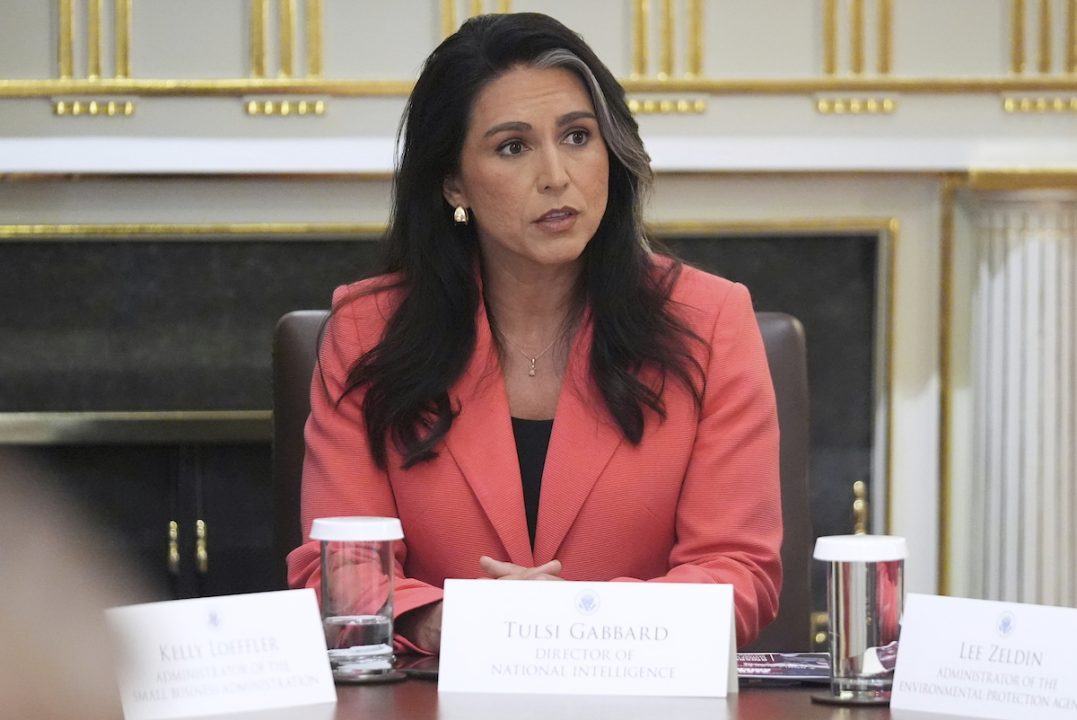
President Trump not only ignored Vice President JD Vance in ordering an attack on Iran in February but also his top intelligence official, former Director of National Intelligence Tulsi Gabbard, who warned the president toppling the Iranian regime was not possible.
Today’s report in The Wall Street Journal mirrors The New York Times’s account of Trump’s fatal mistake of listening to Prime Minister Benjamin Netanyahu’s preposterous claim that Iranians would rise and overthrow the regime once Trump attacked.
That didn’t happen. Now, the six-week war Trump promised is six months old and counting, with no end in sight.
Netanyahu’s “Farcical” Briefing
But in ordering the attack on February 26, Trump didn’t just ignore Vance. He also ignored Joint Chiefs Chairman Dan Caine, the Times reported in April.
Netanyahu and his team briefed Trump and other top officials in the Situation Room on February 11, “suggesting that Iran was ripe for regime change and expressing the belief that a joint U.S.-Israeli mission could finally bring an end to the Islamic Republic,” the Times reported.
The Israelis showed Trump a video in which they pushed the idea that exiled former Iranian Crown Prince Reza Pahlavi would take over Iran once the Islamic Republic fell, the Times continued:
Mr. Netanyahu and his team outlined conditions they portrayed as pointing to near-certain victory: Iran’s ballistic missile program could be destroyed in a few weeks. The regime would be so weakened that it could not choke off the Strait of Hormuz, and the likelihood that Iran would land blows against U.S. interests in neighboring countries was assessed as minimal.
Besides, Mossad’s intelligence indicated that street protests inside Iran would begin again and — with the impetus of the Israeli spy agency helping to foment riots and rebellion — an intense bombing campaign could foster the conditions for the Iranian opposition to overthrow the regime.
“Sounds good to me,” Trump said.
U.S. intelligence analysts called the Israeli presentation “farcical,” while Secretary of State Marco Rubio called it “bullsh*t.”
Joint Chiefs Chairman Dan Caine told Trump that the Israelis “oversell.” And he gave Trump the “alarming military assessment that a major campaign against Iran would drastically deplete stockpiles of American weaponry, including missile interceptors, whose supply had been strained after years of support for Ukraine and Israel,” the Times continued. Caine “saw no clear path to quickly replenishing these stockpiles.”
Vance was most worried about an attack, the newspaper divulged. He thought the war would be “massively expensive” and “a huge distraction of resources.” But Vance knew the mulish president wouldn’t listen to him, and so advised “overwhelming force, in the hope of achieving his objectives quickly,” the Times revealed:
In front of his colleagues, Mr. Vance warned Mr. Trump that a war against Iran could cause regional chaos and untold numbers of casualties. It could also break apart Mr. Trump’s political coalition and would be seen as a betrayal by many voters who had bought into the promise of no new wars.
Mr. Vance raised other concerns, too. As vice president, he was aware of the scope of America’s munitions problem. A war against a regime with enormous will for survival could leave the United States in a far worse position to fight conflicts for some years.
Gabbard Says No
The Journal’s report reinforces that Times account. Trump’s most sober America First advisors opposed the war. They warned that it would end in disaster.
Before launching the attack, Trump “summoned” Gabbard for her assessment, the newspaper reported. Would a major strike topple the regime, as Netanyahu as the Israelis said it would?
“Gabbard outlined assessments from America’s intelligence apparatus,” the Journal reported:
According to people familiar with the meeting, she told Trump that killing Iran’s supreme leader would likely usher in a more hard-line regime open to acquiring nuclear weapons. Tehran would rush to close the Strait of Hormuz, destabilizing the global energy market. And it would strike U.S. forces and partners in the Middle East, prompting questions about American resolve and reliability with allies.
The notes of caution echoed warnings Trump was receiving from all corners. Top military leaders told the president that a war would lead to casualties, concerns about the weapons stockpile and readiness problems for an overstretched force.
Again, intelligence analysts called Netanyahu’s rosy predictions of regime change “farcical.”
Dancing to Netanyahu’s tune, on February 26, Trump ordered U.S. forces to hit Iran two days later and laughably “urged Iranians to overthrow their government.” That didn’t happen.
The Iranian regime remains in power and “show no signs of capitulating,” the newspaper noted:
The deadlock has led Trump to consider declaring victory if the waterway opens, even without a nuclear deal.
Now Trump is relying on sanctions and a perpetual blockade wearing down U.S. forces to crush Iran’s economy, a wait-and-see strategy he argues will send the regime crawling to his feet.
One result of Trump’s ignoring Vance and Gabbard and bending to Israel’s wishes is what Caine and Vance predicted. The war has stripped the United States of its military muscles.
Citing official sources, Reuters disclosed early this month that the war against Iran had depleted “virtually all” of the Army’s long-range missiles that cost $1 million each. And those sources fear “that the falling missile supplies could limit the U.S. ability to deter adversaries, including Russia and China.”
In May, as The New American reported, the Center for Strategic and International Studies warned that restocking the inventory of U.S. ordinance wasted on Iran will require months and even years.