Alan Greenspan, Former Federal Reserve Chairman, Dies at 100
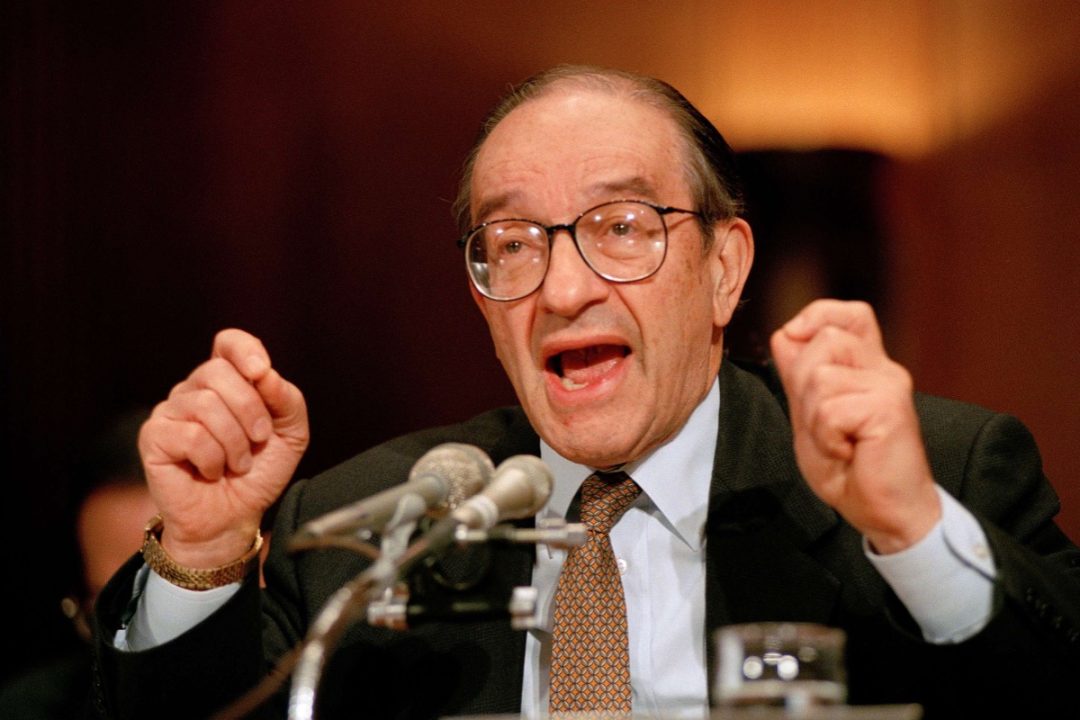
Alan Greenspan, the economist who served as chairman of the U.S. Federal Reserve for nearly two decades under four presidents, died on June 22 at his home in Washington, D.C. He was 100 years old.
One of the most influential men of the late 20th century, he passed away at the same age as fellow power broker Henry Kissinger, who was 100 when he died in 2023.
Greenspan was born March 6, 1926, in New York City. He studied at New York University and Columbia University, earning a Ph.D. in economics. He founded Townsend-Greenspan & Co., an economic consulting firm, and briefly chaired the Council of Economic Advisers under President Gerald Ford.
Role at the Federal Reserve
President Ronald Reagan appointed Greenspan as Federal Reserve chairman in 1987. He was reappointed by Presidents George H.W. Bush, Bill Clinton (for an unprecedented third term), and George W. Bush, serving until 2006. His long tenure coincided with significant economic events, including the 1987 stock market crash, the dot-com bubble, the September 11 attacks, and a period known as the “Great Moderation.”
Nicknamed “the Maestro,” Greenspan is remembered in mainstream eulogies as an advocate of deregulation and free-market principles.
His actual track record is a far cry from those descriptives. In fact, the Greenspan era illustrates a problem far older than Greenspan himself: the Federal Reserve. Created by Congress in 1913 in direct contradiction to the Constitution’s assignment of monetary authority, the Fed operates as a private banking cartel with the power to expand or contract the money supply and manipulate interest rates, thereby transferring wealth from ordinary savers and wage-earners to the financial system, all without democratic accountability of any kind.
The outcome? Patrick Creadon’s 2008 documentary I.O.U.S.A. featured a clip of former Texas Republican Congressman Ron Paul, a physician by trade, telling Greenspan that if a doctor had the same success rate in meeting goals as did the Fed, his patients would die.
Greenspan knew the truth of Paul’s remark. In his 1967 article “Gold and Economic Freedom,” he wrote:
In the absence of the gold standard, there is no way to protect savings from confiscation through inflation. There is no safe store of value. If there were, the government would have to make its holding illegal, as was done in the case of gold….
The financial policy of the welfare state requires that there be no way for the owners of wealth to protect themselves.
This is the shabby secret of the welfare statists’ tirades against gold. Deficit spending is simply a scheme for the confiscation of wealth.
Gold stands in the way of this insidious process. It stands as a protector of property rights. If one grasps this, one has no difficulty in understanding the statists’ antagonism toward the gold standard.
Yet he unflinchingly went along with the steal. In 2004 testimony before Congress, Ron Paul elicited a resounding admission from Greenspan regarding the Fed’s destructive fiat currency (not backed by a commodity such as gold):
Dr. Paul: Maybe there is too much power in the hands of those who control monetary policy, the power to create the financial bubbles, the power to maybe bring the bubble about, the power to change the value of the stock market within minutes? That to me is just an ominous power and challenges the whole concept of freedom and liberty and sound money.
Mr. Greenspan: Congressman, as I have said to you before, the problem you are alluding to is the conversion of a commodity standard to fiat money. We have statutorily gone onto a fiat money standard, and as a consequence of that it is inevitable that the authority, which is the producer of the money supply, will have inordinate power.
“Purposeful Obfuscation”
In a show of that inordinate power and “statist” confiscation of wealth, Greenspan answered a query in 2011 on NBC’s Meet the Press about a downgrade in Standard & Poor’s U.S. bond rating. His solution was simply to print more fiat currency. “This is not an issue of credit rating,” he noted. “The United States can pay any debt it has because we can always print money to do that. So there is zero probability of default.”
But he was not always so forthright. In fact, he became famous for an opaque communication style dubbed “Fedspeak,” bragging twice in 2007 (on CNBC and CBS) of his habit of “purposeful obfuscation” while testifying to Congress under oath.
Writing of Greenspan’s professional legacy in 2010, John Stossel of Fox Business Network recounted his “relentless expansion of the money supply and lowering of interest rates that set in motion the housing bubble that burst in 2007.” Millions of American families lost their homes, retirement savings, and economic security as a direct consequence of the monetary policies and regulatory philosophy Greenspan championed.