A Capital Under Arms: Trump’s Arch and the Militarization of Washington
Washington has always liked monuments. Lately, however, it seems equally interested in bunkers, drones, snipers, and troops.
Which raises a rather basic question: What exactly is the capital preparing for?
On Sunday, President Donald Trump announced,
I have agreed to convert the magnificent Triumphal Arch … into a top grade Military Complex/Triumphal Arch, to house, store, and have the rapid ability to use large numbers of drones, plus Snipers, on both the roof and plaza areas, and additionally have and hold large quantities of sniper ammunition in storage.
Trump said the transformation came at the “strong request” of the U.S. military and was necessary for national security. The Pentagon, however, offered no further explanation beyond the president’s announcement.
From Civic Monument to Armed Outpost
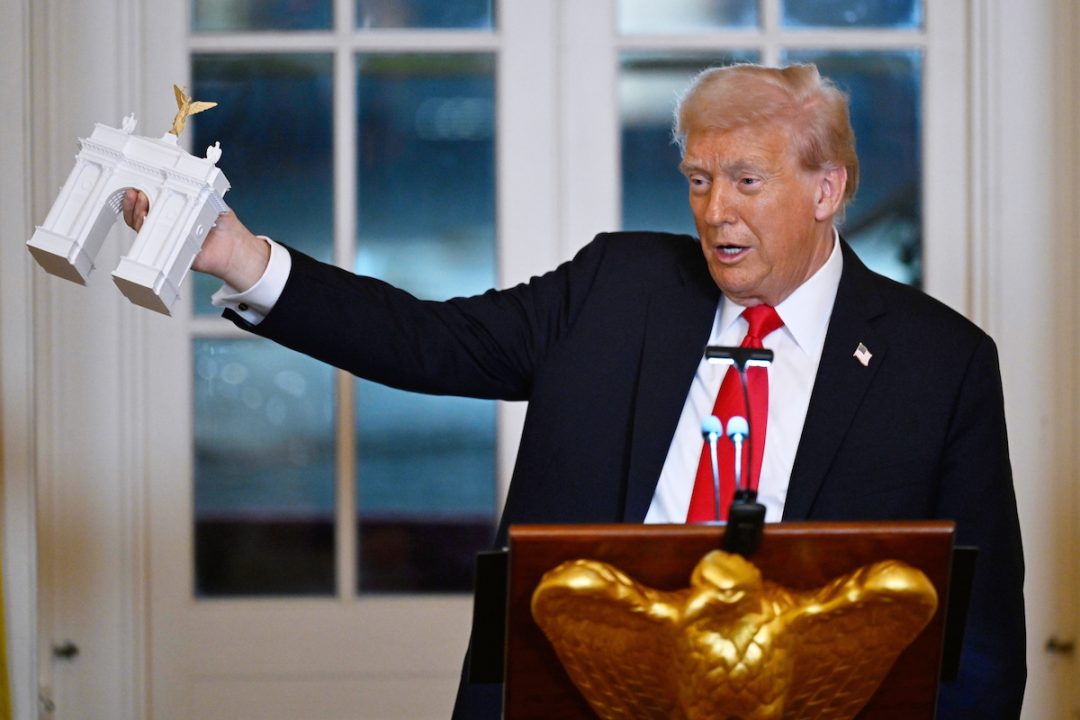
Trump first publicly unveiled the idea in October 2025, displaying models of an “Independence Arch” and presenting it as a monumental addition to Washington ahead of America’s 250th anniversary.
Asked who the arch was for, Trump replied, “Me.”
Trump had hoped to break ground by July 4. That deadline passed as the project moved through federal planning and historic preservation reviews.
The National Park Service (NPS) describes the project in distinctly civic terms. It says the arch would be a “signature monumental structure … contributing to Washington, D.C.s tradition of honoring national principles.”
Located at the intersection of Arlington Memorial Bridge and Memorial Avenue within the George Washington Memorial Parkway, the arch would be “consistent with the avenue’s established role as a ceremonial gateway and ‘Avenue of Heroes’ celebrating valor, sacrifice, and American heritage,” per the NPS.
Official plans depict a monumental granite-clad structure crowned by a central winged figure and two eagles. The main architectural body would rise about 166 feet, while the statuary would bring the total height to roughly 250 feet. The arch would also contain five levels, including gallery space and an observation deck nearly 162 feet above ground.
The renderings remain illustrative and may not reflect the final design.
The scale has created complications even within the government’s own review process.
The NPS concluded that it would have an “adverse effect” on historic properties. The structure could also alter important “character-defining views” around the National Mall, Memorial Bridge, and Arlington National Cemetery.
The project also faces a legal challenge. Three Vietnam veterans and an architectural historian argue that the administration lacks congressional authority to build it on the site. A federal judge has required the government to provide at least 48 hours’ notice before beginning construction-related work.
All of that preceded the latest transformation.
A Fortress Beside an Airport
The location makes the new proposal especially unusual.
Memorial Circle sits near some of the most sensitive airspace in the country. Ronald Reagan Washington National Airport (DCA) lies nearby. Aircraft routinely pass close to the proposed site.
Last week, the Federal Aviation Administration (FAA) concluded that the 250-foot structure itself would not pose a hazard if planners added visibility measures, including an “eternal flame.” That determination concerned the monument. It came before Trump publicly announced plans for a drone facility there.
Representative Don Beyer, a Virginia Democrat whose district includes the area, called the drone proposal “stupid, dangerous, and unworkable.” He argued that launching drones near the airport could create new aviation risks.
Earlier this month, Beyer attacked the project on several other grounds. He said the administration had failed to address warnings about regional traffic, emergency access, and environmental impacts. He also cited the Park Service’s finding that the arch would adversely affect dozens of historic sites.
Military analysts have also questioned the need.
Mark Cancian, a retired Marine colonel and senior advisor at the Center for Strategic and International Studies, noted that Joint Base Myer-Henderson Hall sits about one mile away. The Pentagon is about two miles away. He told Reuters that the rationale for adding another military installation at Memorial Circle remained unclear.
The administration has not identified a specific threat that requires sniper positions or ammunition storage at the arch.
The Ballroom
The arch is not the first ceremonial project to acquire a military mission.
When the White House announced its ballroom in July 2025, it presented the project as a grand venue for state dinners and diplomatic receptions.
As we reported in May, Trump then described it as a hardened military complex, with underground facilities, sniper positions, and a rooftop “drone port” for “unlimited drones.”
The project also faced a legal challenge over the administration’s authority to proceed without congressional approval. On August 31, the Supreme Court allowed construction to continue in a 5-4 ruling focused largely on standing.
The parallel is notable. Both projects began as ceremonial showpieces. Both later acquired explicit military functions while facing legal resistance.
Washington Fortifies
Washington, D.C., already has a sustained military presence on its streets. Trump first deployed the National Guard to the District in August 2025 after declaring a crime emergency. The Pentagon has since extended the mission through January 20, 2029, unless the president ends it sooner.
And now, Washington is gaining hardened underground facilities and rooftop drone infrastructure.
That buildup comes at a moment of deep public frustration with the government itself. Trump’s approval has fallen to 32 percent, while only 17 percent approve of his handling of the cost of living. At the same time, Americans are facing worsening economic pressures. Real hourly wages have fallen over the past year, consumer sentiment has plunged, borrowing costs remain high, and housing and fuel remain painfully expensive. Meanwhile, the costly and unconstitutional war against Iran is approaching its seventh month.
The anger runs deeper than one administration. Seventy-two percent of Americans say that “there is too much money in American politics,” including large majorities in both parties. Voters also are growing more unhappy with the influence of powerful foreign-interest lobbies, primarily AIPAC and similar pro-Israel groups.
In other words, Washington is fortifying itself just as more Americans are struggling and questioning whose interests their government actually serves.
Against that backdrop, the accelerating militarization of the capital raises an uncomfortable question: Who, exactly, is all this high-tech security meant to protect against?