

Florida Locks Illegal Aliens Out of Public Higher Education
Florida’s State University System Board of Governors voted unanimously on September 3 to bar people in the country illegally from enrolling at any of the state’s 12 public universities, effective with the 2027-2028 academic year. The new rule states that any person “who is present in the United States unlawfully” will no longer be eligible for admission. It applies only to new applicants; current students already enrolled will not be affected. The measure passed without discussion as part of the board’s consent agenda, following a 15-minute public comment period at Florida Gulf Coast University in Fort Myers.
The university ban is the second half of a coordinated policy push. It follows a nearly identical rule the Florida Board of Education adopted in June to bar undocumented students from the state’s 24 public colleges and GED programs. Together, the two rules close off Florida’s entire public postsecondary system to foreigners trying to benefit from a crime.
Notably, this policy shift did not come from the state’s Legislature. Republican lawmakers introduced bills during the 2026 regular session to impose similar restrictions statewide, but those measures stalled and died in committee. Unable to secure a legislative majority, Governor Ron DeSantis’ appointees on the Board of Governors and Board of Education adopted the policy administratively instead. State Representative Robin Bartleman and open-borders advocacy groups have argued that this amounts to the executive branch enacting through regulation what elected lawmakers declined to pass — a separation-of-powers objection that Florida’s Republican-led Joint Administrative Procedures Committee would have to act on to have any practical effect. However, the Legislature did repeal a 2014 law last year that had granted illegal students and DACA recipients in-state tuition rates.
Lieutenant Governor Jay Collins defended the rule as “common sense,” writing that “Florida’s public universities are for students who are here legally. Period…. Florida taxpayers should not be expected to subsidize opportunities for people who broke our laws to come here.”
The State University System, which enrolls more than 430,000 students across its 12 institutions, does not currently track which of them lack legal immigration status. In fall 2025, the University of Florida reported nearly 4,800 “non-resident alien” students, a category that included international students on visas and did not specify how many were in the country illegally. Statewide, Florida is home to an estimated 1.2 million foreigners in the country illegally, roughly five percent of the state’s population, according to Pew Research Center estimates. How universities intend to verify legal status at the point of admission remains an open question. — Rebecca Terrell

DOJ: Handgun Ban for 18-20-year-olds Is Unconstitutional, Unenforceable
In a small victory for the Second Amendment to the U.S. Constitution, the U.S. Department of Justice (DOJ) released a memo last week declaring that a federal ban on selling handguns to 18-20-year-olds is unconstitutional and unenforceable.
Since the enactment of the Omnibus Crime Control and Safe Streets Act of 1968, federal law has prohibited federally licensed firearms dealers from selling handguns to adults younger than 21. The DOJ’s September 18 memo, authored by Assistant Attorney General T. Elliot Gaiser, who leads the Office of Legal Counsel, declared that “[18 U.S.C.] sections 922(b)(1) and (c)(1) are presumptively unconstitutional.”
The memo further concluded that “Section[s] 922(b)(1) and (c)(1) may not be enforced to impose criminal penalties on dealers who sell handguns to a class of law-abiding adults who, in nearly every other relevant respect, are members of the political community.”
In a separate statement, Gaiser noted that “eighteen-year-olds may vote, serve on juries, be drafted, and face adult criminal penalties, including capital punishment,” and highlighted how the federal statute violates the Second Amendment.
In a September 18 email statement, Gun Owners of America celebrated the DOJ’s memo as “a huge win for the Second Amendment,” and noted that “millions of law-abiding Americans are denied access to their Second Amendment rights by this unconstitutional ban.” The pro-Second Amendment Firearms Policy Coalition approved of the memo, but urged the DOJ to widen its scope to cover ammunition. Not surprisingly, pro-gun-control organizations condemned the memo.
The DOJ is correct that the federal handgun ban for 18-20-year-olds is unconstitutional. In addition to blatantly violating the Second Amendment’s declaration that “the right of the people to keep and bear Arms, shall not be infringed,” the constitutional state militia — the focus of the first part of the Second Amendment — undoubtedly includes 18-20-year-olds.
Furthermore, the federal ban violates the U.S. Constitution’s enumerated powers. Nowhere in Article I, Section 8 is Congress given the power to regulate the possession or sale of handguns — or any firearms, for that matter. As James Madison noted in The Federalist, No. 45, the federal government’s powers granted by the Constitution are “few and defined.” In other words, even if the Second Amendment were repealed, the federal government would have no constitutional authority to enact gun control.
The DOJ’s memo is a good first step toward pushing back against federal gun control — and the agency can and should press on toward constitutional adherence. — Peter Rykowski
Secret U.S. Court Gets Its First Case and Its First Deportation
For three decades, the Alien Terrorist Removal Court (ATRC, created by Congress in 1996) sat on the books but never once convened. This summer, the Trump administration activated it for the first time and used it to deport a lawful permanent resident without ever showing her or her attorneys the classified evidence against her.

The case involved Nazira Haji Zada, 47, an Afghan-born woman living in Fort Worth, Texas. The Justice Department alleged she was the “matriarch” of a family tied to a foiled 2024 Election Day terror plot. Her son, Abdullah Haji Zada, and son-in-law, Nasir Ahmad Tawhedi, were arrested in October 2024 after purchasing two AK-47-style rifles and 500 rounds of ammunition from an undercover FBI agent, allegedly intending an ISIS-inspired mass shooting. Both men later pleaded guilty in federal criminal court in Oklahoma. Abdullah, who was 17 at the time of his arrest but charged as an adult, was sentenced to the statutory maximum of 15 years. An unclassified FBI summary alleged that Nazira “supported [the] conspiracy,” “pledged loyalty to ISIS,” and “worked to indoctrinate her children with ISIS ideology.”
What makes her case unusual is not the allegation, but the forum. Rather than charging her criminally or processing her through the ordinary immigration-court system, the Justice Department filed the first-ever case before the ATRC, a specialized tribunal Congress created specifically to let the government use classified evidence to deport suspected terrorists without disclosing that evidence in open court, on the assumption that public disclosure would threaten national security. Acting Attorney General Todd Blanche framed the move as fulfilling the court’s original purpose: “Congress created the Alien Terrorist Removal Court three decades ago to remove from the United States alien terrorists who never should have been here in the first place.”
Haji Zada’s court-appointed attorneys, Matthew Farley and Mary Manning Petras, initially signaled they would fight the case, arguing that the tribunal’s secretive procedures violated due process and other constitutional protections and that they themselves were not permitted to review the evidence being used against their client. Last month, however, Haji Zada and the government reached an agreement: Rather than continuing litigating, she consented to removal and was deported to Afghanistan. Her attorneys emphasized that this should not be read as validation of the court’s legitimacy, though. “Dragging lawful permanent residents into court but refusing to show them or their attorneys the evidence that will be used against them is a plain violation of due process,” they said in a statement.
The United States may be harking back to an older established pattern. In 1919, the government deported anarchist agitator and naturalized citizen Emma Goldman, putting her aboard the USS Buford, nicknamed the “Soviet Ark,” along with roughly 249 other radicals rounded up in the Palmer Raids under the era’s anarchist-exclusion laws. The government rationalized that foreign-born agitators whose political loyalties lay with a hostile ideology abroad, rather than with the United States, had no claim to remain.
Because the modern case of Nazira Haji Zada ended in a negotiated agreement rather than a full hearing, the core constitutional issues have not been resolved. Chief ATRC Judge Joan Ericksen did not take additional steps to scrutinize the government’s arguments after granting initial approval for the case to proceed — meaning that it is not clear whether the United States will revert to its age-old habit of forcibly removing foreign-born agitators, or if another court will rule on the side of the late-20th century’s normalization of divided loyalties. — Rebecca Terrell
Far-left German Party Wins Berlin State Elections, Promises to Seize Private Housing
A far-left German political party that is attempting to forcibly seize privately owned housing won Berlin’s state elections on Sunday.
The party, aptly called the Left Party, won 25 percent of the popular vote (up from 12 percent in 2023) and 47 seats in the 158-seat Berlin House of Representatives. As the largest party in the chamber, it has a strong chance of leading the city-state’s next government. Combined with the Social Democratic Party (SPD) and the Green Party, leftist parties retain a majority in the chamber.
The Left Party is directly descended from the Socialist Unity Party that ruled communist East Germany during the Cold War.

The conservative Alternative for Germany (AfD) party also made gains — mirroring its results elsewhere in Germany — rising to 16 percent of the popular vote from nine percent in 2023. However, leftist parties perform more strongly in Berlin than most other German states. The city currently has a coalition government made up of the moderately “conservative” Christian Democratic Union and the SPD.
The Left Party campaigned on nationalizing housing and forcibly seizing rental properties from their private owners. Leading up to the election, lead candidate Elif Eralp said that “the housing issue is the central social issue facing our city, and … I will pull out all the stops to make Berlin affordable again and lower rents.” Politico noted that “the party has taken inspiration from New York City Mayor Zohran Mamdani” in its emphasis on socialist housing policies. Eralp doubled down on her party’s proposal following the election, and coalition negotiations are still underway.
The Left Party is not the only party pushing for nationalized housing. Politico reports:
Nearly 60 percent of voters backed expropriating properties from major real estate companies in a 2021 referendum. The organization that initiated that referendum estimates that the city could forcibly buy as many as 220,000 apartments for up to 60 percent of their market value — amounting to a total of €18 billion.
The Green Party also supports seizing privately owned housing, giving pro-nationalization parties a near-majority in the Berlin House of Representatives.
Provisions of Germany’s constitution appear to allow the Left Party to enact its radical proposal. For example, Article 15 of the German Constitution declares that “land, natural resources, and the means of production may … be transferred to public ownership or other forms of public enterprise.”
The Left Party’s victory reveals the Establishment’s true leanings. Although the media and political elites hysterically oppose the conservative, pro-national-sovereignty AfD — and have even sought to ban the party outright — they largely overlook a communist-descended party that advocates policies far more extreme.
The elections also demonstrate the importance of having a constitution that limits government and protects God-given rights. As the U.S. Declaration of Independence proclaims, “all men … are endowed by their Creator with certain unalienable Rights,” and government exists “to secure these rights.” The U.S. Constitution — if properly interpreted and enforced — upholds the purpose of government. To truly support limited government, Germany’s constitution must be brought into alignment with those principles. — Peter Rykowski
What SoftBank’s $11.87 Billion Bet Reveals About the Migration of Power
SoftBank Group secured an $11.87 billion, two-year loan last week to fund its ongoing investment in OpenAI, nearly 19 percent above its original $10 billion target, with roughly 20 banks competing to get a piece of the facility. It is only the latest installment in an extraordinary financing campaign — and a signal of a much larger power transition.
Here’s the background. In her 2002 book Technological Revolutions and Financial Capital, economist Carlota Perez documented a recurring pattern: Each great technological wave (canals, railways, steel and electricity, mass production, and now information technology) begins with productive, industrial capital in the driver’s seat, then shifts control toward financial capital as speculative investors take over the “installation period,” pouring money into infrastructure long before it proves profitable. This matches a broader historical arc many economic historians have traced: The Industrial Revolution elevated a new class of people — industrialists who owned factories, railways, and steel mills — who gradually displaced the landed aristocracy as the dominant economic (and eventually political) class. By the 20th century, that industrial elite was itself being increasingly supplanted by financiers, as financial capital eclipsed productive capital.

SoftBank’s OpenAI financing looks like the leading edge of a third transition. It isn’t industrialists building factories, and it isn’t traditional financiers allocating capital toward industrial production. It is debt-fueled capital flowing directly into a small cluster of Silicon Valley firms that are quietly building a technocracy. In other words, a new power elite is coalescing.
This shift runs alongside a parallel transformation in the nature of money itself. In Das Kapital, Karl Marx devotes a section of his third chapter to money’s function as “the medium of circulation.” Money, in Marx’s analysis, is not a natural object but a social medium — something that has no purpose on a desert island, but is given significance due to its context in a larger civilization. Money’s power exists entirely in its social use.
That linguistic overlap between money as a social medium and modern social media is not as far-fetched as it at first sounds. Elon Musk’s X Money, which began public rollout in 2026, is explicitly about the ambition: Musk has said for years he wants X to become a Western version of WeChat, the Chinese “everything app” that already fuses messaging, social media, and payments for more than a billion users. X Money now offers FDIC-insured deposits, a Visa debit card, and peer-to-peer payments built directly into what was once just a social-media platform. And it has formally partnered with Visa to enable real-time payments, positioning itself as a direct competitor to Venmo and Zelle. If money is, per Marx’s own framework, a social medium, then a literal social-media platform absorbing the payment function is a natural partnership.
So history has witnessed productive capital’s rise with the industrialists, financial capital’s ascendance with the 20th-century bankers, and now a third phase in which technology firms (controlling both the infrastructure of artificial intelligence and, increasingly, the paths money takes) are pulling power toward Silicon Valley. SoftBank’s willingness to borrow nearly $12 billion on faith in one AI company’s future is a small, concrete signal of just how far that migration has already traveled. — Rebecca Terrell
Trump Denounces UN at Annual Address, but Claims It Has “Great Potential”
During his Tuesday address at the 81st session of the United Nations General Assembly, President Donald Trump strongly denounced the UN and its various globalist initiatives, but simultaneously claimed the global bloc has “great potential.”
During the address, which covered several other topics, most notably the war in Iran, Trump declared that under his presidency, there would be “no global government” and “no global taxes.” He denounced the UN’s International Maritime Organization for attempting to impose “a first-ever global carbon tax,” the International Criminal Court for attempting to investigate U.S. service members, and the UN Human Rights Council for criticizing the United States for anti-“transgender” laws while turning a blind eye to the persecution of Christians globally.
Trump did not stop there. He also denounced the UN — particularly the United Nations Educational, Scientific and Cultural Organization — for supporting mass migration, declaring that “there is no human right to illegal immigration, but there is a right to remain a sovereign nation.” And finally, he declared that the United States “totally rejects any attempt to construct a globalist scheme to control … artificial intelligence.”
In these statements, Trump echoed many of the warnings that The John Birch Society, the parent organization of The New American, has made over the years of the UN’s threat to American sovereignty. If Trump had merely stuck to those statements, his speech — or that portion of it — would have been very positive.
However, Trump also made clear his desire to “reform” the UN instead of exiting it outright. For example, he declared that “the United Nations has great, great potential,” and commended U.S. Ambassador to the UN Mike Waltz for working “to implement the most sweeping UN reforms in history.”
Trump’s statements mirror an overarching theme during his second presidency. On one hand, his administration has strongly opposed many UN agencies and initiatives. For example, the president signed a proclamation in January initiating U.S. withdrawal from nearly 70 international organizations, including the UN Framework Convention on Climate Change, and his administration formally denounced the UN’s 2030 Agenda for Sustainable Development.
On the other hand, both Trump and several of his appointees have openly supported U.S. membership in the UN, and have advocated “reforming” the global body. This emphasis on “reform” is misguided, since the UN’s fundamental purpose is to lay the framework for a full-fledged one-world government — and, along the way, counter and undermine U.S. national interests.
Instead of trying to “reform” the UN, the United States must get out of it entirely. Legislation to do this — H.R. 1498 and S. 669, titled the DEFUND Act — has been introduced in the current Congress. Our members of Congress — and even our state officials — must act before it’s too late. — Peter Rykowski
A Presidential Taboo Broken, and Three Irish Nationalist Leaders Move
For nearly three decades, American presidents have treated the constitutional status of Northern Ireland as untouchable — the “third rail” of British politics that Washington helped defuse but has since studiously avoided touching again. Then-President Bill Clinton played a central role in brokering the 1998 Good Friday Agreement, which ended 30 years of violent conflict known as the Troubles by establishing that Northern Ireland remains part of the United Kingdom unless voters there, and separately in the Republic of Ireland, choose otherwise. Since then, the unwritten rule for U.S. presidents has been neutrality: Encourage peace, praise the agreement, and say nothing about which way the constitutional question should ultimately go.
Donald Trump broke that pattern recently. Appearing alongside Prime Minister Micheál Martin in Dublin, Trump was asked directly about Irish reunification and did not hedge. “I don’t want to cause any problems, but I will tell you, I’d love to see it unified,” he said. “It’s going to happen eventually…. I think it would be a fantastic thing.” Asked about the U.K.’s likely objections, he added, “The U.K. will have something to say about it obviously, but I think it would be a great thing, I mean, how can it be bad?” He repeated the sentiment Sunday, calling a united Ireland “one of the naturals of all time.”

The reaction split along predictable lines. Sinn Féin president Mary Lou McDonald said Trump’s remarks showed that the debate had shifted and called on the Irish government to begin actively preparing for reunification. Democratic Unionist Party leader Gavin Robinson countered that Northern Ireland’s future would be decided by its own people, “not by commentary in London, Dublin or Washington.” Downing Street quickly reaffirmed that British Prime Minister Andy Burnham’s position is unchanged: A border poll remains “off the table,” with no current evidence of majority support in Northern Ireland for leaving the U.K.
That reassurance from London was tested on September 14, when an unprecedented political alignment convened in Cardiff. John Swinney (Scottish National Party, First Minister of Scotland), Rhun ap Iorwerth (Plaid Cymru party, First Minister of Wales), and Michelle O’Neill (Sinn Féin, First Minister of Northern Ireland) met at St David’s Hotel in Cardiff Bay, joined by Sinn Féin president McDonald. Notably, all three attended in their capacity as party leaders rather than as heads of government — a distinction meant to keep the declaration separate from official state policy while still carrying the weight of each nation’s most senior elected figure.
The party leaders held a joint press conference following the meeting, announcing that “Westminster’s time is coming to an end” and issuing a memorandum asserting that no central U.K. government has the right to “block democracy.” They called for independence, formally demanding that Westminster’s Parliament “prepare, plan, and facilitate constitutional change.” Ironically, they also called for re-entry into the European Union.
Irish Prime Minister Martin criticized the memorandum, calling it a tactical error that could “set back Irish unity” by alienating voters. Welsh conservatives and others said the three had “no mandate for independence.” — Rebecca Terrell
The Inspection House
Jeremy Bentham drew it in 1791. A ring of cells around a central tower. The inmate cannot see the watchman, so he must assume the watchman sees him. Bentham advertised his Panopticon as a new mode of obtaining power of mind over mind. He offered it as a prison. Washington has adopted it as a philosophy of government.
The men who wrote our Constitution had already met this beast. It wore the livery of the Crown and carried a writ of assistance, a general warrant permitting the king’s agents to rummage through any Colonist’s house, papers, and person on suspicion, on whim, on nothing at all. James Otis argued against those writs for five hours in a Boston courtroom in 1761. John Adams, a young man in the gallery taking notes, later wrote that then and there the child Independence was born.
That child was swaddled in the Fourth Amendment. Read it. It does not say that your papers may be seized if a secret court nods. It does not say that your life loses its protection because you entrusted a record of it to a third party. It secures the people in their persons, houses, papers, and effects, and it demands a warrant, sworn on oath, naming the particular place and the particular thing to be searched. Particularity was the whole point. Generality was the tyranny.

Today the tower fits in your pocket. Your phone reports your whereabouts to firms that sell what the government is forbidden to seize, and the government buys it, calling the purchase a loophole rather than a crime. Automated license-plate readers log the movements of drivers who have committed no offense and warehouse those movements for years. Facial recognition turns a crowd into a lineup that never consented to stand in one. Fusion centers stitch the whole quilt together. Section 702 vacuums up the communications of Americans as incidental catch, and the catch is queried, without a warrant, by the very officers the Fourth Amendment identifies as the danger.
When the courts are petitioned to intervene, they explain that you abandoned your privacy the moment you dialed a telephone. The third-party doctrine is not law. It is a judicial confession, an admission that the bench has become a gloss on the text rather than a guardian of it.
Understand what this apparatus actually manufactures, because it is not safety. It is the habit of self-command. The man who suspects he is watched edits his letters. He softens his sermon. He does not sign the petition, does not attend the meeting, does not say aloud the thing he knows to be true. Tacitus described a Rome in which men learned to police their own faces. The informer did not have to be in the room. The possibility of the informer being present was sufficient.
That is Bentham’s genius, and Bentham’s crime. The Panopticon does not require a watchman. It requires only that you believe there is one. A free people cannot live inside such a building. Liberty is not merely the absence of chains. It is the absence of the assumption of the eye.
Do not beg for better oversight of the machine. Oversight ratifies the machine. Demand instead what the Framers demanded and what the text still commands: particular warrants, sworn on oath, or nothing at all. Let the states refuse to feed the beast. Close the fusion centers. Forbid state and local agencies to purchase what the Constitution forbids them to seize. James Madison did not construct a government of enumerated powers so that a federal contractor could sell the difference back to it.
The watchman holds exactly as much power as your belief in his authority supplies him. Withdraw the belief. Then pull down the tower. — Joe Wolverton, II, J.D.
Majority Rejects EU’s Direction As Germany’s Economic Engine Sputters
A new poll has delivered what the German daily Die Welt called “a devastating testimony for Europe.” Nearly 70 percent of respondents across six countries rate the European Union negatively, describing a sense of “general decline or loss of normalcy.” The study, a joint project of the European Council on Foreign Relations and the European Cultural Foundation, found skepticism running highest in France, Germany, and Italy, the bloc’s three largest economies.
Nearly half the respondents could not name a single political figure they trusted to lead the EU forward. Top-cited anxieties were the war in Ukraine, the perceived threat of a wider war with Russia, and economic decline. More than 40 percent of Italians and 23 percent of Poles said they feared losing their prosperity. One young respondent described feeling “terribly ashamed” of what he saw as the EU’s capitulation in its 2025 tariff deal with the Trump administration, in which European tariffs on nearly all U.S. goods dropped to zero while the U.S. retained a 15-percent tariff on European exports.
That economic anxiety was on full display just weeks earlier, when European Commission President Ursula von der Leyen told a Paris business audience that roughly €10 trillion ($11 trillion) sitting in European household bank accounts was “idle” (“lazy,” in her original phrasing) and needed to be “put to work” for European companies. Her proposed vehicle, the “Savings and Investments Union,” would rely on securitization, expanded bank and insurance investment rules, and deeper market supervision to unlock what she estimated could be up to €470 billion (more than $500 billion) in additional investment. Commission officials insist participation would remain voluntary, but critics see Brussels eyeing private wealth to patch the holes left by a faltering industrial base and the loss of cheap energy.

Nowhere is that faltering base more consequential than in Germany, the EU’s largest economy and its traditional financial engine. On September 6, the Alternative for Germany (AfD) won an outright 43.8 percent of the vote in the Saxony-Anhalt state election — the first such win for a right-wing party in Germany since the founding of the Federal Republic in 1949 — as Chancellor Friedrich Merz’s Christian Democrats collapsed from 37.1 percent to 17.2 percent.
German industry has been squeezed by high energy costs, slow permitting, and a car-production decline of roughly four percent this year, pressures widely tied to the loss of cheap Russian pipeline gas after 2022. The AfD has floated leaving the EU outright if it gains sufficient national power. Its leader, Alice Weidel, said, “We will leave the European Union. We don’t need the EU. We will send back illegal immigrants, and increase border security.”
Can the EU survive the loss of its keystone? Only time will tell. — Rebecca Terrell
Canada to the EU?
With the USMCA (United States-Mexico-Canada Agreement) now on life support thanks to the increasingly rancorous trade war between the United States and Canada, it appears that Canada’s globalist leadership, helmed by Prime Minister Mark Carney, is looking at a new option for extending the European multilateral and globalist system to North America.
On September 16, European Commission President Ursula von der Leyen, delivering the EU’s “state of the union” address (with Carney in attendance), announced a proposal for Canada to become the EU’s first-ever “associate member.” The announcement came on the heels of remarks made the previous Sunday by Carney, in which he revealed that Canada was developing “a unique alliance with the European Union.” The media, of course, is portraying all of this as U.S. President Donald Trump’s fault, with The New York Times proclaiming, “Trump Wanted Canada as the 51st State. He Ended Up Pushing It Toward the European Union.”
While there may be a little truth to that, it is also a fact that Carney is a globalists’ globalist, dedicated to Canadian integration with the “global order” by any means possible. He is one of the most credentialed central bankers on the planet, having served as governor of both the Bank of England and the Bank of Canada (the only person ever to have done so). On his first trip abroad as prime minister, Carney told an audience in Paris last year that Canada was “the most European of non-European countries.” And in a keynote speech in Davos earlier this year, he decried the “rupture in the world order” and urged middle powers to pick up the slack and “build a new order.”
It is clear from last year’s Canadian elections that Mark Carney is the globalists’ handpicked agent to act as a foil for Trump’s America First, anti-globalist actions. With last week’s bombshell EU announcement, their investment in Carney appears to be paying off handsomely. While it isn’t entirely clear what an “associate membership” in the EU would entail, or how it would be brought about, Carney lost no time affirming his commitment to the proposal, delivering a stemwinder to the European Commission the following day in which he welcomed deeper integration with Europe. Canada, he told the Europeans, sought closer integration in finance, trade, AI and other tech, defense, critical minerals, and more. He received a standing ovation, and later clarified to reporters that he was re-aligning Canada with Europe because of the intransigence of, well, other countries:
We do not seek power to dominate others. On the contrary, we are pursuing resilience so that no one can control our open markets, impair our sovereignty, threaten our territorial integrity, or undermine our freedoms, our democracies, our rule of law.
No sooner had Carney committed Canada to EU associate membership than European Parliament President Roberta Metsola announced that Australia and New Zealand would also be welcome to pursue deeper affiliation with the EU.
Since there is currently no legal mechanism for “associate membership,” the EU would have to modify its bylaws, which would require the approval of all 27 member states. While such an action would not happen overnight, Eurocrats have a long track record of getting their way, by hook or by crook, when a critical globalist agenda item is at stake. So far, despite decades of popular opposition to its obvious collectivist and anti-West program, the only true setback the EU has suffered is Brexit — and that was drawn out for many years. All other Euroskeptic intransigence has been successfully steamrolled, and the project of assembling a Continent-wide socialist state has continued to advance.
As we have reported many times in The New American, regional government schemes are a globalist tool for simplifying and streamlining the project of world government. First corral the refractory nations of the world into regional government blocs, goes the globalist logic, and the consummation of world government becomes a straightforward merger of a few regional authorities rather than nearly 200 sovereign states. To this end, other such unions, patterned on the European Union, have been created and are in various stages of development. The African Union is probably the most advanced, but there are also the Andean Community and Mercosur blocs in South America, and of course the USMCA in North America. Prior to that, the North American Free Trade Agreement sought to grow into a “North American Union,” even as globalists tried to bring about a larger Western Hemispheric union, the Free Trade Area of the Americas, which eventually fell apart.
In short, efforts to replicate the EU in the Western Hemisphere have not been successful (from a globalist perspective), so the new tack appears to be trying to draw critical American countries into the EU web from overseas.

Earlier this year, Mercosur, the trade bloc that includes full members Argentina, Brazil, Uruguay, Paraguay, and Bolivia, as well as associated countries Chile, Ecuador, Panama, Colombia, Guyana, Peru, and Suriname, officially applied to create a free trade zone with the European Union, a momentous piece of news that attracted little attention thanks to the drama in the Middle East. With the announcement of Canada’s EU “associate membership,” it is becoming clear that the European Union intends to poach as many countries as it can from the Western Hemisphere, drawing them into its operational sphere as a means of implementing regional governance in the Americas with or without U.S. consent.
And of course, should Canada join the European Union in any capacity, it might become a vessel for EU-style unlimited migration from the Middle East and Africa into North America, a development that would be enormously consequential for the United States. Imagine Canada flooded with the same types of lawless, anti-West immigrants that have overwhelmed Europe, and consider the likelihood that many of them would then attempt to enter the United States across our largely unguarded northern border.
As for ordinary Canadians, a BBC article with carefully curated man-on-the-street interviews, mostly from the urban Toronto area, would have us believe that Canadians in general are giddy with anticipation at the prospect of being able to live and work in Europe visa-free. Canadians, the article suggests, are tired of what they view as a forced relationship with the United States, to the detriment of Europeans with whom they have a lot more in common.
The above is part of an article by Steve Bonta. To read the entire article at TheNewAmerican.com, click here.
NYMHM: News You May Have Missed
When Everything Becomes a National Security Threat
Trump’s Approval Numbers Worsen. Americans Don’t Like Policies on Iran, Economy, Inflation.
Daycare Teacher Babysits Low-tech, “No Screens” Kids; Learns a Scary Lesson
Trump Threatens to Annihilate Iran If It Doesn’t Capitulate, Agree to U.S. Terms
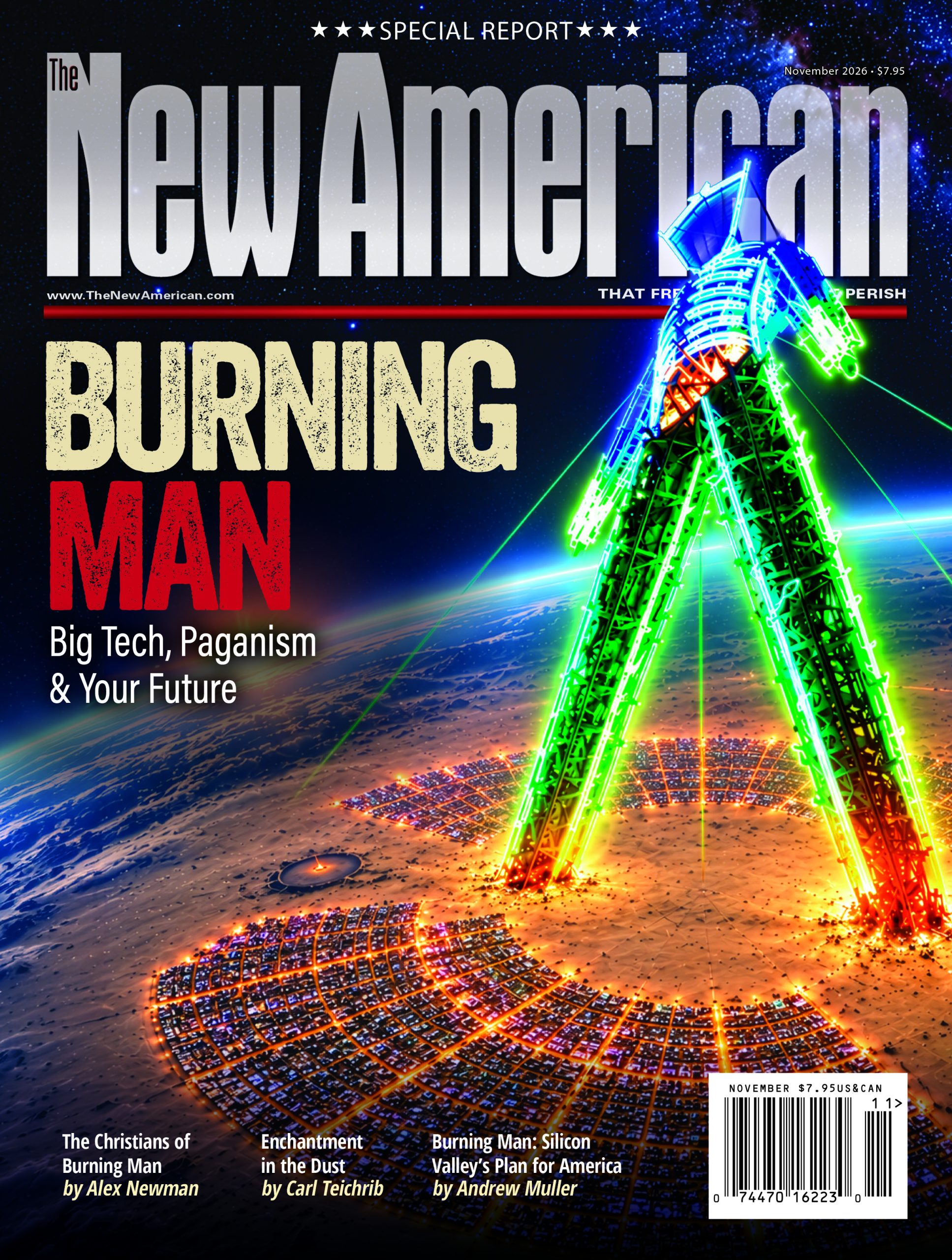
Burning Man & the New Age: Gospel Missionary Tells All
Inside Burning Man With Top Christian Researcher
A Capital Under Arms: Trump’s Arch and the Militarization of Washington
Trump TV Goes Live As White House Press Pool Goes Dark
Who Really Controls Government? Mel K Exposes the Post-WWII Deep State
Ukraine War Heats Up As British Media Tells People to Prepare for War With Russia
Re-educating America: Classical Schools and “Old Ideals” Can Bring New Success
CNN, MS Now, Politico Sue Trump to Overturn Ban From White House
Trump and U.S. House Protect Lead Ammunition and Fishing Tackle
Lindsay Clancy: One Hung Jury — One Hanged Jury System?
Video of 2016 GOP Debate Shows Trump Saying That Bush 43 Should Have Been Impeached for Iraq War
Massie Roasts Johnson for Recessing Ahead of Important Votes
Johnson Recesses House to Duck Hegseth Impeachment Vote
The Slow-boiled Frog: Creeping Tyranny Becomes Normal
Democrat Wants to Block Trump “Sale” of 40K Bombs to Israel
Fuel Skyrockets As Wars, Tight Refineries, and Record Diesel Profits Collide
The Constitution Can’t Protect You If You Don’t Protect It
[END]