

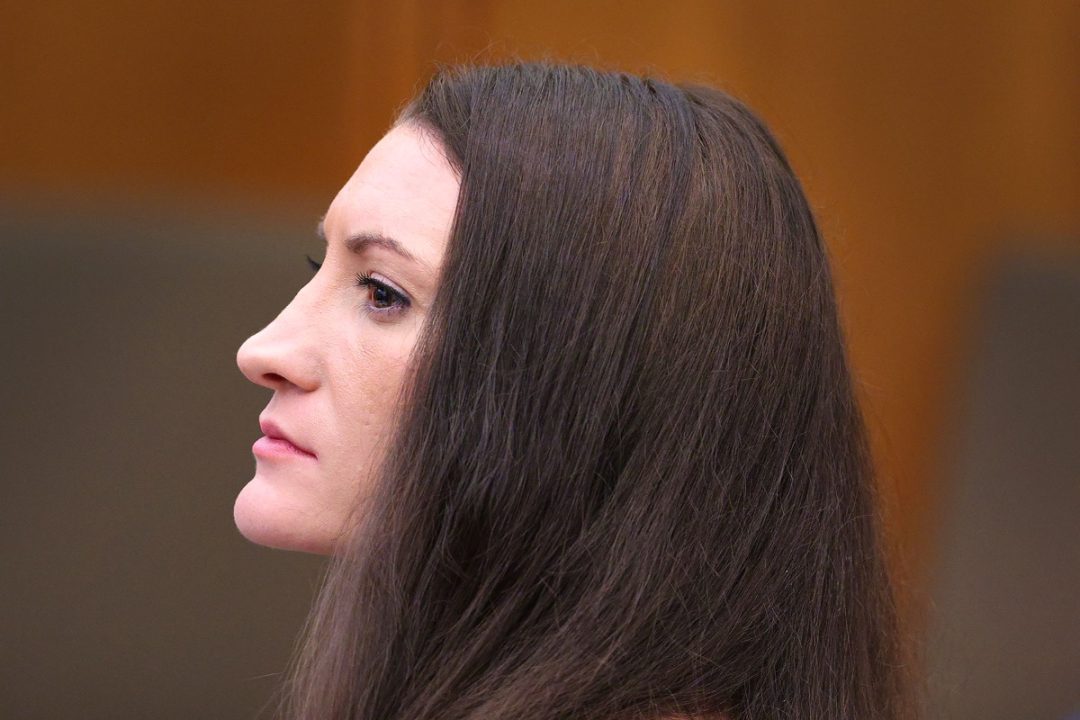
Lindsay Clancy: One Hung Jury — One Hanged Jury System?
In the legendary 1957 film 12 Angry Men, one holdout juror initially prevents a conviction in a murder trial. “Juror 8” (played by Henry Fonda) says he’s just not yet convinced of the defendant’s guilt. Through persuasion, reasoned analysis, and a little shaming, he leads an effort that eventually results in a not-guilty verdict. He’s a quiet hero.
This comes to mind with the Lindsay Clancy trial, even though the latter is not quite the same. In it, there also was one holdout juror, now identified as Michael P. Desronvil, 48, of Bridgewater, Massachusetts. There likely was prejudice influencing the proceedings, too. There additionally was an 11-1 split — though favoring “not criminally responsible” and at the trial’s end, not beginning. Most significantly, while Desronvil may qualify, we don’t know with certainty if there’s any hero in the Clancy story. We do know this, though:
There certainly are villains.
We needn’t know precisely what happened during jury deliberations to say this, either.
We can start with the jurors who, by incrementally providing information about Desronvil, enabled his “outing.” There’s also the media that reported on his background and an X account that ultimately disclosed his name. The result?
Desronvil was doxxed and endangered. He received threats and his house was watched. He had to retain an attorney and, with his wife, decamp to an undisclosed rural New England location for safety. Governor Ron DeSantis (R-Fla.), appreciating the danger to Desronvil, publicly offered him asylum in the Sunshine State. Yet apparently underappreciated is that what’s most seriously imperiled here isn’t a single man, but a system.
That is, will jurors now be less likely to go against the 11 “angry men” — and perhaps wrong men — knowing they could be doxxed?
Activists or Opportunists — or Both?
It goes without saying that what Clancy did — brutally strangling her three little children to death — is horrible beyond words. What perhaps must be said because it’s under-emphasized is that loose-lipped jurors have been disgorging too many words. This began with their complaints about Desronvil, then still unnamed. As The Guardian reported Friday:
Speaking to NBC10 earlier this month, Roni Carlson, the jury’s foreperson, said the single holdout juror “admitted he had reasonable doubt, and I started filling out the forms, I was so excited.”
“There were three forms I had to fill out and I started filling them out, I wrote my signature on each one, and then he said, ‘But I’m still not going to say that she’s not guilty by reason of insanity,’” she added.
Another juror, Kellie Farina, said: “He had the hardest time getting off the fact that Lindsay viciously killed her children … Every one of us in the hours of our frustration would get up and walk the room because you just couldn’t sit anymore.”
Meanwhile, juror Paula Devlin said: “He was very arrogant,” adding: “He really did not take anything that anybody said.”
For his part, Desronvil disputes this. As he said in a statement (tweet below) to NewsNation on Thursday:
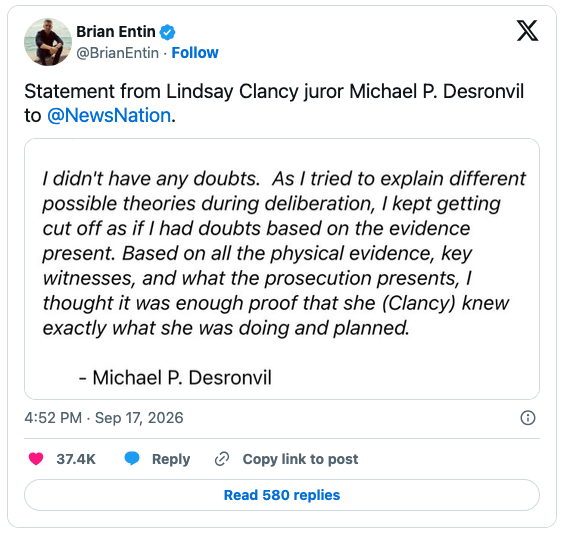
Desronvil also had his complaints about other jurors. According to YouTuber Ray Marcel, who said he spoke with Desronvil off-camera for about an hour, the latter claimed that eight of the jurors leaned not guilty from day one and seemed “like they were activists.” The aforementioned Devlin lent this credence, too, many say, with a statement she made.
Being interviewed on CBS Saturday Morning on September 12, the juror stated (video below):
Even though we didn’t know what was going on outside of our little bubble that we were in, we knew that this was a turning point, and this would be something that could change something to make it better for other women in the future, for other families. You know, justice for those children is this never happening again.
In fairness, it’s entirely possible a person could judge a case properly and still consider the above as an afterthought. But it’s not a good look.
Then, however, there’s also the following, courtesy of commentator J.R. Dunn on Friday:
One juror [perhaps Devlin] appeared on three separate media outlets within a short period, each time looking completely different. In one case made up and with a contemporary hairstyle, in another wearing the frizzy just-got-back-from-Woodstock do of the late 60s, while in a third, she wore no makeup at all and had her hair in a severe bun, coming across as a Sicilian immigrant grandmother of the 1890s. Why go to this effort? To suggest to viewers that a larger number of women were involved? Who knows.
Loose (and Immature?) Lips
All the preceding matters, however, are immaterial to the doxxing. One significant point in this was Devlin (again) revealing to CBS Mornings that Desronvil was a black man (video below). Since Plymouth County, where the jurors were drawn from, is only around 8.5 percent black, this did narrow things down.
The same day the above aired, September 11, Boston’s NBC 10 published sensitive information about the “holdout juror.” This involved allegations that he’d committed domestic assault and battery, among other transgressions. There’s no record, however, of Desronvil being convicted of anything. Moreover, as the Daily Caller reported September 11:
Andrew Kloster, a longtime government attorney, told the Daily Caller that “This just looks like the expected smear campaign against a juror who was exercising his rights.[”]
(You can read the Caller’s article for details, though, and draw your own conclusion.)
Of course, all this information provided more clues to identity. Then, finally, blogger Aidan Kearney (Turtleboy) solved the puzzle and posted Desronvil’s name and photo on X September 12.
Eye on the Ball
Really, though, the main point is that bigger and underappreciated picture. People get caught up in whether Desronvil is a hero or mistrial monkey wrench. They get distracted by titillating “he said, she, she, she, she said” details. But the principle here is simple:
You don’t out jurors — ever.
It doesn’t matter if you love or hate a given juror’s actions. It doesn’t matter if the person is a saint or sickening sinner.
Because it’s not about the saint or sinner but the system.
Jury duty is a sacrifice of time out of your life — it shouldn’t be a possible sacrifice of your life. But this fear will be a possibility if jurors know they can be doxxed. It is a fact then, too, that they’ll be less likely to render an honest, but against-the-grain judgment. This undermines our criminal justice system.
If 12 Angry Men is updated for the 2020s, it could perhaps just be a 23-minute (subtracting commercials) show. Juror 8 could, despite his doubts, think “I don’t want to be the next Michael Desronvil. And, yeah, this defendant is probably guilty, anyway.”
Just hope that when it happens in real life, you’re not the hapless soul unjustly charged with murder.