
Vatican Excommunicates Traditionalist Group for Schism
The Vatican has pronounced a decree of excommunication against adherents of a traditionalist group, the members of which adhere to the Latin Mass and other practices that were common to the Church prior to modernizing changes introduced in the 1960s.
The Priestly Fraternity of Saint Pius X (SSPX) was founded as a missionary order by Archbishop Marcel Lefebvre in 1970, with full approval of the Vatican. However, on July 1, the order consecrated four new bishops without papal mandate, a schismatic act in the opinion of Pope Leo XIV and others of the Roman Curia. Two days prior, Leo wrote to SSPX Superior General Father Davide Pagliarani, urging his group to abandon its plans. Pagliarani countered with a June 30 letter explaining that the consecrations stem from fidelity to time-honored Catholic tradition that often contradicts the teachings and practices of the modern, mainstream Church.
In the pope’s letter he acknowledged the fraternity’s “devotion to liturgical life, commitment to priestly formation, apostolic zeal and desire for fidelity to Tradition.” However, the Holy Father pleaded: “Please turn back!” He warned that a “schismatic act” of unauthorized episcopal consecrations would deprive faithful attached to the SSPX of “licit and, in some cases, even valid reception of the Sacraments.” The letter emphasized the gravity of tearing “the seamless garment of Christ” and called for discussion, stating the Church remains “open to a path of dialogue and understanding that the Holy Spirit can make possible.”
Pagliarani’s Response
Pagliarani framed his response respectfully, stating: “Far be it from us to separate ourselves from the Roman Church.” The SSPX, he said, believes “it to be our very duty to do everything possible to mend Christ’s seamless garment, torn by forces and pressures incompatible with a truly Catholic spirit.” He then recalled the fraternity’s episcopal consecrations of 1988, when it was also accused of schism “for reasons and in circumstances entirely analogous to those of today.” Regardless, Pagliarani noted, “after so many years, we are speaking together as a father and his son. Your Holiness is paternally urging me to avoid a schism which, theoretically, has already taken place.”
He asked the pope not to pronounce any censures on his fraternity but instead to consider the support that the SSPX has received from various prelates of the Church, including some of Leo’s predecessors, as well as “the thousands of souls who have rediscovered the Catholic faith and the practice of religion through the apostolate of the Society.”
Consecration Plans
The SSPX announced plans for the July 1 consecrations this past February. The announcement explained that, since August 2025, Pagliarani had been attempting to discuss the need for new SSPX bishops with the Vatican. (Bishops ordain priests, so without them, the fraternity would eventually fold as today’s priests age and die. There are only two surviving SSPX bishops of the four consecrated in 1988, ages 68 and 69 respectively.)
In January, the Vatican responded to the SSPX with “a letter which [did] not in any way respond to our requests,” according to the statement. Pagliarani and his advisors unanimously decided to carry on without Vatican approval, citing an “objective state of grave necessity.”
Within days, Cardinal Victor Manuel Fernández met with Pagliarani, offering to resume dialogue on the condition that the SSPX postpone the consecrations. Upon his return to the General House of the SSPX in Écône, Switzerland, Pagliarani penned a letter to Fernández, stating, “We both know in advance that we cannot agree doctrinally, particularly regarding the fundamental orientations adopted since the Second Vatican Council.” (The reference is to Vatican II, a council that took place between 1962 and 1965 for the purpose of modernizing the Catholic Church.)
Underscoring intent to proceed, the SSPX announced the names of its four future bishops in May. Fernández fired a warning shot, threatening excommunication.
SSPX Open Letter
Then, on June 24, the SSPX dropped a bombshell. Its “Open Letter to His Holiness Pope Leo XIV and to the Cardinals,” signed by five SSPX prelates, was accompanied by a 28-page “Profession of Catholic Faith of the Society of Saint Pius X to enlighten souls in the face of modern errors.” The documents present a comprehensive restatement of core Catholic doctrines and include the following:
I acknowledge in particular that modern errors represent a dreadful threat to the whole of the Catholic order, and that their penetration into the life of the Church, under the influence of the Second Vatican Council and the post-conciliar reforms, has provoked a crisis of exceptional gravity: agnosticism attacks the knowledge of God; naturalism attacks the necessity of grace; subjectivism attacks the supernatural motive of faith; relativism attacks the immutability of dogma; situation ethics attacks the divine law; liberalism attacks the Social Kingship of Christ; false ecumenism attacks the uniqueness of the Church; collegiality and synodality attack the divine constitution of the Church in her hierarchy; liturgical anthropocentrism attacks the Holy Sacrifice of the Mass.
In response, on June 26 and 27, the Vatican held an extraordinary consistory to respond to these SSPX pronouncements. Cardinal Gerhard Müller rejected the “scandalous accusation” that Rome has departed from the Faith and argued that defiance of the pope crosses into schism. He invoked historical precedents and proposed a pastoral commission for return to full communion. Others criticized the SSPX’s actions and accusations as undermining papal authority and Church unity, prioritizing private judgment over obedience to the successor of Peter.
So their argument boils down to this: The Vatican stresses unconditional obedience to the pope; the SSPX emphasizes doctrinal fidelity to “eternal Rome” and the Deposit of Faith.
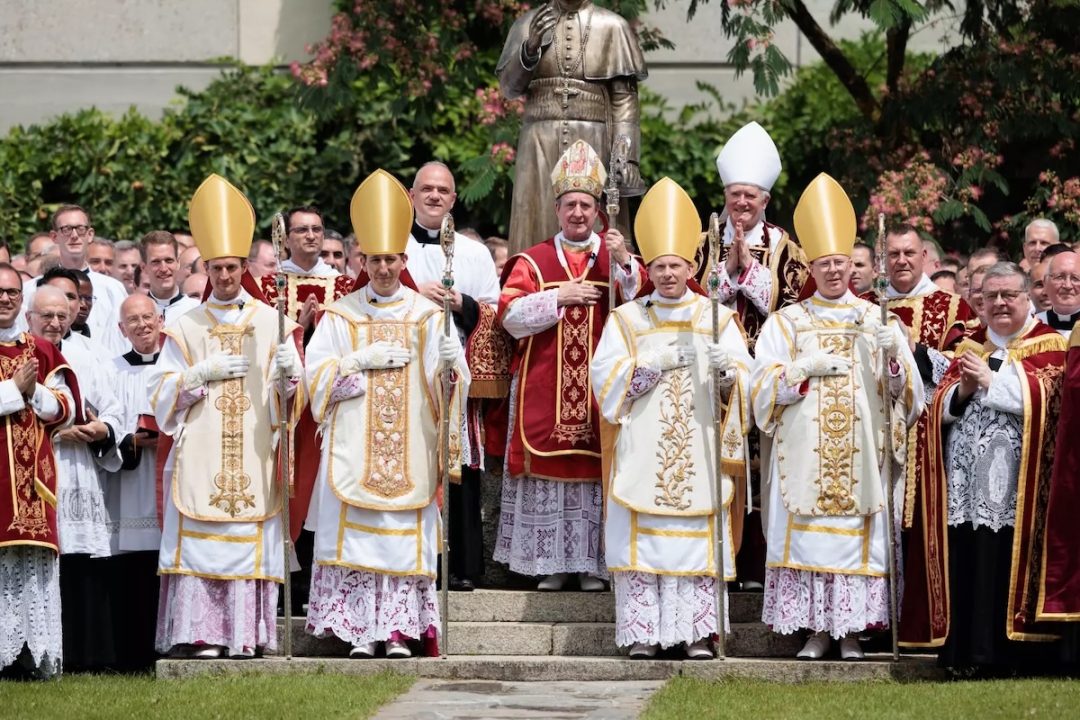
Some 16,000 attended the consecration ceremony in Écône. In a booklet distributed there, SSPX specified that its new bishops will not be assigned to diocesan sees, an act which would “usurp the jurisdiction of the Sovereign Pontiff.” The bishops were consecrated exclusively to enable them to ordain future priests.
Excommunication
The Vatican does not agree, and Vatican News summarized the decree of excommunication as follows:
The excommunication newly separates the bishops and priests of the Fraternity of Saint Pius X from the Church of Rome. As for the lay faithful, those who formally adhere to the Fraternity are to be considered excommunicated.
This article is part of The New American’s weekly online newsletter Insider Report, which is emailed to TNA subscribers each week. Click here to subscribe to The New American to receive the Insider Report and access exclusive content.