

Another Socialist at No. 10: Burnham Vows to Fix the U.K. With Government Programs
The musical chairs of prime ministers continues in the United Kingdom. Andy Burnham has been appointed to the nation’s top leadership position following Keir Starmer’s resignation a month ago. Another point of consistency is that the new prime minister is another Labour Party socialist who believes government has the answers to the country’s persevering woes.
Vowing More Government
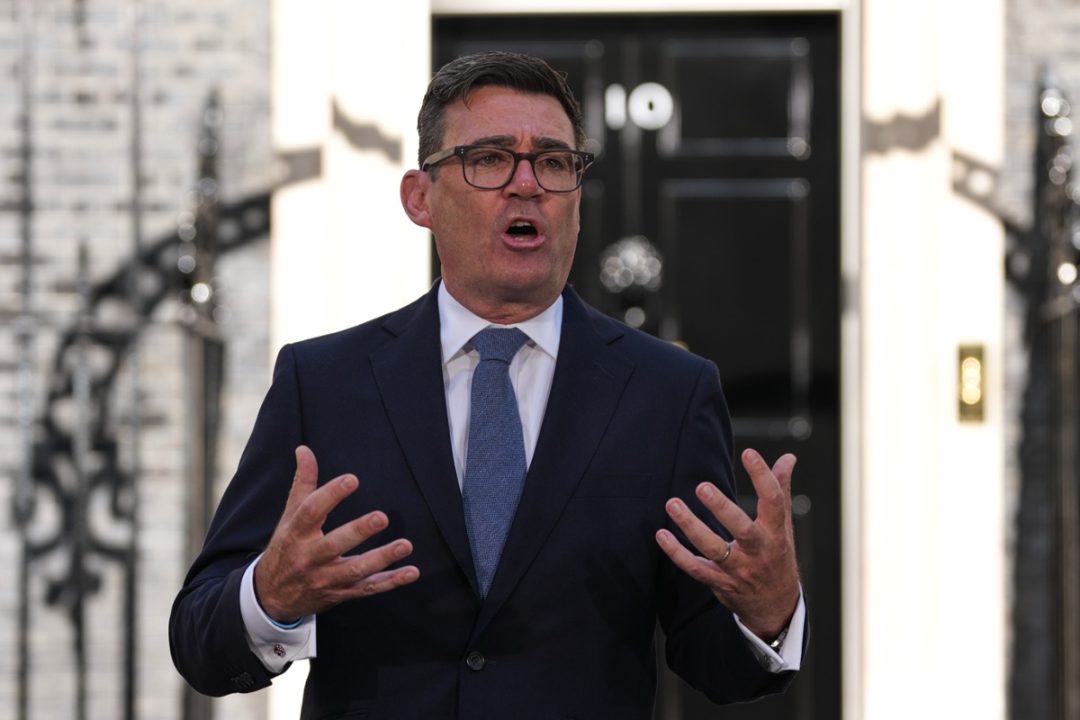
Burnham is the seventh PM in a decade. In his first speech as head of state, he acknowledged that his appointment is part of a long pattern of instability. “We have not been good enough and we need to be better. We will be,” he said. “Britain needs to show the world that we can regain our stability once again.”
He called his appointment a “circuit breaker” and vowed to bring about the “biggest changes in the last 40 years.” Those will include new political and economic models, he said, vowing to improve the people’s lives with more effective government programs:
In the 1980s, Britain took some wrong turns. Political power was centralized, economic power privatized, large parts of the country deindustrialized — and they still haven’t recovered. Many feel as though they’re still in decline, and they don’t have the ability to turn things around. And that’s why we will change politics. To make it more collaborative, more about problem solving than point scoring. And we will take power out of here and carry it into every postcode in the land so that they can do more — and in doing more, build a new economy where we put life’s essentials back under stronger public control to make them affordable to you again.
The new leader talked of putting the government at the center of a reindustrialization campaign. He vowed to bring forth a new 10-year plan that will include “help” with the high cost of living. He said he wants to help more young people get work by changing the education system and providing more mental health support. He also wants to build more public housing. This will somehow decrease the welfare bill, according to Burnham. The point is to invest in people’s success and help people live well. “I will put the care of people at the heart of everything I do,” he announced.
Increasing Foreign Aid
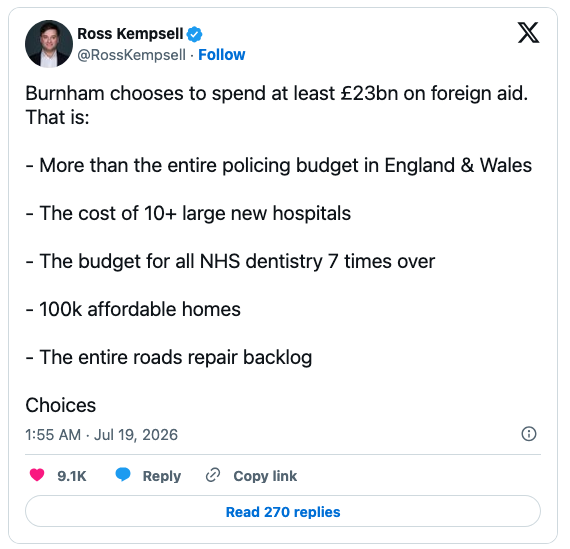
Burnham also made comments indicating his administration will increase foreign involvement. According to reports, he wants to boost foreign aid by £16.5 billion a year ($22 billion), more than double current levels. MP Rupert Lowe said on social media that this “is a decision that betrays millions and millions of British men and women.”
Ross Kempsell, a sitting member of the House of Lords and right-wing commentator, compared what Burnham wants to dole out in foreign aid to how it could serve the citizens at home.
Refusing to Acknowledge Mass Migration’s Consequences
Burnham is a former mayor of Greater Manchester, and was an MP for Leigh from 2001 to 2017. He’s been a speaker for the World Economic Forum and has no problem acknowledging that he’s a socialist. In May 2025, he told the left-wing publication Renewal, “I’m happy to call myself a socialist.” Burnham also made clear that he believes the government should have control over everything people need to live. “The things that are utterly essential for people to have a good life, the things that everybody depends on, they need to be run much more firmly in the public interest,” he said. He also seemed to suggest that everyone should be living in government housing, saying:
If I look at the multiplicity of challenges facing the country in all of the public services and in the sustainability of public spending, the position of councils, benefit system, and the NHS [National Health Service] in terms of what it’s dealing with, the single best investment you could make to deal with that would be to give everybody a decent home — and build hundreds of thousands of council homes and social homes. That would be the best use of public money that we could possibly make right now.
Burnham believes the housing-homeless crisis in the U.K. is the fault of the private sector. Astoundingly, we don’t know of a single instance in which he acknowledges the role mass migration has played in the country’s housing problems. Net migration to the island nation peaked in 2023 at nearly a million — close to 900,000. Reports say that number is now down significantly, to 171,000. Yet between 2021 and 2024, the country took in 2.5 million migrants who are still there. With the number of homeless or near-homeless far below that, how many more British people would have access to housing if their leadership class prioritized them over migrants?
More and More Money
The obvious takeaway from sensible observers is that the new PM’s socialist utopia will require more revenue — money the government will have to take from the people. One of the first things Burnham will want to do, writes Daniel Herring, a researcher at the Centre for Policy Studies, “is find more money to spend.” And since he can’t borrow much more (the U.K. is nearly £3 trillion — about $4 trillion — in debt), “he’ll have to raise taxes.” Herring says many in the Labour Party are calling for Burnham to raise capital gains tax. But it won’t help. Herring believes that “the main problem with Labour’s plans is that it will cause economic harm while probably not raising much, if any, money.”
Capital-gains taxes are one of many Britons could see increase. There are proposals or discussions regarding boosting inheritance taxes, savings taxes, income taxes, stealth taxes, and property taxes.
Dawn Neesom of GB News recently asked a question that is likely on the minds of many productive Britons:
Given the two stories about the potential tax raises we got coming in — a new property tax, a new inheritance tax, or “death tax,” and this capital gains tax — I’m starting to ask myself … “What is the point in actually working?” … I might as well just hold my hands out and not do anything.
British conservatives say the only difference between Burnham and his predecessor is style, not substance. Both men hail from the same party and essentially believe in the same policy prescriptions yet the public is leaning more toward right-wing ideologies and parties.
No British prime minister has served more than three years since David Cameron’s stint ended in July 2016. Will Burnham break the cycle?
Not likely.