
U.S. Official: Attacks on Iran Will Continue. Trump: Iran Wants Talks; Ceasefire Over. Iran: We Did Not Ask for Talks.
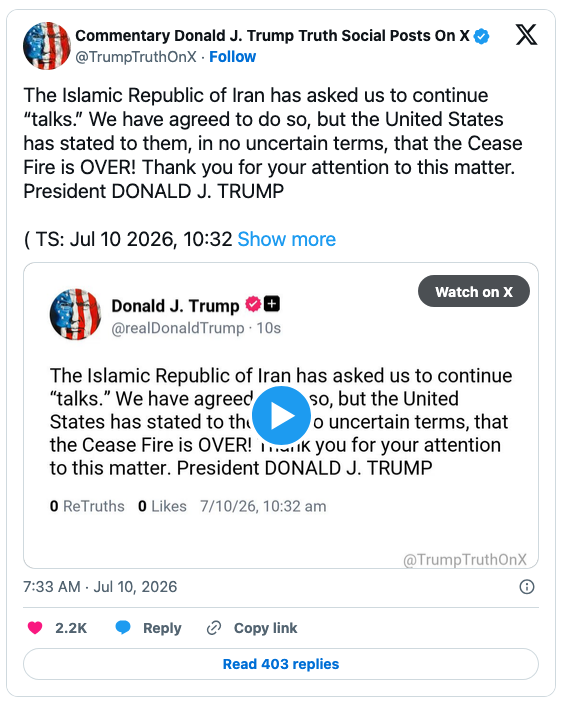
A day after a U.S. official said U.S. forces would “slap” Iran around in the coming days or weeks, President Donald Trump claimed that Iran wants to continue peace talks but that the ceasefire in the war is over.
Apropos of the new fighting in the region this week, Axios reported that U.S. attacks could go on for a month or more. The website also reported that “regional negotiators” are scrambling to stop the collapse of the talks.
On Truth Social, Trump said that U.S. officials have agreed to more talks with Iran, but that the ceasefire is done. That presumably means U.S. forces will continue to attempt to pound Iran into submission to U.S.-Israeli regional hegemony.
Iran denied that it had asked for more negotiations.
More Bombing Ahead
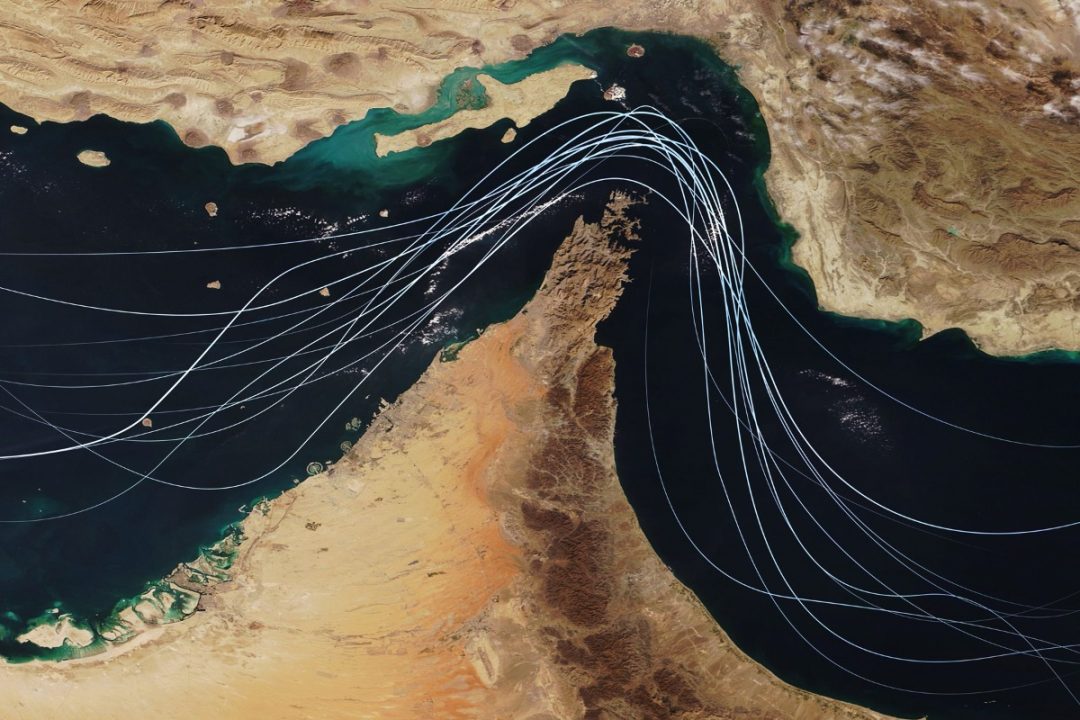
After Iran attacked multiple ships in the Strait of Hormuz early this week, U.S. Central Command responded with two days of bombing more than 170 targets in Iran.
Iran retaliated with attacks across the region.
After the first of those attacks, Trump declared that the ceasefire had ended. “To me, I think it’s over,” he said, answering a reporter’s question:
I don’t want to deal with them. They’re scum. You know what scum is. They’re scum. They’re sick people. They’re led by sick people. They’re vicious, violent people.
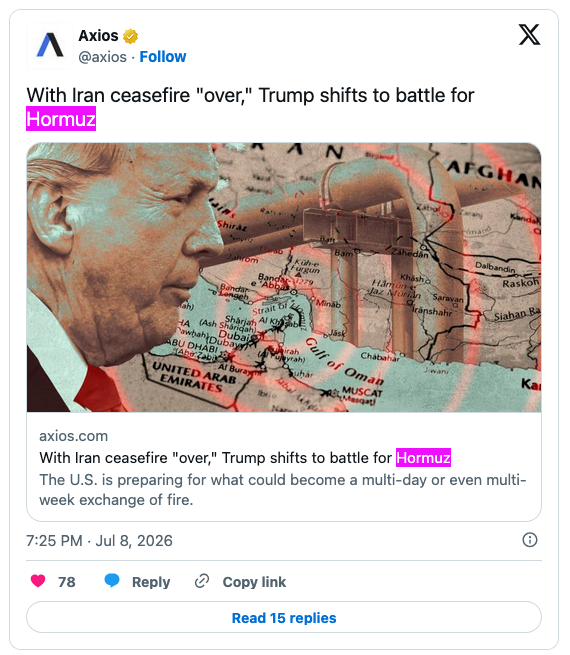
But U.S. forces aren’t finished by a long shot, Axios disclosed. “The White House is preparing for what could become a multi-day or even multi-week exchange of fire with Iran over the Strait of Hormuz,” the website explained:
The length and severity of the new campaign hinge entirely on Tehran’s next moves, U.S. officials tell Axios. …
A war that began with the goal of degrading Iran’s missile capabilities and destroying what remained of its nuclear program has evolved into an open-ended fight over the world’s most important energy chokepoint.
A U.S. official said the current escalation could last a day or two, a week or a month, depending on whether Iran continues its attacks on commercial ships in the Strait of Hormuz.
“We’re going to slap them a bit so they understand we’re not f***ing around,” the U.S. official said.
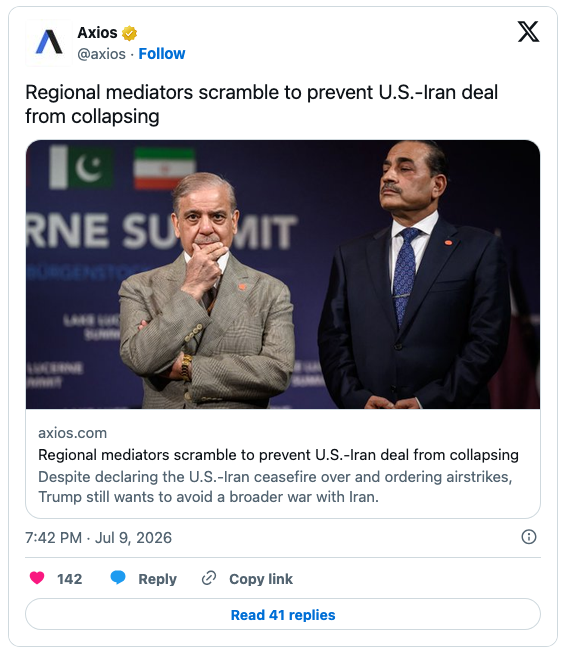
Thus are negotiators from Qatar and Pakistan “trying to de-escalate tensions between the U.S. and Iran and revive negotiations on a nuclear deal,” the website continued, sources from those countries and an American official said.
“The mediators think that, regardless of the recent escalation, the parties made progress toward a nuclear deal in earlier rounds of talks and want to prevent the MOU [Memorandum of Understanding] from collapsing,” Axios continued:
A regional source from one of the mediating countries said the mediators believe the recent Iranian attacks in Hormuz were initiated by elements inside the Iranian regime that oppose the MOU and want to undermine it.
Trump: Iran Wants Talks
Today, on Truth Social, Trump reiterated what he said days ago.
“The Islamic Republic of Iran has asked us to continue ‘talks,’” he wrote:
We have agreed to do so, but the United States has stated to them, in no uncertain terms, that the Cease Fire is OVER!
Iran disputed that claim. “The Islamic Republic of Iran has made no request for negotiations with the US,” said Foreign Ministry spokesman Esmaeil Baghaei.
As well, the Iran International English X feed reported what Iranian Parliament Speaker Mohammad Bagher Ghalibaf said today. “Negotiations with the United States should be conducted only by those prepared for war, warning that Tehran would respond if Washington violated its understanding with Iran,” the feed reported, paraphrasing the Iranian leader.
During a meeting with his counterpart in the Indonesian Consultative Assembly, the X feed continued, Ghalibaf revealed telling Vice President J.D. Vance that Tehran did not trust the United States.
“Ghalibaf said Iran had never abandoned its defense preparedness and would stand firmly against the United States if it betrayed the agreement”:
He said the United States, Israel and NATO had failed to force Iran into surrender during the recent war, adding that the conflict would not end with Iran giving in.
That mirrors what Ghalibaf wrote on X two days ago.
“America still hasn’t learned that bullying and breaking promises are no longer cost-free,” he wrote:
Let me put it plainly: if you strike, you’ll get hit.”
Don’t flail around pointlessly, or you’ll sink even deeper.
The Strait of Hormuz will only open with “Iranian arrangements,” not American threats.
That statement comports with the MOU, The Wall Street Journal explained in an analysis of the agreement.
That codicil says that “the Islamic Republic of Iran will make arrangements using its best efforts for the safe passage of commercial vessels with no charge, for 60 days only, from the Persian Gulf to the Sea of Oman and vice versa.”
“The language of the deal has left the two sides fighting over that point rather than making progress on a final agreement on Tehran’s nuclear program,” the Journal reported:
“This gap in interpretation is wide, baked into the deal, and not exactly surprising,” said Michael Horowitz, an Israeli geopolitical analyst. “Washington has tried to convince Tehran that compliance would be more profitable, but this framing misses the point. Iran’s behavior isn’t driven by financial motives but by security concerns and bargaining leverage. It’s a power dynamic.”