
Vol. 42, No. 07
07/01/2026
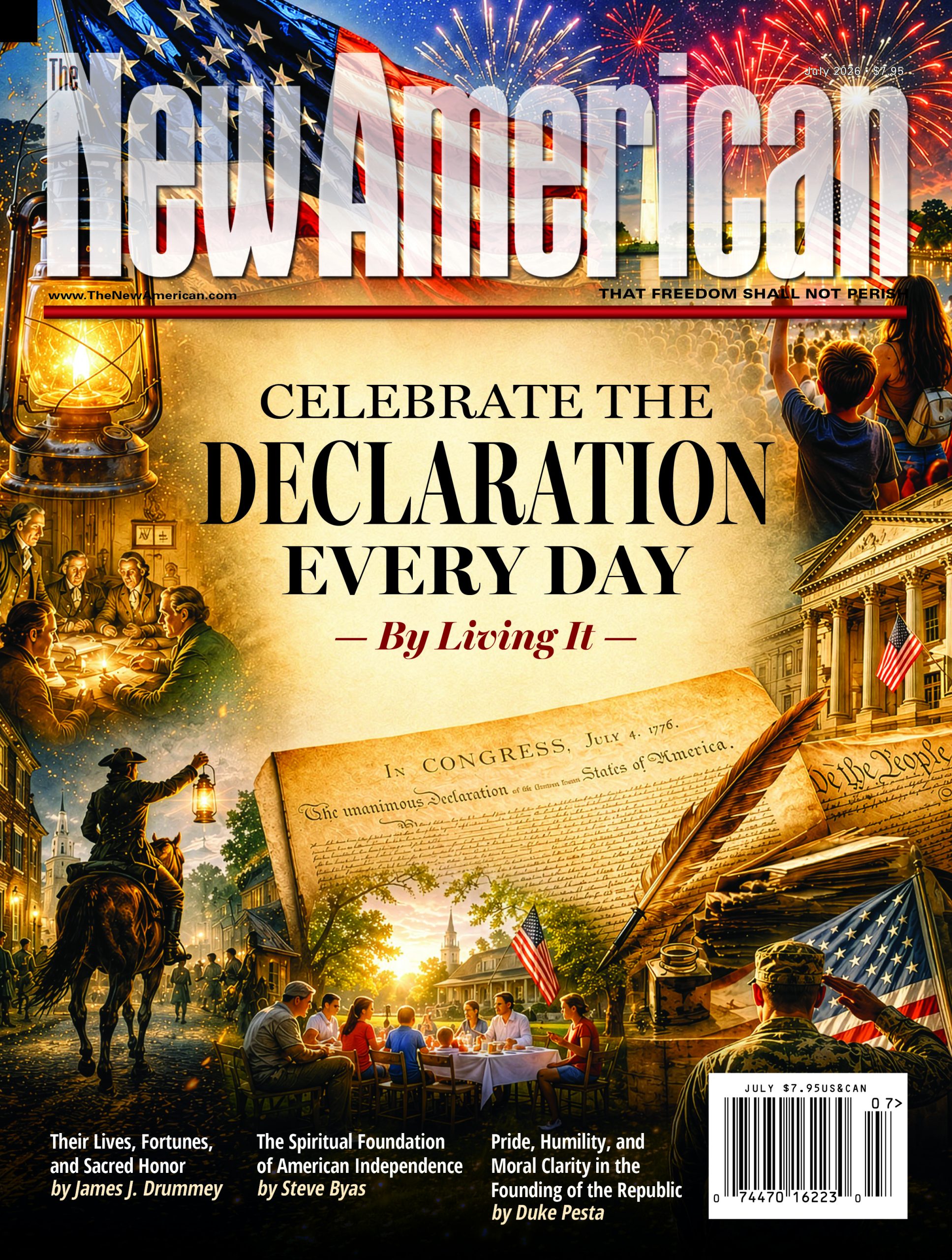
Celebrate the Declaration Every Day — By Living It
AT A GLANCE
• The words in the Declaration of Independence mean nothing if we do not put them into practice.
• Learning and applying the principles in the Declaration is the best way to celebrate it.
• Prior to the American Revolution, patriots informed fellow citizens through the Committees of Correspondence.
• In a very real sense, we should “celebrate” the Fourth of July every day through our patriotic endeavors.
On the Fourth of July, Americans gather around picnic tables, slap burgers on the grill, and gaze skyward at fireworks bursting over darkened fields. Children wave little flags. Politicians deliver speeches. Bands play patriotic songs. And when the last ember fades and the smoke drifts away, most Americans go home feeling vaguely good about their country and resume, the very next morning, the quiet, unremarkable surrender of the principles they just celebrated.
This is not a celebration of the Declaration of Independence. It is a eulogy for it.
Supreme Court Justice Clarence Thomas understood this when he issued a challenge that every American who calls himself a patriot must hear, consider, and act upon. In a lecture at the University of Texas at Austin on April 15, Thomas spoke with the clarity of a man who has spent decades reading what the Founders actually wrote, and watching what modern Americans actually do. Not mincing words, he declared that the Declaration’s immortal words are, without the commitment to back them up, nothing more than “mere words on parchment paper. Nice words, but nonetheless, just words.”
He is right. And that truth should sting.
What the Declaration Actually Says
Before we can live the principles of the Declaration of Independence, we must know them. This is not as obvious as it sounds. Most Americans, if pressed, could fumble through a vague recollection of “all men are created equal,” but the full architecture of the document, and the radical weight of its claims, has been systematically stripped from public education, public discourse, and public memory.
So let us read it plainly.
The Declaration opens with a statement about the laws of nature and of nature’s God — a grounding of the entire American enterprise not in the will of government, not in the preferences of the majority, but in the fixed, objective moral order established by the Creator Himself. The Founders were not making a political calculation. They were making a metaphysical claim: that there is a God, that He created man, and that from that fact flow certain inviolable rights.
Then comes the sentence that Abraham Lincoln called the “sheet anchor” of the Republic: “We hold these truths to be self-evident, that all men are created equal, that they are endowed by their Creator with certain unalienable Rights, that among these are Life, Liberty and the pursuit of Happiness.”

Notice what the Founders said and what they did not say. They did not say rights are granted by government. They said rights are endowed by the Creator. They are unalienable, meaning they cannot be surrendered, bargained away, or legislated out of existence, because no government gave them and no government has the authority to take them. Government does not create rights. It either protects them or violates them. There is no third option.
This distinction is not semantic. It is the entire ballgame. A right that comes from government can be revoked by government — by the stroke of a pen, by the passage of a statute, by the reinterpretation of a judge appointed by men with interests of their own. A right that comes from God cannot be legitimately revoked by any earthly power. The Founders understood this with a precision that most of their modern descendants have entirely lost. They were not speaking loosely when they invoked the Creator. They were building a philosophical firewall between the citizen and the state — a wall that could only hold as long as the people understood why it was built.
That understanding is what has eroded. And its erosion is not accidental.
For generations, the educational establishment — from the progressive reformers of the early 20th century through the curriculum designers of today — has quietly, systematically dismantled the teaching of natural law, the philosophy of the founding, and the intellectual tradition that made the Declaration intelligible to the men who signed it. What has replaced it is a curriculum that treats rights as political grants, the Constitution as a “living document” that means whatever the powerful wish it to mean, and the Founders themselves as flawed men whose ideas need not bind us. The result is a citizenry that celebrates a document it cannot explain, defends principles it cannot articulate, and remains defenseless against a government it was supposed to restrain.
This is not an accident of neglect. Neglect is passive. What has happened to civic education in America is active — the deliberate substitution of one framework for another. The old framework said rights precede government, and government’s only legitimate function is to secure them. The new framework says rights are whatever the democratic majority, the regulatory agency, or the federal court decides they are today. These two frameworks are not in tension; they are at war. And for the better part of a century, only one side has been fully engaged on the battlefield.
The Declaration continues: “That to secure these rights, Governments are instituted among Men, deriving their just powers from the consent of the governed — That whenever any Form of Government becomes destructive of these ends, it is the Right of the People to alter or to abolish it.”
This is the hinge upon which all of American political philosophy turns. Government exists for one purpose: to secure the rights that God gave to man. The moment it fails in that purpose, the moment it becomes the instrument of oppression rather than the guardian of liberty, the people retain both the right and the duty to alter or abolish it. The government is the servant. The people are the master. That is not rhetoric. That is constitutional architecture.
And then the Declaration closes with words that most Americans have never paused long enough to truly absorb: “And for the support of this Declaration, with a firm reliance on the protection of divine Providence, we mutually pledge to each other our Lives, our Fortunes and our sacred Honor.”
Fifty-six men signed their names to that sentence. They knew what it meant. In the eyes of the British Crown, they had just signed their own death warrants.
Words Without Commitment Mean Nothing
Here is the hard truth that Justice Thomas placed before us, and that we dare not flinch from: The words of the Declaration did not change history; the commitment behind them did.
“Nothing in the Declaration of Independence,” Thomas said, “matters without that final sentence. Without that sentence, the rest of the Declaration is but mere words on parchment paper. Nice words, but nonetheless, just words. What changed the world was not the words, but the commitment and spirit of the people who were willing to labor, sacrifice, and even give their lives — what Lincoln at Gettysburg called ‘the last full measure of devotion’ — for the Declaration’s principles.”
Thomas was not speaking abstractly. He was speaking historically, and every word he said is confirmed by the record.
Consider what the signers actually suffered for those words. Francis Lewis watched his wife imprisoned by the British, her health destroyed; she died shortly after her release. John Hart fled into the woods for months while British soldiers occupied his farm, burned his property, and scattered his family. He died before the war ended, never seeing his home restored. Carter Braxton sold off almost his entire estate to fund the Revolution and died impoverished. Thomas Nelson, Jr. ordered American artillery to fire upon his own home in Yorktown, which the British had commandeered as a headquarters. Robert Morris, who largely financed the Revolution from his personal fortune, ended his life in a debtors’ prison.
These men did not merely agree with the Declaration. They bled for it.
And that is precisely why it changed the world.
It is worth sitting with that truth rather than rushing past it, as we are so accustomed to doing. We live in an age that has almost entirely lost the concept of pledging something real, something irreplaceable, to a cause greater than oneself. We are comfortable. We are busy. We have mortgages and careers and streaming services and the thousand small frictions of modern life pressing against us from every direction. The idea that a man might order artillery fire upon his own house — his own home, the place where his children slept and his family gathered — in order to deny its use to a tyrannical enemy is almost incomprehensible to the modern American mind.
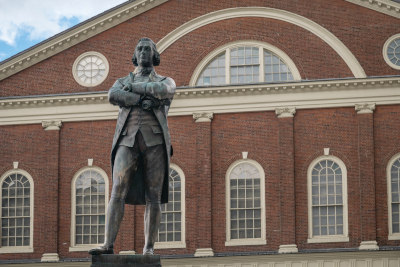
But Thomas Nelson understood something we have forgotten: There are things worth more than property, more than comfort, more than personal safety. He understood that a house is a house, but a republic built on the principles of natural law and human dignity is a civilization, and that civilizations, once lost, are not easily recovered. The Romans did not believe Rome could fall. The citizens of the Byzantine Empire did not believe Constantinople could fall. Every civilization that has ever collapsed into despotism did so in the presence of people who were quite certain it would not. Certainty of survival is not a shield. It is an anesthetic.
We would do well to recover that understanding before we are forced to learn it the hard way.
Justice Thomas made this point with an urgency that should penetrate every comfortable, flag-waving, fireworks-watching American who has come to regard the Fourth of July as little more than a summer holiday. He implored his listeners: “Celebrate it by standing up for it, by defending it, and by recommitting yourselves to living up to its ideals. Channel the courage of the men who faced down a king and signed it.”
That is our clarion call: Channel the courage of the men who faced down a king.
As James Otis boldly declared, “Let the consequences be what they will, I am determined to proceed.”
That is not the language of a man content with picnics.
The Committees of Correspondence: How Principles Became a Revolution
Americans did not wake up one morning and decide to declare independence. The Revolution was prepared over years through networks of communication, education, and organized resistance that carried the principles of liberty from one town to the next, from one Colony to the next, until the entire continent was united in a common understanding of what free men owed to tyranny.
That network had a name: the Committees of Correspondence.
In November 1772, Samuel Adams proposed the creation of a standing committee in Boston to state the rights of the Colonists and to correspond with other towns throughout the Colonies. The response was electric. Within months, Massachusetts had more than 80 such committees. By 1774, virtually every Colony had established its own network.
Writing under the pseudonym “Valerius Poplicola,” Adams wrote in the Boston Gazette to “Let Associations & Combinations be everywhere set up to consult and recover our just Rights.”
What did these committees do? They wrote. They communicated. They shared information that the Crown and its loyalist press suppressed or distorted. They exposed the schemes of Parliament. They refuted the lies told about Colonial resistance. They educated ordinary farmers, tradesmen, and merchants in the principles of natural law and constitutional liberty, principles that Samuel Adams, John Adams, James Otis, and others had been developing and articulating for years.

What made the committees indispensable was not merely what they communicated, but how they communicated it. They did not speak in the elevated abstractions of the academy. They translated philosophy into plain language. They made clear the dense arguments of Algernon Sidney, John Locke, Cicero, John Trenchard and Thomas Gordon’s Cato’s Letters, Samuel von Pufendorf, and many other philosophers and historians. In an 1825 letter to Henry Lee, Thomas Jefferson explained that the Declaration of Independence was not intended to be original, but rather to express the “harmonizing sentiments of the day” and the “American mind,” drawing on common-sense principles found in writings by figures such as Aristotle, Cicero, Locke, and Sidney and bringing them down to the level of the town meeting, the tavern, and the churchyard.
Expressing the “harmonizing sentiments of the day” meant that Jefferson and his colleagues purposefully made the principles of liberty legible to the man behind the plow and the woman at the spinning wheel. They understood, in other words, that the defense of liberty is not an elite project. It is a popular one, and it can only succeed when the people themselves understand what they are defending and why.
That insight is as revolutionary today as it was in 1772.
John Adams understood the significance of what was happening. He would later reflect that the Revolution was accomplished in the minds of the people years before a single shot was fired at Lexington or Concord.
In a letter written to Hezekiah Niles in 1818, Adams observed, “The Revolution was effected before the war commenced. The Revolution was in the minds and hearts of the people; a change in their religious sentiments, of their duties and obligations.... This radical change in the principles, opinions, sentiments, and affections of the people was the real American Revolution.”
The Committees of Correspondence were the instrument of that revolution in the minds and hearts of the people. They were the infrastructure of informed consent. They were the reason that when the moment came — when the British marched on Concord, when the shot heard round the world was fired — the people were ready. They knew why they were fighting. They knew what they were defending. They knew what was at stake.
That knowledge did not come from picnics; it came from men who understood that the pen, the pamphlet, and the organized exchange of truth were as essential to liberty as the musket.
The Modern Committees of Correspondence
We live in a different age. The threats to liberty have changed their uniform, if not their nature. The enemy today does not wear a red coat. He wears a bureaucrat’s necktie, a professor’s tweed jacket, a media anchor’s suit. He does not impose taxes by parliamentary decree; he imposes them through a labyrinthine regulatory state that most citizens cannot navigate and that most politicians do not read. He does not quarter soldiers in private homes; he installs the surveillance apparatus of a national-security panopticon in every pocket and every living room.
But the disease is the same: the systematic erosion of the understanding that rights come from God, not government, and that government exists to serve the people, not to rule them.
And the remedy is the same: organized, persistent, principled education and communication.
In this age, the role of the Committees of Correspondence has been taken up by The John Birch Society.
This is not a casual comparison. It is a precise one.
The John Birch Society was founded in 1958 by Robert Welch and a group of patriotic businessmen who understood something that most Americans of the time, people comfortable in postwar prosperity, had not yet grasped: that the same conspiracy of collectivism that had been tearing down liberty in Europe and Asia for decades had its hands deep inside the institutions of American government, education, and culture. Welch understood, as Samuel Adams had understood two centuries earlier, that you cannot defend what you do not understand, and you cannot fight what you cannot name.
The Society set about doing what the Committees of Correspondence had done: informing, organizing, and mobilizing citizens at the local level. It launched the publications The Review of the News and American Opinion, which in 1985 were combined into The New American, a magazine of rigorous, unapologetic, constitutional journalism. It established local chapters across the country. It produced educational materials, hosted speakers, and created the infrastructure through which citizens could learn the principles of the Republic and act upon them.
The parallels to the Colonial committees are not superficial. Both organizations arose in response to the concentrated power of a government — or a network of governments — that had grown hostile to individual liberty. Both recognized that the battle for freedom is, first and always, a battle for the minds and consciences of the people. Both understood that suppressing information is fatal to freedom. Both committed to the long, unglamorous, essential work of education — not because it was exciting, but because it was necessary.
And both understood something else that the comfortable and the complacent have always refused to accept: The price of inaction is higher than the price of engagement. The Colonist who stayed home while the Committees of Correspondence met, who told himself that politics was someone else’s business, who reasoned that things would probably work themselves out, did not avoid the cost of the Revolution; he simply paid it later, with interest, when the Redcoats came to his door. The American today who cannot name his congressman, who has never attended a local meeting, who regards civic engagement as a hobby for the especially motivated, is making the same calculation. And he will discover, as his Colonial predecessor did, that liberty deferred is liberty lost.
“Early on,” essayist Diane Ackerman noted, “[Samuel Adams] realized that revolutions don’t require a majority to prevail, but rather an irate, tireless minority keen to set brushfires in people’s minds.”
The John Birch Society has been setting those brush fires of liberty for nearly seven decades.
Living the Declaration: What It Actually Demands
Justice Thomas did not call upon Americans merely to remember the Declaration. He called upon them to live it. And living it requires more than sentiment; it requires specific, concrete, costly action.
What does that look like?
It means learning what the Declaration actually says and why. The self-evident truths of the Declaration are not self-explanatory. They are grounded in a tradition of natural-law philosophy — in Sidney, in Blackstone, in Cicero, in Pufendorf, and in the Reformed theology that shaped the Colonial mind — that most Americans today have never been taught. You cannot defend what you do not understand. The Committees of Correspondence understood this. The John Birch Society understands this. Do you?
It means standing up for those principles when it is costly. The signers did not pledge their lives and fortunes when it was safe to do so; they did it when the full weight of the British Empire was arrayed against them. As quoted earlier, Justice Thomas specifically called on his listeners to “channel the courage of the men who faced down a king.” That means speaking the truth when the crowd is against you. It means defending the Constitution when your own party is violating it. It means refusing to trade liberty for security when the government waves its latest emergency before your face.
It also means organizing. The Revolution was not won by isolated individuals acting alone. It was won by networks — the Sons of Liberty, the Committees of Correspondence, the Continental Congress — networks of people who knew and trusted one another, who shared information and resources, who acted in concert. Liberty does not survive through individual heroism alone. It survives through organized, sustained, principled action. The lone patriot who nurses his convictions in private, who keeps his principles to himself for fear of social friction or professional consequence, accomplishes nothing. He may feel righteous, but he will change nothing. It is the man who brings his convictions into the public square — who joins, who organizes, who builds — who moves the needle of history back in the right direction.
It means taking the long view. The Committees of Correspondence were not formed weeks before the Battle of Lexington. They were formed in 1772 — three years before the shooting started. Samuel Adams was playing a long game. He was preparing the people. He was educating the people. He was building the organizational infrastructure that liberty would require when the moment arrived. We must do the same.
It means rejecting comfort as a virtue. The greatest enemy of liberty in our time is not the tyrant, it is the comfort that makes tyranny tolerable. When government grows too large to resist without sacrifice, too complex to understand without serious study, and too entrenched to challenge without organized effort, most people simply accommodate themselves to it. They tell themselves things are not so bad. They turn on the television. They go to the picnic. They watch the fireworks.
And the Republic slips a little closer to annihilation.
The Last Full Measure of Devotion
Lincoln’s phrase, which Justice Thomas invoked, comes from the Gettysburg Address — delivered on a field where 50,000 men had fallen in three days of combat.
“It is for us the living,” Lincoln said, “to be dedicated here to the unfinished work which they who fought here have thus far so nobly advanced.”
The unfinished work.
It is still unfinished. It will always be unfinished, as long as there are human beings with the ambition to acquire power and the cunning to deceive the people into surrendering it. The Declaration of Independence is not an artifact. It is an assignment.
The men who signed it knew they might hang for it. Several of them lost everything they had. None of them could have known whether his sacrifice would produce the republic they envisioned, or whether it would simply be another failed uprising crushed by the boot of empire. They pledged their lives, their fortunes, and their sacred honor anyway because the principles were true, and truth obligates.
That obligation does not expire. It does not pass away with the generation that first accepted it. It is inherited by every American born into the Republic those men bled to establish, and by every person who has come to these shores seeking the liberty their principles promised. We did not earn this inheritance. We received it. And what is received as a gift from the sacrifice of others carries with it a moral weight that mere enjoyment cannot discharge. You do not honor a gift by consuming it. You honor it by preserving it, defending it, and passing it on intact, or better than you found it, to those who come after you.
That is the standard to which Justice Thomas called us. It is the standard to which Samuel Adams held his contemporaries. It is the standard to which The John Birch Society holds itself and its members today.
Celebrate It by Living It
So by all means, gather your families on the Fourth of July. Light the grill. Wave the flag. Watch the fireworks. There is nothing wrong with celebration, and there is genuine beauty in a free people pausing to remember the day their freedom and independence from tyranny were declared to the world.
But do not mistake the celebration for the thing itself.
The Declaration of Independence is not a holiday; it is a covenant. It is a covenant between free men and the principles of natural law, sealed with the blood and treasure of 56 men who staked everything on the proposition that those principles were worth dying for.
To celebrate the Declaration, as Justice Thomas made clear, is to stand up for it. To defend it. To recommit yourself to living up to its ideals.
That means learning it. Teaching it to your children. Supporting organizations such as The John Birch Society that do the work the Committees of Correspondence once did: informing, organizing, and mobilizing citizens in defense of the principles upon which this Republic was built.
It means refusing to be silenced when those principles are mocked, distorted, or simply ignored.
It means pledging — in whatever measure your circumstances allow — your own life, your own fortune, your own sacred honor to the same cause.
After July Fourth celebrations, fireworks fade; picnic tables are folded and put away; and all too often speeches are forgotten by the following morning.
But the Declaration of Independence and the timeless principles it espouses, if we learn them and live them, will never die.
Go to jbs.org/join and enlist in the only organization in America doing today what the Committees of Correspondence did in 1772: setting brush fires of liberty in the minds of a people who, if they can be reached in time, still have the capacity to save their country and their liberty.
The Founders pledged everything to win our freedom and independence from tyranny. Because they honored their pledge, we have freedoms today — very much endangered, but still largely intact — that we can employ to save our freedoms. What will you pledge?