

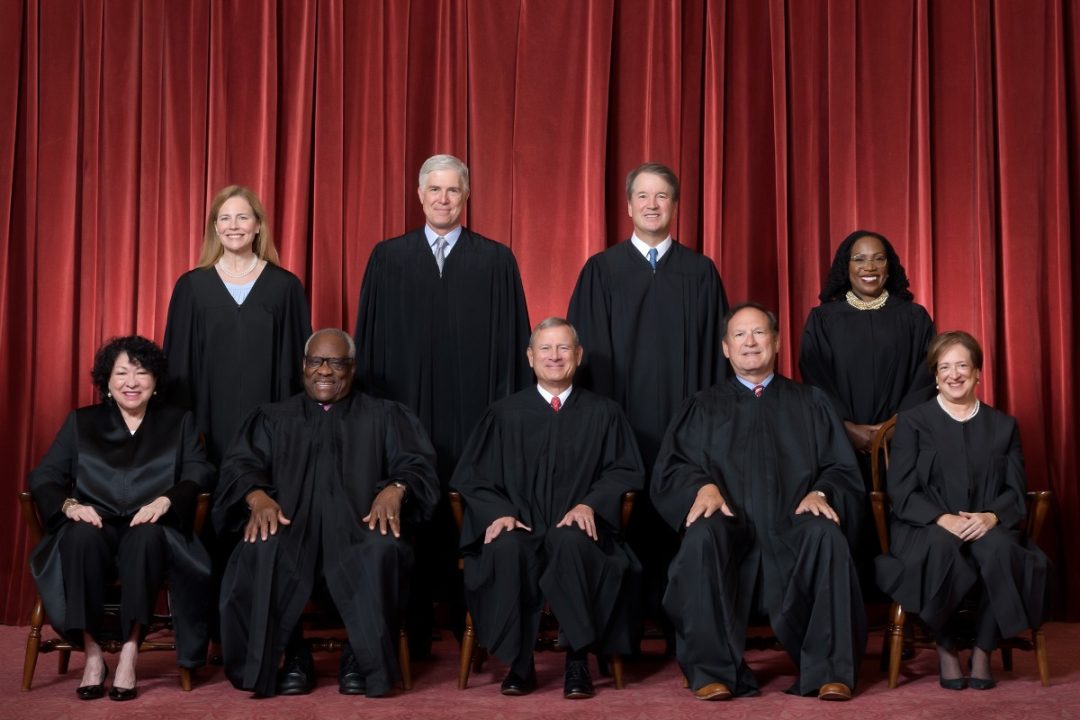
Supreme Court Wraps Up 2025 Term. Did It Uphold the Constitution?
Last week, the U.S. Supreme Court wrapped up its 2025 term, which began in October of last year, releasing all its opinions on merits cases. In total, the Court released 67 opinions on a wide array of cases, on issues including immigration, elections, the administrative state, gun control, and transgenderism.
How faithfully did the Supreme Court abide by the U.S. Constitution this term? An analysis of the Court’s released opinions indicates that although it has upheld the Constitution in certain high-profile cases, in multiple other cases it has entrenched an expansive, unconstitutional view of federal power at the expense of individual freedom and state sovereignty.
Getting It Right
First, let’s look at what the Supreme Court got right this term:
• In Wolford v. Lopez, the Court struck down a Hawaii gun-control law for violating the Second and 14th Amendments, upholding the individual, God-given right to keep and bear arms.
• In Trump v. Slaughter, the Court ruled that the U.S. president may remove commissioners of “independent” federal agencies — a major victory for the separation of powers under the Constitution — and overruled the 1935 decision Humphrey’s Executor v. United States.
• In Chiles v. Salazar, the Court ruled in favor of a Colorado therapist who challenged a state law that bans so-called conversion therapy for violating her First Amendment-protected right to free speech.
• In National Republican Senatorial Committee v. Federal Election Commission, the Court struck down the Federal Election Campaign Act’s restrictions on campaign spending by political parties, a victory for the First Amendment. Although the three leftist justices — Sonia Sotomayor, Elena Kagan, and Ketanji Brown Jackson — argued that the ruling would compromise “our democracy’s integrity,” they failed to note that massive campaign spending is merely a symptom of an enormously powerful, overreaching federal government.
• The Court issued multiple positive immigration-related rulings, including Mullin v. Doe, in which the Court ruled that the president can lawfully revoke the Temporary Protected Status designation for Syrian and Haitian migrants.
Not Challenging Underlying Laws
The Court also issued multiple rulings that — despite often having a positive outcome — upheld federal usurpations and other unconstitutional laws. Here is a partial list:
• In Learning Resources, Inc. v. Trump, the Court correctly struck down tariffs that President Donald Trump imposed using the International Emergency Economic Powers Act, but it upheld and even defended both the law itself and Congress’ underlying, decades-long, and unconstitutional delegation of power to the executive branch.
• In United States v. Hemani, the Court correctly struck down the federal prosecution of an individual for owning firearms because he occasionally used marijuana, on the basis that the prosecution violated the Second Amendment. However, the Court did not strike down the underlying federal law for exceeding Congress’ powers under the Commerce Clause.
• In Louisiana v. Callais, the Court correctly struck down racial gerrymandering, which Democrats had used to artificially expand their representation in Congress, but it refused to strike down the underlying, unconstitutional Voting Rights Act.
• In Landor v. Louisiana Department of Corrections and Public Safety, the Court correctly dismissed an attempt to use the Constitution’s Spending Clause to force states to follow federally mandated policies, but it refused to strike down the Religious Land Use and Institutionalized Persons Act for exceeding Congress’ powers under the Commerce Clause.
• In West Virginia v. B.P.J. and Little v. Hecox, the Court correctly ruled that the 14th Amendment and Title IX do not prohibit states from separating women’s and men’s sports teams by biological sex, pushing back against judicial activism and leftist social engineering. However, it did not challenge the constitutionality of Title IX.
• In Chatrie v. United States, the Court ruled that a “geofence warrant” is covered under the Fourth Amendment. But, as Justice Neil Gorsuch noted in his concurring opinion, the Court used convoluted reasoning not fully aligned with the Fourth Amendment’s original meaning.
Notably, in several of these and other decisions, Justice Clarence Thomas wrote concurring opinions in which he pointed out the unconstitutionality of the underlying federal statutes. Unfortunately, he was the only justice to voice a constitutional, strict-constructionist stance on Article I, Section 8 broadly, and the Commerce Clause specifically.
Getting It Wrong
Finally, the Supreme Court issued multiple rulings that flagrantly violated the Constitution, in both in their outcome and reasoning:
• In Trump v. Cook, the Court effectively carved out an exception to its decision in Trump v. Slaughter, ruling that the president cannot remove members of the Federal Reserve Board of Governors, unconstitutionally violating the Constitution’s separation of powers and upholding the unconstitutional Federal Reserve System.
• In Trump v. Barbara, the Court unconstitutionally ruled in favor of birthright citizenship.
• In Federal Communications Commission v. AT&T, Inc., the Court unconstitutionally ruled that the FCC did not violate the Seventh Amendment by issuing forfeiture orders without a trial by jury.
• In Monsanto Co. v. Durnell, the Court ruled that the Federal Insecticide, Fungicide, and Rodenticide Act shields Monsanto from state-level lawsuits. Despite siding with the majority, Thomas wrote a concurring opinion challenging the federal law’s constitutionality.
Although the Supreme Court has issued multiple rulings upholding the Constitution — to a greater degree than it did even a decade ago — it continues to entrench federal usurpations that exceed Congress’ enumerated powers under Article I, Section 8. Achieving a “conservative” majority has not deterred the Court from this dangerous path.
Restoring Constitutionalism
These decisions demonstrate that we cannot rely on the Supreme Court to promote adherence to the U.S. Constitution. Instead, we must focus on “making America states again,” including by urging state legislators to nullify unconstitutional federal acts (including court rulings), reject all federal funding, and restore a state government structure consistent with America’s founding principles. Finally, we must educate our fellow citizens and influential community members about a proper understanding of the Constitution and America’s founding principles, including the concept of enumerated powers.
This article is part of The New American’s weekly online newsletter Insider Report, which is emailed to TNA subscribers each week. Click here to subscribe to The New American to receive the Insider Report and access exclusive content.