


Graham Platner’s Gone, but Does He Merely Reflect Democratic Party Values?
In 2006, it emerged that then-congressman Mark Foley (R-Fla.) had sent sexually explicit texts to a male congressional page. This made a continued career in GOP politics untenable, and he resigned from office the very next day.
In 1989, it was revealed that a male prostitution/call-boy operation was being run out of the D.C. apartment of then-congressman and open homosexual Barney Frank (D-Mass.). Its “madam” was a male escort with whom the politician had a relationship. Frank didn’t resign, ever. Perhaps he knew his Democratic constituency would continue reelecting him — which they did, until his 2013 retirement a generation later.
In 2016, a Democratic operative and vote fraudster named Scott Foval was caught making an admission on hidden camera. “There is a level of adherence to rules on the other side [Republicans],” he confessed, “that only when you’re at the very highest level, do you get over.”
The above, though anecdotal, raise a question: Is there a profound moral difference between the two major parties? Commentator Monica Showalter seems to think so, and she says that the Graham Platner situation is a prime example.
The Platner Case
Platner is the Democratic ex-candidate for Senate from Maine who just yesterday pulled out of his race. The tipping point for the scandal-plagued politician was an ex-girlfriend’s accusation relating to a 2021 rape. The woman, Jenny Racicot, is a leftist herself and detailed the alleged crime to Politico. And it was a scandal too far — if you believe the Democratic establishment.
High profile Democrats coast to coast withdrew their Platner endorsements. Yet this was despite having stood by the man even after, writes Showalter, his
first half-dozen or so scandals, from Nazi tattoos, to trust-fund bunny life, to porno site posts, to child sex talk and possibly worse, to credible sexual assault allegations.
But then came the new victim, along with corroborating evidence. Of course, Platner would’ve just liked “to keep getting away with it,” Showalter adds. But “someone up top among the Democrats, controlling Politico, said ‘no.’”
The last point doesn’t mean Democrats suddenly found their moral compass. After all, decades ago they stood by Bill Clinton, whose sexual indiscretions were legion. (He was also credibly accused of sexual assault.) Rather, the Platner take-down had all the earmarks of a Democratic intra-party hit job.
Too Convenient?
It wouldn’t be the first time. The Democrats apparently did the same to Congressman Eric Swalwell when they wanted him removed from the California gubernatorial race. As for Platner, though, pundit John F. Di Leo makes a good point. Racicot says she didn’t come forward in 2021 because she, a Democratic partisan, didn’t want to damage Platner’s political career. But he didn’t have a political career at the time — he wasn’t running for office.
This isn’t to say Racicot’s accusation isn’t true. There is, again, that corroborating evidence (e.g., 2021 texts sent to various people relating to the assault). It is to say that her reason for coming forward now may not ring true. Here’s what may, courtesy of investigative journalist Jennifer Van Laar:
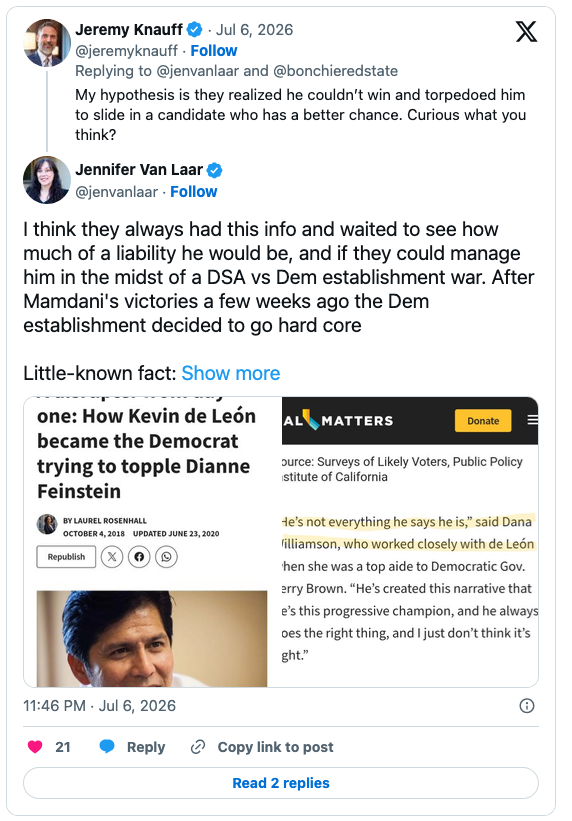
Some observers believe the Democratic establishment has damning files on virtually all their candidates/office holders. This information can be deployed, too, anytime a Democrat becomes a liability and must be whacked, the theory goes.
To the point of my article, though, this all, writes Showalter,
highlights that Democrats have a lot of candidates with these kind[s] of problems. And maybe that has something to do with their own morals, and the anti-family values stances they advocate. Their party is loaded with zero-morals people….
I penned a deep essay about this in February, framing it as leftists being “low-virtue people” (LVPs). Yesterday, too, I cited the 2008 piece “Don’t listen to the liberals — Right-wingers really are nicer people, latest research shows.” Among the findings were, the article relates,
that Right-wingers are happier, more generous to charities, less likely to commit suicide — and even hug their children more than those on the Left.
Then there’s this gem: Among other failings, leftists were more likely to “agree with the statement ‘there are no right or wrong ways to make money’.”
There’s also the probable reason why the #MeToo movement, which targeted sexual predators, fizzled.
That is, likely much to its progenitors’ surprise, it was mainly destroying leftists.
Natural intelligence (mine) long ago estimated that approximately 90 percent of those ensnared were left-wingers. And a Grok artificial intelligence analysis I requested yesterday put the number at 70 to 85 percent.
A Cultural Milieu?
Are we just talking about pseudo-elites here, however? What of the rank-and-file Democrats who enable them? Regarding this and returning to Platner, the aforementioned Di Leo writes:
Democrat voters selected him over more “normal,” relatively inoffensive mainstream Democrats just three months ago, when virtually all his many shortcomings were already known….
There is no difference on the issues, after all, between Platner and the less obviously reprehensible Democrat candidates he defeated.
… The only difference between them is that Mr. Platner made his offensiveness too visible, through a tattoo, some published posts, and a few cases of past behavior.
The voters, Di Leo summed up, “consciously chose the most blatantly repulsive one [candidate] of the group.”
In fairness here, note that people are swayed by style more than substance. Many voters may not know about all a candidate’s scandals or if they’re even true. But they clearly perceive his appearance and level of charisma and speaking ability. And within the context of Maine culture, Platner was right out of central casting.
As for bad character, though, the truth is that we don’t need to learn of personal scandal to discern it. You see, people generally reckon “morality” too narrowly, sometimes fancying it as restricted to sexual matters. In reality, “moral” and “immoral” encompass all that is, respectively, right and wrong. And regarding this, what’s most scandalous about today’s liberals is hiding in plain sight.
That is, their positions.
Just consider some of what today’s leftists generally support:
- The “transgender” agenda.
- Sexual-distortion treatments (euphemistically called “gender-affirming care”) for minors.
- Putting boys in girls’ sports and spaces (and vice versa).
- Rampant prenatal infanticide (abortion).
- The institutionalized unjust discrimination prescribed by diversity, equity, and inclusion (DEI).
- Playing groups against one another to gain political power; e.g., peddling the “white supremacy” lie.
- Enabling a de facto foreign invasion via open borders.
These positions are objectively evil, and advocating for them is the real scandal. And is it surprising that candidates who’d embrace scandalous positions would have scandalous personal lives? That’s to be expected.
Explanation?
So what accounts for this? Is leftism really associated with evil? Or is such a claim mere partisan bias?
The saying “As the twig is bent, so grows the tree” is relevant here. As I explained in my February essay, people become either LVPs or higher-virtue people (HVPs) mainly due to early-years influences. Upon maturity, too, they will generally gravitate toward ideology (worldview, really) that corresponds to their moral foundation. LVPs will tend to glom onto low-virtue ideology.
Put simply, it’s obvious that a group strongly supporting abortion is morally far different from one that passionately defends life.
Second, there’s a reason why moral relativism/nihilism permeates virtually every leftist to the core. (Note: This ism is the belief that what’s called “morality” is a mere social construct.) This isn’t to say no conservatives embrace it; tragically, too many do. But it characterizes leftists. Why?
That early-years socialization is a major factor again. Yet an added incentive is that it enables you to justify anything you may want to do. Your sins aren’t really sins, after all, if morality is mere social construct. They’re just “lifestyle choices.”
This relativism/nihilism not only justifies misdeeds, however, but fathers them. For upon adopting it, a person no longer has any firm guide rails keeping him even close to the straight and narrow. It’s like being given moral carte blanche by the devil.
The lesson here is that a person’s politics doesn’t emerge in a vacuum; it reflects his heart, mind, and soul.
So, as the song goes, “Teach your children well” — because the parenting of today becomes the politics of tomorrow.