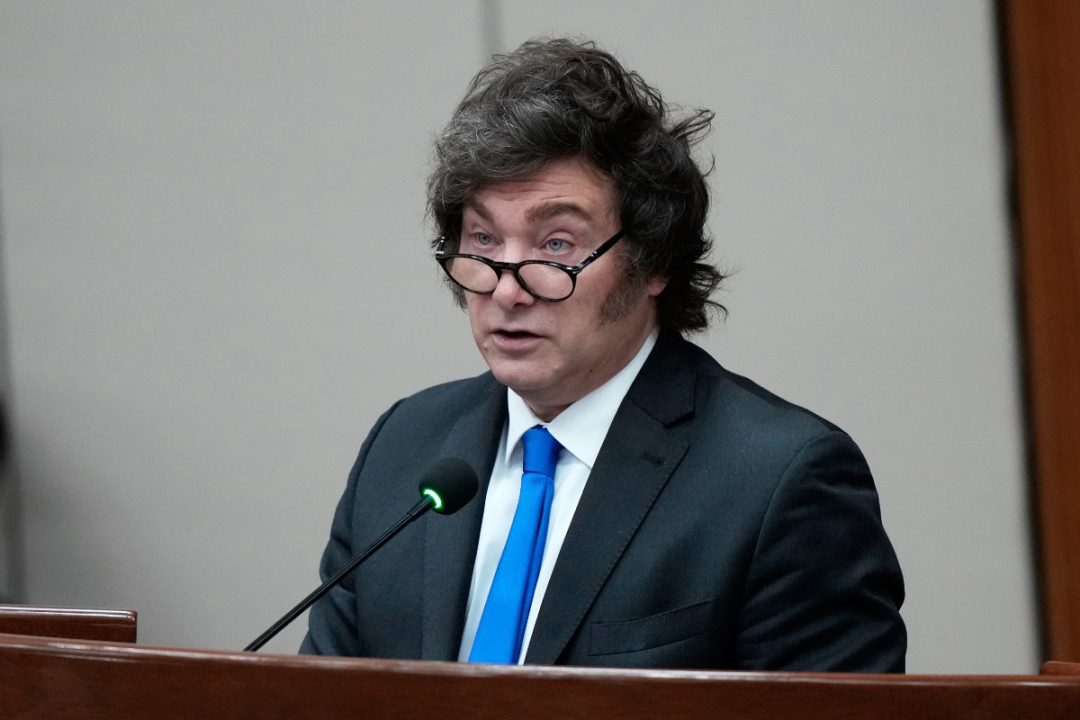
“Fiscal Shackle” Revolution: Argentina’s Milei Aims to KILL the Debt State — for Good
“Rain will always fall downwards,” the saying goes. “Don’t try to change the impossible.” And government will always run up debt to buy votes and print “counterfeit” currency to cover the deficits.
While this is taken for granted, a revolution led by Argentine President Javier Milei aims to break the cycle. If it succeeds, deficit spending (and currency inflation) may become a thing of the past, too.
What Milei is tackling is part of what’s sometimes known as the “Cycle of Democracy.” (It’s usually called the “Tytler Cycle,” but Alexander Tytler didn’t actually write it.) It goes:
A democracy cannot exist as a permanent form of government. It can only exist until the voters discover that they can vote themselves largesse from the public treasury. From that moment on, the majority always votes for the candidates promising the most benefits from the public treasury, with the result that a democracy always collapses over loose fiscal policy, always followed by a dictatorship. The average age of the world’s greatest civilizations has been 200 years.
Milei’s bold plan is called the “Grillete Fiscal,” meaning the “fiscal shackle.” The plan is, too, for it to constrain not just his current ruling government, but future ones as well.
Commentator Thomas Kolbe reported on the story last Wednesday, contrasting Argentina’s recent economic success with Germany’s statism-born malaise:
While Germany’s debt spiral is accelerating ever faster, Argentine President Javier Milei is steering his country in the opposite direction. Germany’s statists will soon be left looking foolish once it becomes obvious that the German model has failed.
Only contrast reveals one’s own mistakes. Javier Milei is the antithesis of Germany’s political class, and the comparison could hardly be starker. While Germany continues to expand the state, Argentina is slashing subsidies and radically reducing the size of its public bureaucracy. While Berlin piles up enormous amounts of public debt, Buenos Aires is posting a primary budget surplus. [German Chancellor] Friedrich Merz believes in the healing powers of state intervention, whereas Milei is deregulating markets and paving the way for an investment boom.
Argentina has achieved an economic turnaround while Germany continues its economic decay. Argentina’s economy is growing steadily, private-sector employment is expanding, and the poverty rate is falling rapidly.
At a time when Germany is doubling down on debt, the arms industry, and green state planning, Milei appears like a comet defying both political gravity and conventional doctrines of government.
The Plan
Not willing to rest on his laurels, however, Milei now wants to make economic sanity permanent. Website La Hora reports on the fiscal-shackle plan, writing that the proposal (auto-translated from Spanish)
is part of a package of economic and institutional reforms presented at the end of July 2026, which includes modifications to the Central Bank’s Organic Charter, the prohibition of monetary financing by the Treasury and other reforms to the financial and insurance system. The declared objective is to shield the balance of the public accounts and reduce political discretion over spending. …
The mechanism proposed by Milei goes a step further: if the State enters into a deficit and a balanced budget is not approved, automatic restrictions similar to a US shutdown would be activated. Non-essential spending would be paralyzed, the government would not be able to expand spending without budget support, and the pressure would fall on Congress and the Executive to correct the problem. The philosophy is to turn fiscal balance into an institutional lock, not a simple political promise.
But the most disruptive aspect of the proposal is not only the adjustment of spending, but who pays the political cost.
According to the design laid out by Milei, if the deficit persists for several months and Congress does not correct the budget, automatic sanctions would be activated that include the freezing of hiring and transfers and, in one of the versions explained by the president himself and by analysts who support the initiative, the president, his ministers and legislators would stop receiving their salaries for the duration of the non-compliance. The idea is to alter the incentives: that the cost of the deficit ceases to fall solely on citizens and begins to have direct consequences for those who make fiscal decisions.
Ending the debt state truly would be a revolution. It’s not just that it would encourage fiscal responsibility, either. Remember that money is big government’s lifeblood; limiting the supply limits government. This is, too, where another already mentioned part of Milei’s plan enters the equation. As BBC News Mundo related (auto-translated from Spanish) July 31, Milei’s Central Bank reforms would
put an end to … an uncontrolled issuance of banknotes that has generated an inflationary spiral in the country.
The reform, the president argued, “comes to put an end to the scam of counterfeiting money to finance high politics.”
“Scam” is the right word. The United States, for example, increases the money supply (i.e., counterfeits currency) by six to seven percent annually on average. This amounts to approximately $1.4 trillion (as of now), backed by nothing, added to the economy per year. This dilutes the value of the dollars in your pocket.
So it’s no wonder late economist Walter E. Williams once made the crack he did about this legalized lunacy.
He said that were he brought before a judge for counterfeiting, he’d say he was just engaging in “monetary policy.”
A Better Way
Speaking of Williams, he’d likely appreciate Milei’s plan. For it would eliminate what Williams called the two forms of hidden taxation: deficit spending and currency debasement (money printing). Yet it could be improved.
Since only accountability changes bad behavior, denying profligate legislators their salary (currently just a proposal) would be a good start. Another consequence would be far more effective, however.
Question: What do politicians generally crave above all else? With people in high finance, the answer might be money. But with politicians it’s power. That’s a major reason why they enter politics and not business.
Given this, the consequence for failing to balance the budget after a prescribed period of time should be automatic expulsion from office. This theoretical plan would mandate that a new election would then have to be held. And the expelled legislators would not be allowed to run in it.
This would completely alter the incentives. Politicians currently are motivated to spend our money to buy votes and special-interest-group support to retain power. Deficits are just the broken eggs to make their omelet. The expulsion consequence would reverse this: Avoiding deficits would be their omelet.
And the special-interest groups’ broken hearts would be their broken eggs.
To quote philosopher Herbert Spencer, “The ultimate result of shielding men from the effects of folly, is to fill the world with fools” — and legislatures with foolish spenders. Politicians will continue wasting our money until and unless destroying our budget means destroying their careers.