

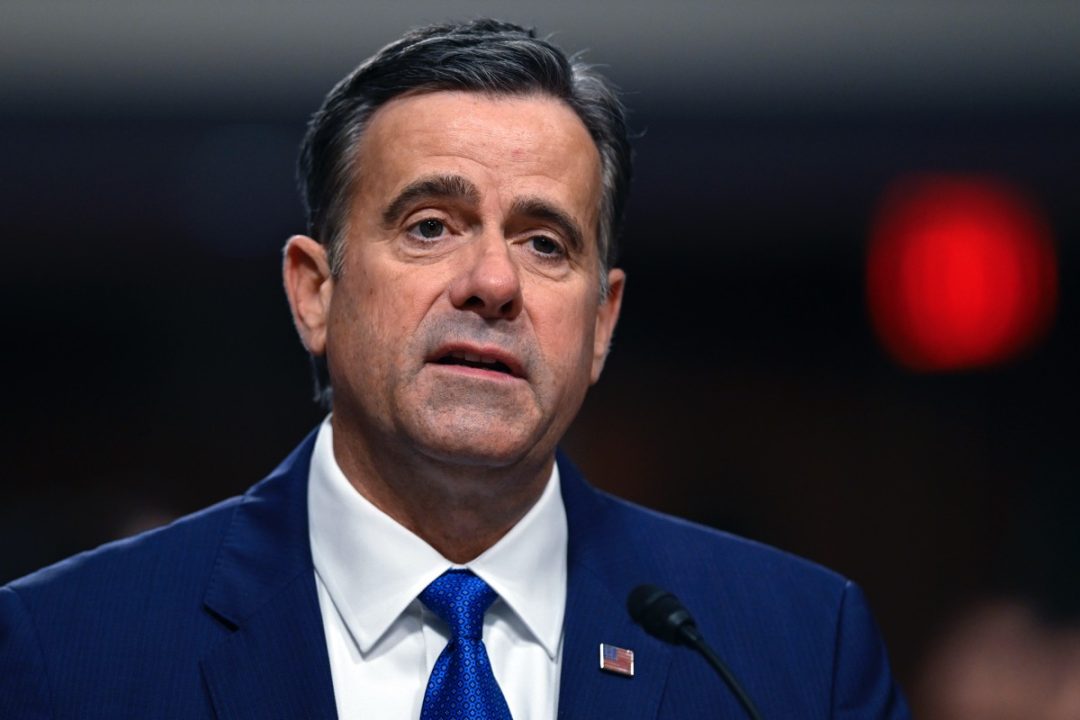
CIA Chief Secretly Visits Moscow. Does U.S. Proxy War Endanger American Military?
CIA chief John Ratcliffe visited Moscow this week without the knowledge of top administration officials. The Wall Street Journal also reported that Ratcliffe warned Russian officials not to attack U.S. NATO allies.
While the Kremlin denied that Ratcliffe uttered any such veiled threat, yesterday a top Russian official did warn Great Britain not to supply Ukraine with long-range missiles that could strike inside Russia. Otherwise, Russia might strike British military targets inside and outside Ukraine.
The two reports suggest that the U.S.-NATO attempt to encircle Russia and wage war on the country through proxy state Ukraine might well blow up into a wider war.
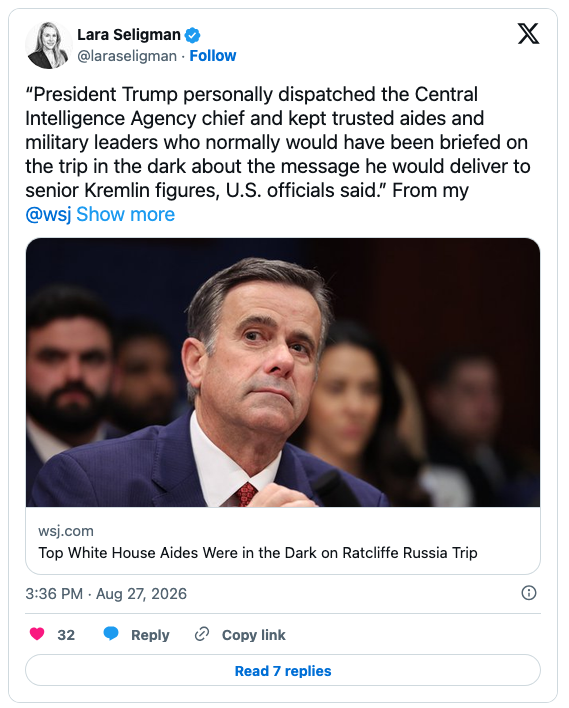
Surprise Visit
Ratcliffe’s maiden mission to Moscow was a “surprise,” the Journal reported. He went to “deliver a warning to Russia not to attack NATO countries,” sources told the paper.
U.S. intelligence said that Russian President Vladimir Putin “could try to test the resolve of the North Atlantic Treaty Organization with a limited assault on an allied country in the next few years,” the newspaper continued:
U.S. officials are concerned that Putin, squeezed in Ukraine and under pressure at home, could launch an assault ranging from a cyberattack to a small-scale land incursion, likely on a Baltic nation, the Journal [previously] reported.
A shortfall in critical Western munitions, driven by expenditures in the Iran war, also could factor into Putin’s thinking. The U.S. has degraded its stockpile of certain weapons because of transfers to Ukraine after Russia’s 2022 invasion, as well as the Iran conflict.
“Degraded” is one word for what subsidizing Ukraine’s futile fight and the war in Iran have done to America’s military muscle. Another is wasted. The U.S. Army has used “virtually all” of its long-range missiles against Iran. Replacing that ordnance will take years. Russia and China clearly know the two wars have seriously dissipated U.S. military power.
Kremlin spokesman Dmitry Peskov said that Ratcliffe met with his Russian counterparts, but did not meet with Putin.
President Donald Trump told Israel-First podcaster Glenn Beck that Ratcliffe’s sojourn was “semi-routine,” the Journal explained, and said that “something may come out of it” relative to the Russia-Ukraine war. “We’re working very hard to get that war ended,” Trump said.
When Trump will start working to end the war with Iran and keep his promise to stop endless foreign wars isn’t clear.
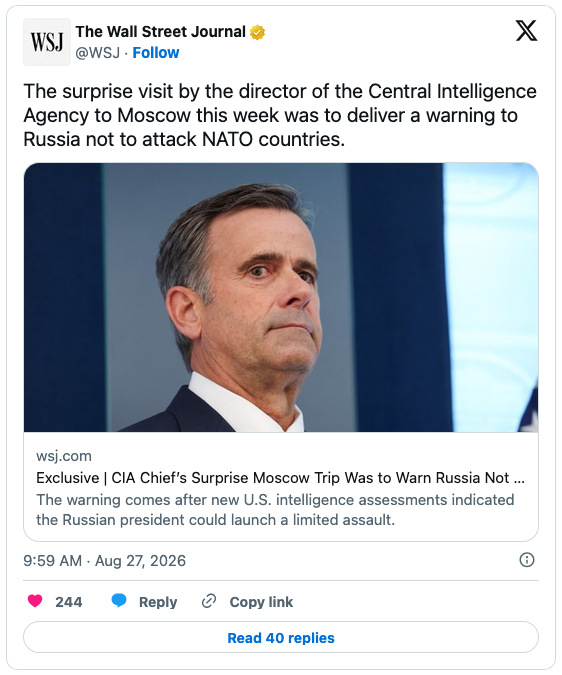
Strangely, a separate Journal offering revealed, top Trump officials were as in the dark about Ratcliffe’s trip as they are about Trump’s wee-hours Truth Social rampages. The trip “was so sensitive that even some senior White House officials didn’t know about it ahead of time,” the newspaper reported.
Trump “personally dispatched” the CIA director and “kept trusted aides and military leaders who normally would have been briefed on the trip in the dark about the message he would deliver to senior Kremlin figures, U.S. officials said,” the Journal continued:
By sending the spy-agency chief, Trump relied on a different aide after previous rounds of negotiations using other trusted envoys failed to stop the fighting in Russia’s war with Ukraine. Over the past few months, Moscow has escalated its attacks on Ukraine, boosted support for Iran’s regime and resisted American attempts to improve economic ties.
Ratcliffe’s secretive journey, which included flying into Moscow in an unmarked U.S. C-17 military cargo plane from Latvia, sent European officials scrambling for information after news of the visit spread, some of those officials said. After being briefed, two European officials said the CIA director reinforced to his Russian intelligence counterparts that the U.S. remained committed to the North Atlantic Treaty Organization’s Article 5, which says that an attack on one member is considered an attack on all. The Wall Street Journal previously reported that Ratcliffe warned Russian officials not to attack NATO countries.
Russia Warns England
Kremlin spokesman Peskov claimed that Ratcliffe did not warn Russia not to attack NATO. “A lot of this kind of scare-story material is being published right now,” he said:
Of course, it has nothing to do with reality and nothing to do with the intentions of the Russian Federation.
True, perhaps, but if Ratcliffe did issue such a warning — or threat — he essentially told Putin that the U.S. and NATO reserved the right to wage a proxy war against Russia through Ukraine’s corrupt dictatorship.
Thus did Russian Foreign Ministry spokesperson Maria Zakharova warn Great Britain: It had better stop giving Ukraine long-range cruise missiles to hit targets inside Russia.
“This came a day after Moscow accused Ukraine of striking a shopping center in Russian-controlled Donetsk with British Storm Shadow missiles, wounding civilians, including children,” Fox News reported, citing Reuters.
On Thursday, Zakharova said “Britain was ‘one step away’ from becoming legally complicit in what she described as civilian-targeted ‘terrorism,’ warning that failure to change course would bring ‘catastrophic consequences.’”
U.S. Assets Are Targets
A question for hate-Russia globalists here is how many steps away America is from a Russian attack on U.S. assets across Europe. As with his promise not to start a war in the Middle East, another of Trump’s broken promises is involving the United States directly in Ukraine’s fruitless war against Russia.
In October, the Financial Times reported that U.S. intelligence is waging a secret, illegal war there.
“For months,” the paper reported, American intelligence officials have “been helping Ukraine mount long-range strikes on Russian energy facilities, in what officials say is a co-ordinated effort to weaken Vladimir Putin’s economy and force him to the negotiating table.”
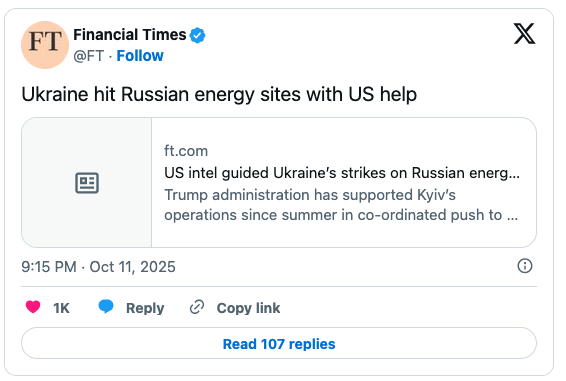
“Intelligence shared with Kyiv has enabled strikes on important Russian energy assets including oil refineries far beyond the frontline, according to multiple Ukrainian and US officials familiar with the campaign,” the Times continued:
The previously unreported support has intensified since midsummer and has been crucial in helping Ukraine carry out attacks that Joe Biden’s White House discouraged. Kyiv’s strikes have driven up energy prices in Russia and prompted Moscow to cut diesel exports and import fuel.
The intelligence sharing is the latest sign that Trump has deepened his support for Ukraine as his frustration with Russia has grown.
Frighteningly, shared information doesn’t just involve passing along documents. It “helps Kyiv shape route planning, altitude, timing and mission decisions, enabling Ukraine’s long-range, one-way attack drones to evade Russian air defences, said the officials familiar with the matter.”
The United States is “closely involved in all stages of planning. A US official said Ukraine selected the targets for long-range strikes and Washington then provided intelligence on the sites’ vulnerabilities,” the Times noted:
But others involved and briefed on the operations said the US had also set out target priorities for the Ukrainians. One of them described Kyiv’s drone force as the “instrument” for Washington to undermine Russia’s economy and push Putin towards a settlement.
Since 2022, the United States has wasted $164 billion on Ukraine, the Council on Foreign Relations reported. Much of that money paid for weapons sent to Ukraine or resupplied U.S. ordnance inventory. Ukraine is killing Russians with American weapons.
The question is, When does Russia warn the United States to either back off or be attacked?