

ICE Moves to Buy Robot Quadrupeds As Federal Police State Expands
The Department of Homeland Security is preparing to add four-legged robots to ICE’s growing enforcement arsenal.
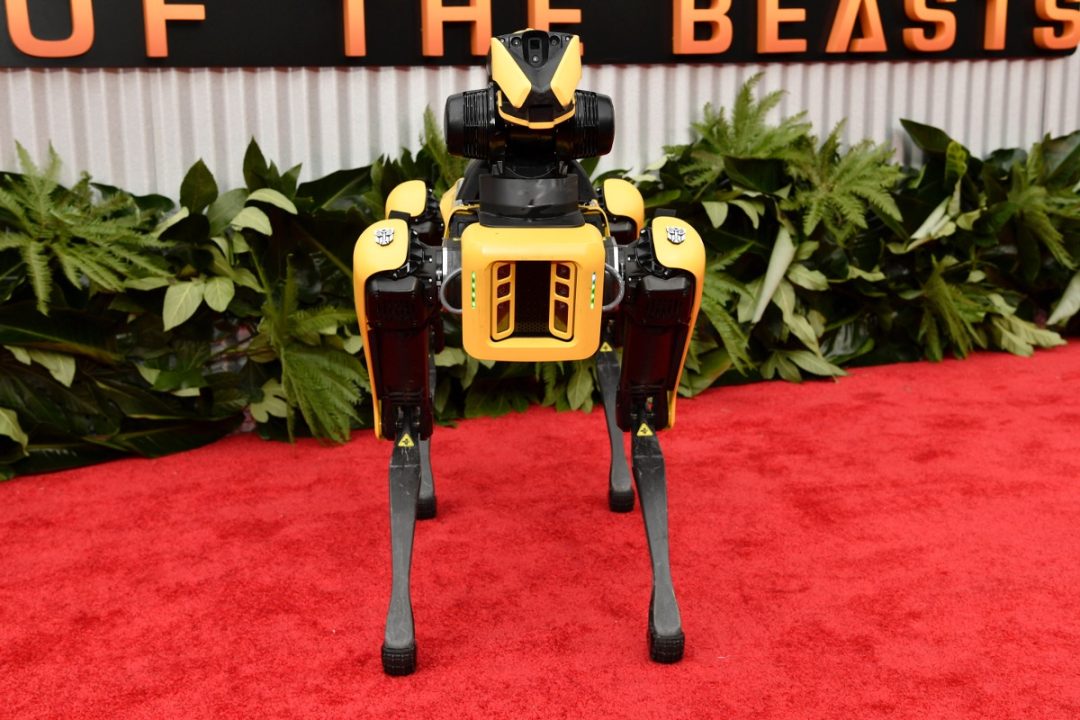
They are often called “robot dogs,” a friendly label that makes the machines sound more familiar, if not sympathetic, and far less threatening than they really are.
In reality, they are sophisticated mobile surveillance platforms capable of performing a wide range of tasks, including surveillance, navigation, inspection, object manipulation, and semi-autonomous patrols.
The proponents point to the safety benefits. Agents can send a machine into a dangerous area instead of risking human lives.
But there is a darker side to normalizing such technology. Once robotic surveillance becomes an ordinary tool of federal law enforcement, the line between legitimate tactical use and a more pervasive, militarized police infrastructure becomes easier to cross.
Let us stress: Enforcing immigration law is essential. Building a dystopian domestic police state to do it is not.
ICE Goes Shopping
The Department of Homeland Security (DHS) published an acquisition forecast on August 27 for what it called the “Boston Dynamics SPOT Robots Procurement.” The buyer is U.S. Immigration and Customs Enforcement’s (ICE’s) Office of Firearms and Tactical Programs (OFTP).
The projected value is between $1 million and $2 million.
DHS says ICE wants the machines and related accessories for “inspection, situational awareness, and hazard assessment in environments that may pose risks to personnel.”
The forecast describes the purchase as a new requirement, and anticipates an award in the fourth quarter of fiscal year 2026. It also lists the procurement as noncompetitive and names Boston Dynamics directly.
A senior DHS official told NBC News that ICE plans to use the robots in buildings and other areas considered too dangerous for officers to enter. The machines would carry cameras and sensors capable of detecting chemicals and relay information to agents about whether an area is safe to enter. The official said the robots “will not be used to make arrests.”
ICE published a separate market research notice on August 28 seeking information about “quadruped unmanned ground vehicles.”
That notice is not yet a contract solicitation. But its draft specifications provide a much clearer picture of what ICE wants.
Each proposed vehicle would weigh about 106 pounds with batteries. It would carry high-definition cameras with 360-degree visibility, and include thermal imaging with 30-times optical zoom.
The platform would feature enhanced lighting with low-light capability and powerful illumination, extended radio capability, and a front-mounted manipulation arm with a gripper.
ICE also wants a transmission range of more than 2,700 feet and training specifically designed for law-enforcement officers.
What “Spot” Can Do
Boston Dynamics already markets Spot specifically to government and police agencies.
Its Government & Public Safety Kit combines the four-legged platform with an advanced camera system, extended radio communications, and an optional robotic arm.
The base robot weighs about 72 pounds, stands roughly 24 inches high while walking, and measures about 43 inches long. It can move at up to 3.6 mph, climb 30-degree slopes, and step over obstacles nearly 12 inches high.
Officers can remotely send Spot up and down stairs, through buildings, and across rough terrain. With standard public safety radios, operators can control Spot from over half a mile away under suitable conditions. The robot can also carry up to 30 pounds of sensors and other equipment.
Two-way communications allow officers to see, hear, and speak through the machine while remaining far from the people it is observing.
The optional “Spot Arm” adds a physical dimension.
Boston Dynamics says the arm can open doors, grasp and lift objects, drag items, flip switches, and turn valves. Some actions are semi-autonomous. An operator can identify a door or object, then let the machine perform much of the task itself.
That makes Spot more than a rolling camera.
It can enter spaces, inspect them, manipulate its surroundings, and carry specialized sensors into places where officers do not want to go themselves.
Boston Dynamics promotes these capabilities for barricaded suspects, suspicious packages, hazardous-material incidents, and other dangerous situations. It has also discussed perimeter security and the integration of chemical, nuclear, and other specialized sensors.
Those uses can serve legitimate safety purposes.
But they also show how much surveillance and physical capability can now be concentrated in a single mobile machine.
From Remote Tool to Autonomous Patrol
More consequential still is autonomy.
Spot does not always require an officer to guide every movement.
Boston Dynamics advertises both manual and autonomous missions. Users can record a route and have Spot repeat it autonomously. The robot can navigate around new obstacles and dynamically replan its route. When paired with a docking station, it can recharge itself, and if it falls, it can right itself.
That capability already has a federal precedent.
In 2022, under President Joe Biden, the DHS Science and Technology Directorate tested similar quadruped robots with Customs and Border Protection (CBP).
Operators sent the machines into a mock residential building. The robots entered the structure, moved through hallways, peered around corners, and navigated stairs while carrying cameras and other sensors.
DHS also tested an autonomous sentry function.
The machines followed predetermined GPS waypoints, completed their circuits, and returned to base without an operator directing every movement. DHS tested the autonomous patrols in both daylight and at night.
Officials described such semi-autonomous systems as “force multipliers.”
Now, under President Donald Trump, ICE is considering bringing this class of machine directly into its tactical operations.
ICE Militarizes
The robot proposal comes as ICE rapidly expands an already formidable tactical apparatus.
ICE’s own fiscal 2024 annual report describes Special Response Teams, Tactical Emergency Medical Services, crisis negotiation units, and a sniper program. OFTP, the same office behind the proposed robot purchase, trained more than 1,500 personnel in use of force and tactical operations.
That buildup accelerated dramatically under the “One Big Beautiful Bill” (OBBB), which provided roughly $170 billion for border and immigration enforcement through 2029.
An In These Times report put the scale in perspective:
If the immigration enforcement apparatus of the United States were its own national military, it would be the 13th most heavily funded in the world.
ICE has also dramatically increased its weapons purchases. From January 20 through October 18, 2025, its small-arms spending reached $71.5 million, roughly seven times the comparable 2024 figure.
The OBBB also included $45 billion for rapidly mushrooming detention capacity and nearly $30 billion for ICE removal and enforcement operations.
Billions more are going toward surveillance and technology. As Biometric Update reported, more than $5.2 billion within ICE’s share was slated for infrastructure modernization, including $2.5 billion for artificial intelligence, biometric collection, and digital case tracking.
ICE is adding new weapons as well. Last week, the agency awarded a $16.7 million contract for 6,000 pairs of electric shock gloves.
Now come the robots.
Each tool may have its own stated justification. Taken together, however, they reveal something larger: A federal agency increasingly equipped like a paramilitary force, backed by AI, biometrics, surveillance systems, shock weapons, tactical teams, and machines capable of autonomous operation.
Enforce the Law Without Building a Police State
The larger issue is not what ICE says these machines will do today. It is what Americans are being asked to normalize for tomorrow.
For sure, immigration enforcement is a legitimate function of government. A country has every right to secure its borders and remove those who have no lawful right to remain.
But building this kind of federal police infrastructure is something else entirely.
Authorities created for one emergency, one population, or one political priority rarely remain confined there. And the federal government, regardless of which party controls it, has repeatedly shown why it should not be trusted with increasingly sophisticated technological tools on the assumption that they will always be used narrowly and responsibly.
Americans should not have to choose between enforcing immigration law and accepting an increasingly militarized federal police force equipped with autonomous surveillance machines.