

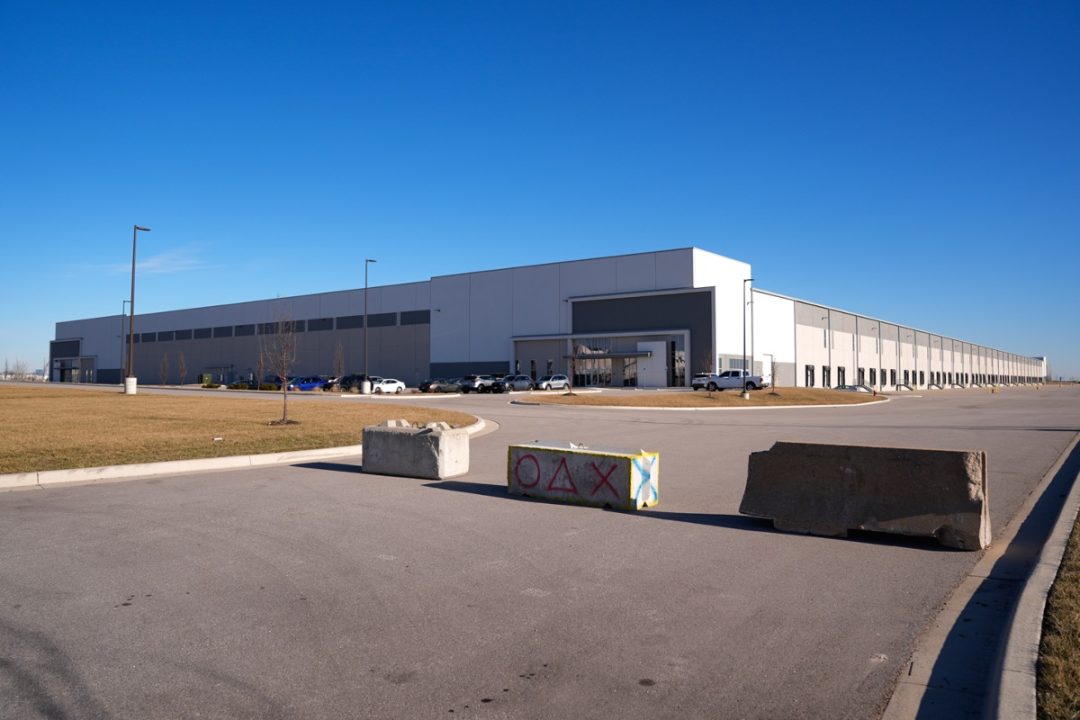
DHS Building Large-scale Detention Network Using Warehouses and Navy-linked Contracts
The Department of Homeland Security (DHS) plans to drastically expand the nation’s mass-detention capacity. The strategy runs on two tracks. DHS is acquiring existing industrial warehouses and converting them into large-scale detention centers. At the same time, it is preparing to build new massive facilities through a contracting pathway tied to the U.S. Navy.
The buildout is tied to immigration enforcement and follows years of record migrant inflows under the previous administration. The deliberate “open-border” policy substantially increased the scale of the problem. Yet the response appears to extend well beyond both immigration enforcement and traditional constitutional restraints, raising alarms about permanency, diminishing oversight, and the normalization of large-scale civil detention inside the United States.
In the broader context, the warehouse conversions and new construction fit into a continuing expansion and militarization of domestic law enforcement infrastructure and federal surveillance authority. That trajectory, more than any single border policy, represents the deeper and more consequential shift.
Mega Warehouses
The facilities at the center of the plan are not traditional detention complexes. They are commercial logistics structures located in industrial zones near highways and rail lines originally built for storage and freight movement.
According to NBC News, the scale alone distinguishes these sites from previous models:
The proposed centers are so large that some could house as many as 8,000 detainees at once, according to a DHS spreadsheet of more than 20 potential locations that was verified by NBC News. The largest federal prison in the U.S., for example, has roughly 4,000 inmates.
At least three warehouse properties have already been acquired. In Surprise, Arizona, U.S. Immigration and Customs Enforcement (ICE) paid about $70 million for a 418,000-square-foot facility in an industrial park. “The building is the size of more than seven football fields,” reported the local NBC affiliate. Near Philadelphia, a 520,000-square-foot warehouse sold for more than $87 million. In San Antonio, another site, valued at $37 million, spans nearly 640,000 square feet.
The size of these buildings drives the policy implications. Housing, feeding, monitoring, and providing medical care for thousands of people inside a single enclosed structure is not a minor operational adjustment. It represents a structural shift in how civil detention is organized.
According to previous reporting from NBC, the funding comes from the reconciliation package dubbed “One Big Beautiful Bill” Trump signed into law last July.
“The warehouses would be owned by ICE outright and not contracted through the private prison industry or states,” officials told the outlet in November.
Detention Network
The mega warehouses already being purchased are not stand-alone projects. They are designed to plug into a wider detention architecture that federal planning documents describe as a coordinated national system.
The Washington Post reported in December that internal ICE documents outline plans for seven new large-scale detention hubs intended to anchor this network. Each site would hold between 5,000 and 10,000 detainees and operate near major logistics corridors in states including Virginia, Texas, Louisiana, Arizona, Georgia, and Missouri. Together with 16 smaller processing warehouses, the system would create capacity to confine more than 80,000 people at a time.
Under the model described in the draft solicitation, newly arrested migrants would first enter short-term processing facilities for intake, medical screening, and case handling. After several weeks, they would be funneled into one of the seven major hubs for removal staging. The smaller warehouses, holding between 500 and 1,500 people, would function as feeder and overflow sites within the same pipeline.
The solicitation details extensive structural modifications,
ICE plans to heavily modify the structures to include intake areas, housing units with showers and restrooms, a kitchen, dining areas, a medical unit, indoor and outdoor recreation areas, a law library, and administrative offices, according to the solicitation. Some of the facilities will include special housing designed for families in custody.
Detainees would begin arriving 30 to 60 days after construction starts, according to the document.
The draft states the new facilities will “maximize efficiency, minimize costs, shorten processing times, limit lengths of stay, accelerate the removal process and promote the safety, dignity and respect for all in ICE custody.” ICE acting Director Todd Lyons described the operational goal in business terms. He said deportations should run “like [Amazon] Prime, but with human beings.”
Military Logistics
The warehouse conversions and hub network form the fixed base of the expansion. An integrated military logistics contracting channel supplies the rapid deployment capacity that allows the detention system to scale.
Journalist Pablo Manríquez reported in early February:
A massive Navy contract vehicle, once valued at $10 billion, has ballooned to a staggering $55 billion ceiling to expedite President Donald Trump’s “mass deportation” agenda.
The mechanism is the Worldwide Expeditionary Multiple Award Contract, or WEXMAC. It was originally designed to move military logistics into remote or unstable regions. The contract was repurposed under a designation called “TITUS,” short for Territorial Integrity of the United States. According to the contract language, the scope includes “humanitarian assistance/disaster relief, contingency, exercise, lodging, logistics, water-based, and land-based support.” The base period began in January 2025 and runs through December 2029, with options extending performance through 2034.
Manríquez wrote that this shift “converts the U.S. into a ‘geographic region’ for expeditionary military-style detention”:
In the world of federal contracting, it is the difference between a temporary surge and a permanent infrastructure.
Under this structure, projects can be launched through rapid “task orders.” That helps bypassing the lengthy public bidding process typical of civilian procurement. As Manríquez put it,
the infrastructure is currently a “ghost” network that can be materialized anywhere in the U.S. the moment a site is picked.
Contract line items cited in the reporting include “‘soft-sided’ tent cities capable of housing up to 10,000 people each,” large-scale sanitation and shower units, food preparation equipment, medical-support tents, and “Force Protection” materials such as barriers and guard structures.
A Detention System Built to Scale
Unlawful entry is a violation of federal law, and immigration enforcement is a legitimate federal responsibility. However, the expected detention of tens of thousands of immigrants — a majority of whom may have no criminal convictions beyond civil immigration violations or misdemeanor entry offenses — raises humanitarian concerns. The expansion also raises questions regarding the constitutionality of possible prolonged detention without individualized judicial review.
The military-linked contracting layer adds another troubling dimension. It allows detention infrastructure to scale quickly wherever federal authorities define an operational need. Today, it is framed as immigration enforcement. Yet, the long record of federal overreach suggests that such a network could be repurposed. Indeed, the state can easily use it for quarantine enforcement during public health “crises,” detention tied to national security or “counterterrorism” investigations, or other “emergency” authorities invoked.
The longer-term issue, then, is whether the United States is normalizing a permanent domestic detention apparatus built for scale.
Related:
DHS Expands Surveillance Reach With New Drone Office
Federal Court Blocks ICE From Restricting Congressional Oversight Visits
DHS Says ICE Officers Have “Federal Immunity.” The Law Is More Complicated