DOJ Report Details FBI’s “Richmond Catholic Memo” That Targeted “Radical Traditionalist Catholics”
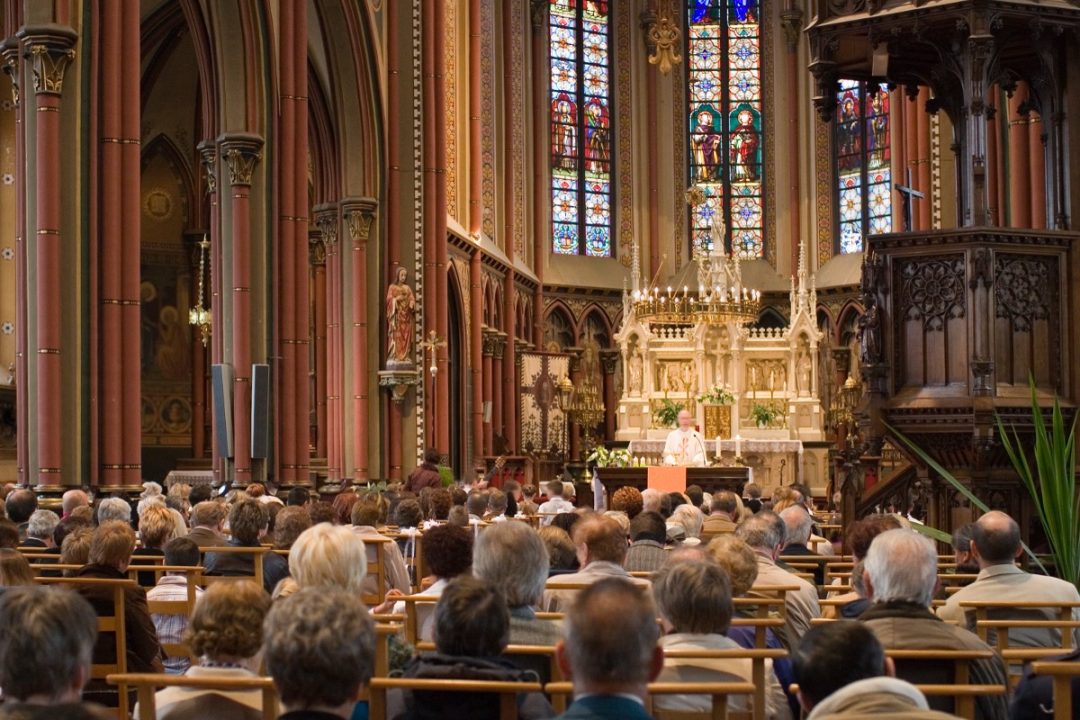
In 2023, the FBI under President Joe Biden attempted to cast so-called radical traditionalist Catholics as fanatical racists, antisemites, and possible terrorists.
The politicized agency’s office in Richmond, Virginia, not only linked a certified kook with two priests and then investigated those priests, but also relied on left-wing media reports and the disgraced Southern Poverty Law Center to help concoct a cockamamie theory that the FBI eventually renounced.
Details about the effort appear in the Department of Justice’s Weaponization Working Group’s 231-page report. The bureau’s agents suggested that “radical traditionalist Catholics” were a band of deranged malcontents who might at any time stage a nationwide terror campaign.
The latest on the far-left Biden Justice Department comes almost four months after a report that showed the administration targeted Christians in general for mistreatment and prosecution because they did not support the administration’s fanatical advocacy for the mass murder of the unborn and genital mutilation of minors under the guise of “gender-affirming care.”
The Priests
Published pursuant to President Donald Trump’s Executive Order 14147, “Ending the Weaponization of the Federal Government,” the report explains that the probe of “radical traditionalist Catholics” and the subsequent notorious “Richmond Catholic Memo” opened when the FBI began investigating a convict — Target 1 — who attended Our Lady of Fatima Chapel, of the Society of St. Pius X. The Vatican recently declared the society to be in schism and excommunicated from the Catholic Church, though canon lawyers have cast serious doubt on the legality and effect of that declaration.
In any event, “during his time in prison, Target 1 continued espousing violent, racial views,” the report notes:
He wrote to a relative that the “government is evil” and “all that needs to be done is for us to truly unite in Christ Jesus and make total war against the Satanic occultists Government.” He vowed to “destroy” “Jews, Liberals, communists, degenerates, Zionists, progressives, capitalists, globalists, and green-party PETA-type environmentalists.”
Thus did FBI contact “Priest 1” to inquire about Target 1, the report continues:
He said he knew Target 1 through the church — though not well — and that, to Priest 1’s knowledge, Target 1 was not a member of the church, was not Catholic, and had never been to Confession. Priest 1 knew Target 1 attended 3-4 catechism classes but said that Target 1’s “stance on things definitely need[ed] to be modified before he c[ould] join the church.” Priest 1 also stated that Target 1 had “crazy views about race” and war and was a white supremacist. When asked if Target 1 “ever discussed committing violence,” the FBI report recounts that Priest 1 “seemed to become nervous and began stumbling on his words,” and asked “if he could talk to the leadership of the church and/or a lawyer before speaking further.”
The bureau also investigated Priest 1’s uncle, “Priest 2,” for that cleric’s supposed radical connections. Federal agents hounded that priest in his international travels.
The bureau had opened “Guardian” files on the two, but then closed them because the priests had done nothing wrong.
“Radical Traditionalist Catholics”
At the same time, the Richmond field office was developing its theory that “radical traditionalist Catholics” (RTCs) were a national security threat. That kookery is summarized in the notorious Richmond Catholic Memo.
“The thesis of the Richmond Catholic Memo … linked the ‘interest of racially or ethnically motivated violent extremists’ to ‘radical-traditionalist’ Catholic ideology,” the report notes.
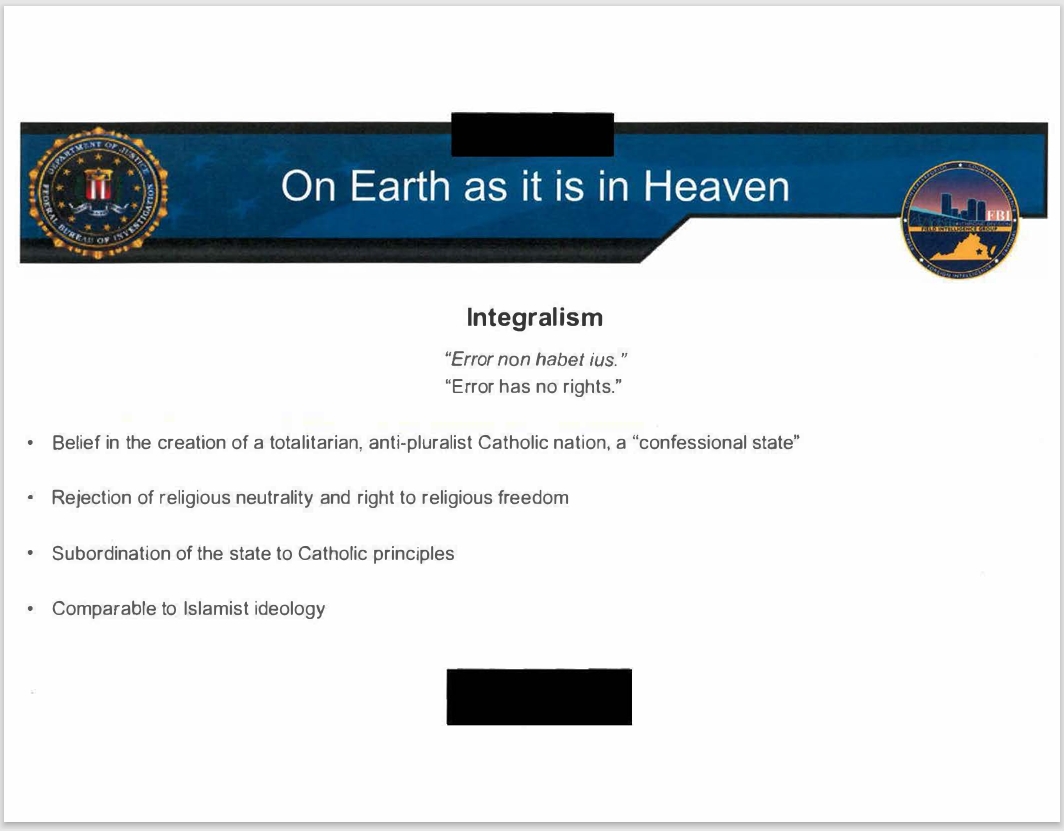
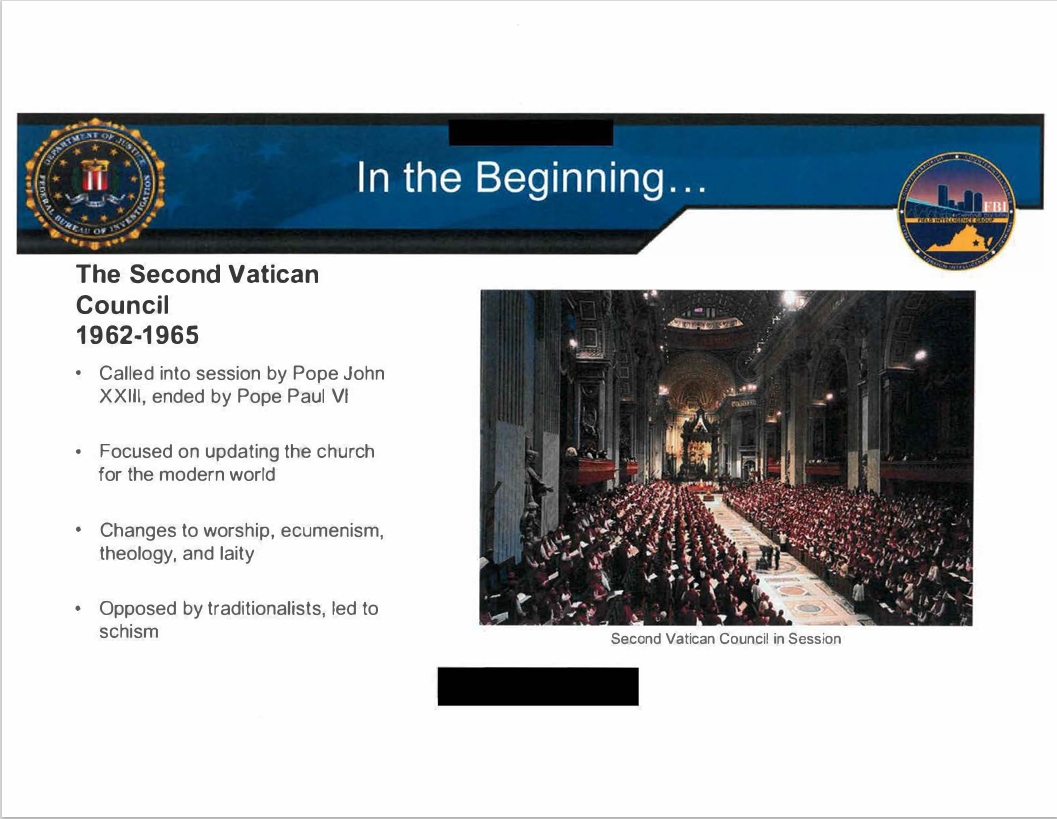
“To support the Memo then, FBI needed to define the term ‘radical traditionalist Catholic,’” which it did in a footnote:
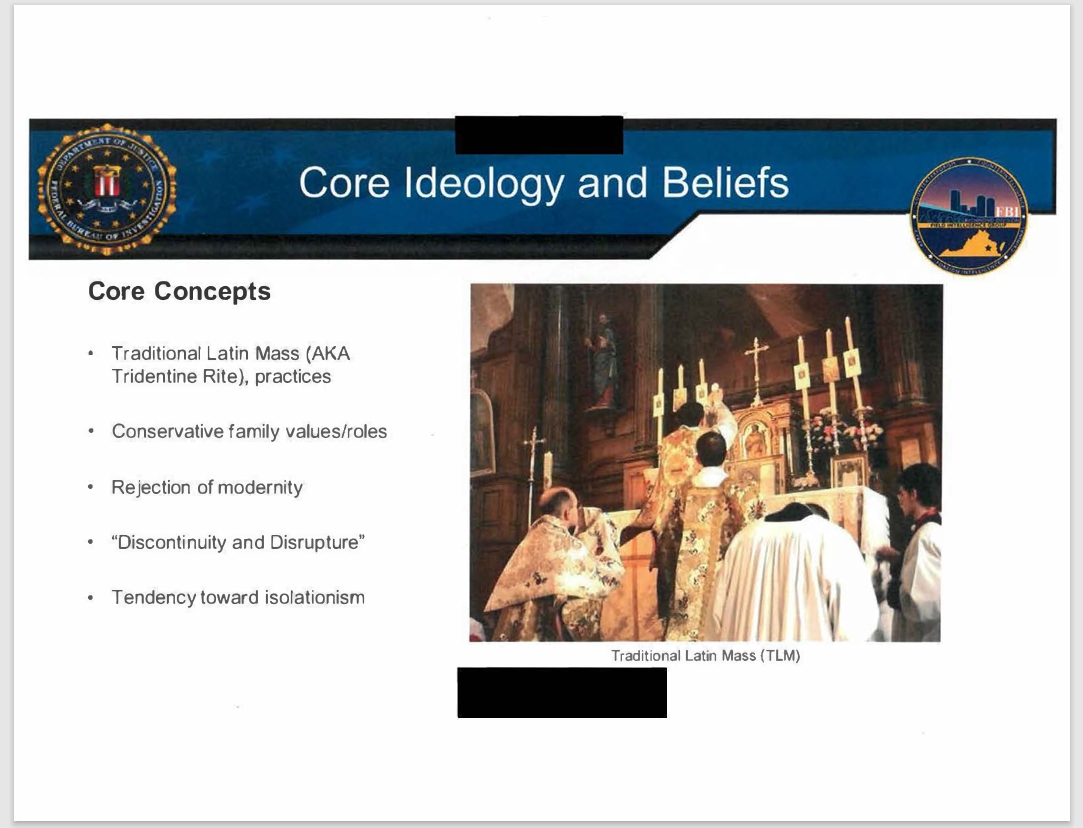
RTCs are typically characterized by the rejection of the Second Vatican Council (Vatican II) as a valid church council; disdain for most of the popes elected since Vatican II, particularly Pope Francis and Pope John Paul II; and frequent adherence to anti-Semitic, anti-immigrant, anti-LGBTQ, and white supremacist ideology. Radical-traditionalist Catholics compose a small minority of overall Roman Catholic adherents and are separate and distinct from “traditionalist Catholics” who prefer the Traditional Latin Mass and pre-Vatican II teachings and traditions, but without the more extremist ideological beliefs and violent rhetoric. Vatican II took place from 1962-1965 and essentially shaped the modern Roman Rite Catholic Church. It was intended to help the church respond to global cultural changes in the aftermath of World War II and resulted in significant reforms to the liturgy, attitudes toward non-Christian religions, roles and responsibilities of the laity, views on religious freedom, etc.
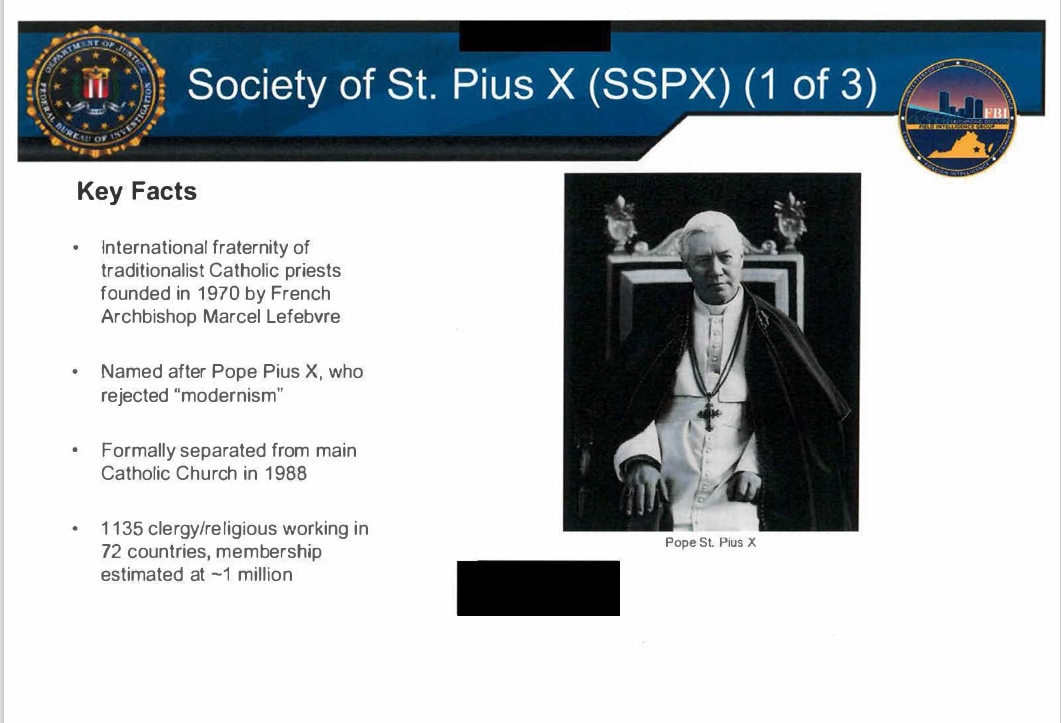
Thus did the bureau waste time creating a presentation called “Traditionalist Catholicism Overview” that “makes broad generalizations about so-called ‘Traditionalist Catholics’ and provides a window into how the Richmond Field Office differentiated ‘radical traditionalist Catholics’ that the office believed posed national security threats from others,” the report says:
The differentiation involved mostly doctrinal disputes, including changes made by the Second Vatican Council.
The memo also targeted “multiple chapels and a seminary” near Richmond to apprise them of “the warning signs of radicalization and enlist their assistance to serve as suspicious activity tripwires.”
FBI Sources
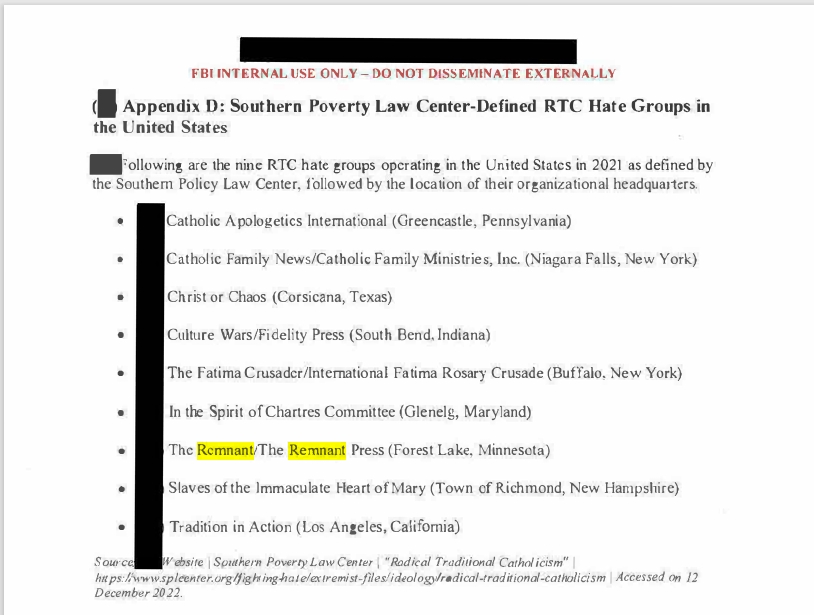
Also included in the report is an appendix titled “Southern Poverty Law Center-Defined Hate Groups in the United States.” Those groups include Culture Wars magazine and its Fidelity Press; The Remnant, a venerable traditionalist Catholic newspaper; and other organizations.
The FBI also used the far-left Salon website and equally far-left Atlantic magazine as sources for some of its claims, the report observes. “For example, citing Salon articles, [the Richmond Catholic Memo] pointed to ‘increasing collaboration’ between a ‘far-right Catholic media outlet’ and the political ‘“groyper” movement,’ and, citing an Atlantic article, referenced ‘increase[d] hostility toward abortion-rights advocates on social media sites in the run-up to and aftermath of’ the overruling of Roe v. Wade.”
A federal grand jury recently indicted the SPLC and a top former official on charges of wire fraud, making false statements, and money laundering in connection with funding the very hate groups it claims to fight.
After the anti-Catholic memo leaked to the public, an internal probe found that those who conducted the investigation lacked “professional judgment and failed to adhere to FBI standards.”
Those involved were supposed to “be admonished,” and the FBI “terminated from their positions” those involved in creating the memo.
The report is 21 pages of text and 210 pages of exhibits.