
Grand Jury Returns Superseding Indictment of SPLC
The Southern Poverty Law Center not only financed extremist organizations the outfit claimed to be fighting, but also paid extremists to stay in organizations they wanted to leave, a superseding federal indictment of SPLC alleges.
Filed on June 2, the federal grand jury’s new indictment adds details to the wire fraud, making false statements, and money laundering charges the group faces. It drills into the dates, fake businesses, and recipients of more than $3 million from the outfit.
SPLC pleaded not guilty last month. It complained to the court that federal prosecutors wrongly released the superseding indictment to the media before it was unsealed.
The New Indictment
Filed on April 21 in the U.S. District Court for Alabama’s Middle District, the original 11-count indictment alleged that SPLC secretly paid extremist “field sources,” called “Fs,” including more than $1.2 million throughout two decades to a member of the neo-Nazi National Alliance. Those Fs continued their activities, which in turn helped SPLC raise more money.
“While the SPLC received donation money under the auspices that the funds would be used to ‘dismantle’ violent extremist groups, this donation money was, instead, being used, in part, by the SPLC to pay leaders and others within these same violent extremist groups,” the indictment alleged:
That money was then used for the benefit of the individuals as well as the violent extremist groups.
As the introduction of the new filing explains, “Unbeknownst to donors, some of their donated money was being used to fund the leaders and organizers of racist groups, including the Ku Klux Klan, the Aryan Nations, and the National Alliance.”
SPLC paid field sources to promote racist groups “at the same time that the SPLC was denouncing the same groups on its website,” the new indictment alleges:
The SPLC also had a field source who was a member of the online leadership chat group that planned the 2017 “Unite the Right” event in Charlottesville, Virginia. That field source made racist postings under the supervision of the SPLC and helped coordinate transportation to the event for several attendees. … [T]o covertly pay its field sources, the SPLC opened bank accounts connected to a series of fictitious entities. The covert nature of the accounts allowed the SPLC to disguise the true nature, source, ownership, and control of the fraudulently obtained donated money the SPLC paid the field sources. … [T]to keep the scheme going, the SPLC made a series of false statements related to the operation of the accounts.
Extremists Paid to Stay in Organizations They Wanted to Leave
Three allegations in the second indictment should interest the elderly suckers and leftist coconuts who sent SPLC millions of dollars in donations.
The National Alliance neo-Nazi not only collected more than $1.2 million throughout more than 20 years, the indictment alleges, but also broke in to the headquarters of another extremist organization and stole 25 boxes of documents. Those documents became the basis of a story for SPLC’s “Hatewatch” resource. And that, in turn, was a device to raise even more money under false pretenses.
More nefariously, SPLC paid extremist field sources to stay in organizations after the sources asked for help to leave them. Those Fs were F-30, F-31, and F-32.
“Out of money and seeking to get out of the white nationalist movement …, F-30 reached out to the SPLC, unsolicited, and discussed a plan to leave the movement,” the indictment alleges:
Thereafter, the SPLC employee offered F-30 a monthly salary of approximately $2,500.00 in addition to payment of expenses to continue to lead and maintain the violent extreme organization that F-30 told the SPLC employee he wanted to leave.
Amusingly, while using donors’ money to fund F-30’s activities, SPLC created a web page devoted to F-30, which it then used “to solicit more public donations”:
At one point, F-30 asked an SPLC employee to soften the language about him on his … webpage so that it would not scare off new members from joining his extremist organization. The SPLC employee agreed and changed the language.
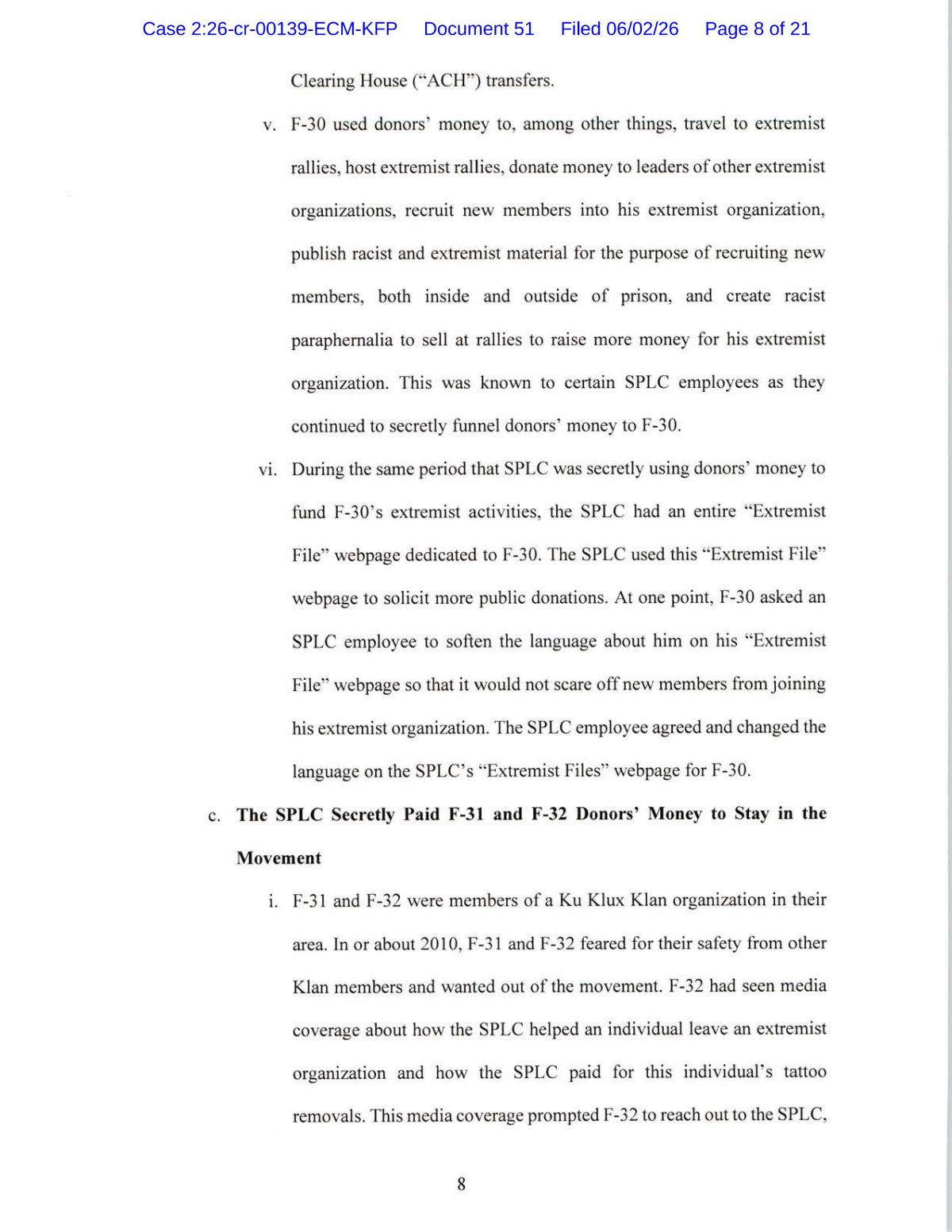
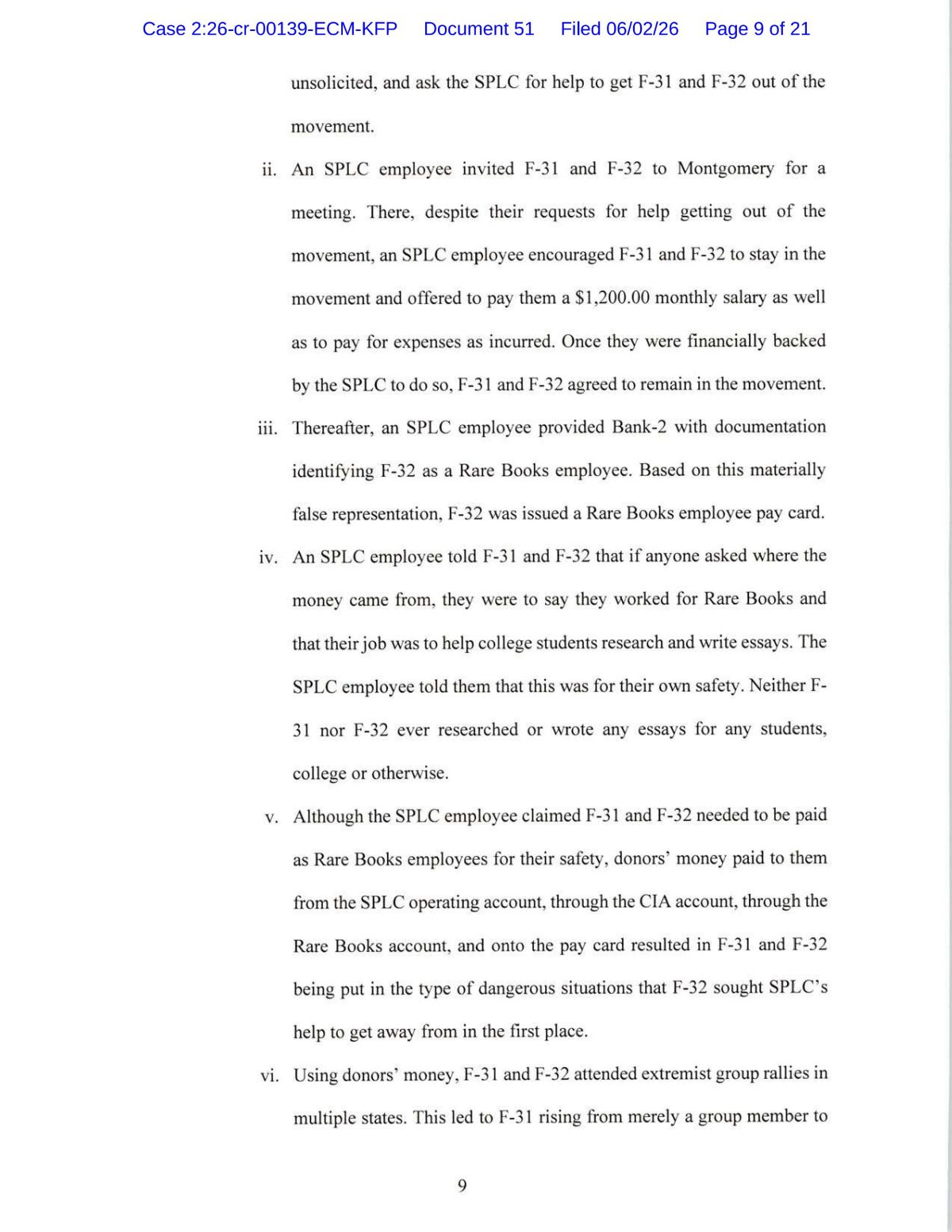
Fearing for their safety, F-31 and F-32 decided to leave their Klan group. F-32 “had seen media coverage about how the SPLC helped an individual leave an extremist organization and how the SPLC paid for this individual’s tattoo removals,” the indictment says:
This media coverage prompted F32 to reach out to the SPLC, unsolicited, and ask the SPLC for help to get F31 and F32 out of the movement.
An SPLC employee invited F-31 and F-32 to Montgomery for a meeting. There, despite their requests for help getting out of the movement, an SPLC employee encouraged F-31 and F-32 to stay in the movement and offered to pay them a $1,200.00 monthly salary as well as to pay for expenses. … Once they were financially backed by the SPLC to do so, F-31 and F-32 agreed to remain in the movement.
SPLC Cries Foul
The Justice Department (DOJ) trespassed its own policy by releasing an “unsigned, unstamped Microsoft Word version of a draft superseding indictment to members of the media — before unsealing any legitimate filing and before alerting (or providing a copy to) defense counsel,” SPLC alleges.
“Releasing draft indictments without a foreperson and Assistant U.S. Attorney’s signatures, and issuing statements to members of the media via e-mail about a ‘returned’ superseding indictment still under seal … before it has been posted on the docket or even communicated to defense counsel, serves no legitimate law enforcement purpose and impacts the defendant’s right to a fair trial,” the outfit says:
And the fact that this draft document was given to national outlets, which then issued at least two online stories available to the world, and pushed out on social media, only exacerbated the numerous violations and prejudicial effect in this case.
SPLC wants the court to sanction DOJ.
Abbe Lowell, the go-to criminal defense attorney for high-profile political clients, answered DOJ in a statement to CBS News.
“This apparent superseding indictment attempts to shore up the flaws in the initial charges, but it changes nothing,” he said:
The SPLC did not lie to its donors, it did not mislead banks it did business with, and its informant program prevented violence and saved lives.