

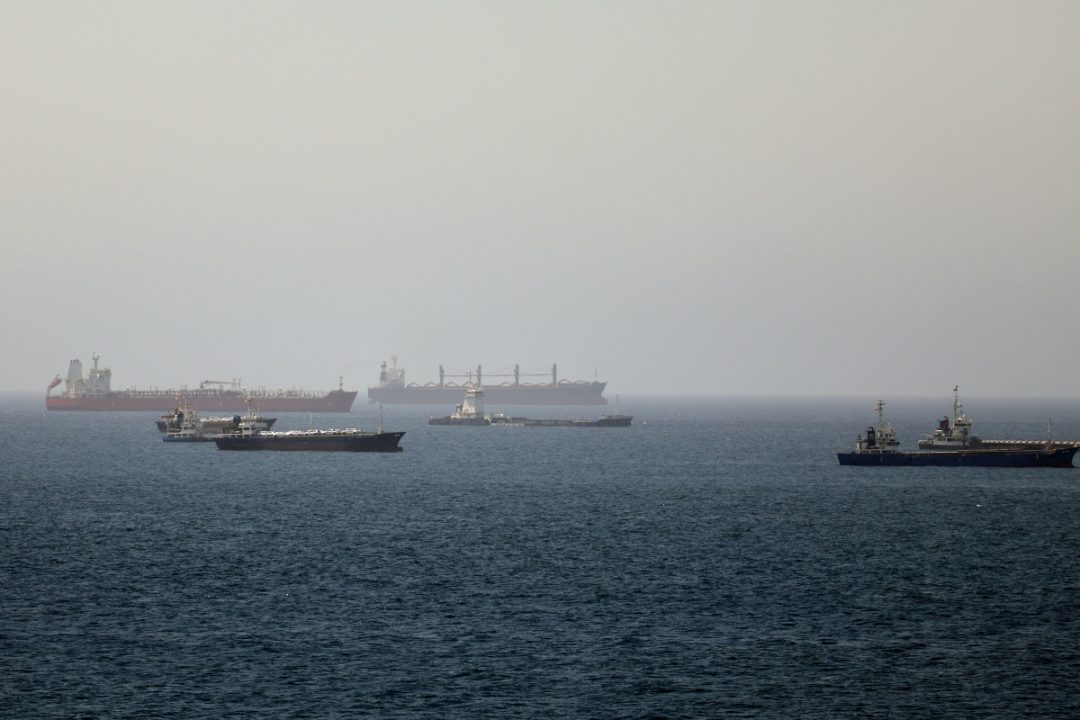
Iran Attacks Bahrain, Hits Tanker in Strait
Iran hit Bahrain with drone strikes today along with a tanker in the Strait of Hormuz to retaliate against a U.S. airstrike against drone and missile storage facilities on Iran’s coast.
While the U.S. Central Command said the strike against Iran was retaliation for its hitting a Singapore-flagged tanker, Iran claims that the United States violated the ceasefire agreement. CENTCOM released footage of what it said was the attack.
The leader of the Iranian Parliament warned the Gulf nations they should not have put themselves under U.S. protection.
“Violence will be met with violence,” Vice President JD Vance wrote on X yesterday.
Meanwhile, The Associated Press reported, sea routes near Oman are expanding to permit more traffic to exit the Persian Gulf.
Latest Trouble
AP reported Bahrain said a “number of Iranian drones” targeted the country in what the government called “a flagrant threat to the security of citizens and residents.”
The Iran Observer X feed elaborated, reporting that the strikes in Bahrain hit U.S. military bases.
United Kingdom Maritime Trade Operations, which monitors shipping, confirmed an “incident” in the Gulf.
“The Master of Tanker has reported being struck by an unidentified projectile,” UKMTO explained:
The vessel sustained damage to their bridge; all crew are reported safe. No environmental damage reported at present. Vessels are advised to transit with caution and report any suspicious activity to UKMTO, authorities are investigating.
As The New American reported yesterday, CENTCOM reported that Iran hit the M/V Ever Lovely with a “one-way attack drone,” which invited the retaliatory strike on Iran’s coastal military facilities.
“The Singapore-flagged cargo ship was exiting the Strait of Hormuz along the Omani coast at the time of Iran’s attack,” CENTCOM reported:
The unwarranted aggression against commercial shipping by Iranian forces clearly violated the ceasefire. Furthermore, Iran’s dangerous behavior undermined freedom of navigation as commerce increasingly flows through the vital international trade corridor.
Iran saw the attack differently.
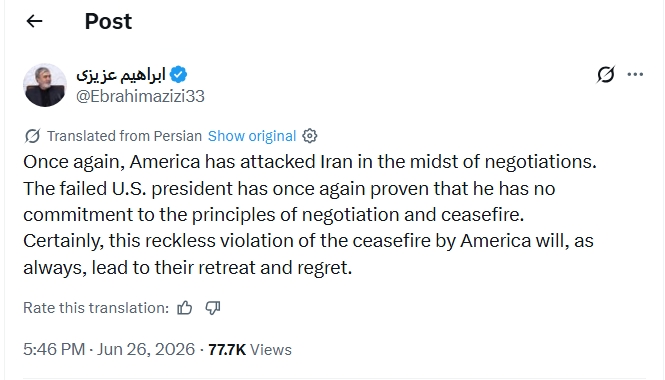
“Once again, America has attacked Iran in the midst of negotiations,” parliament leader Ebrahim Azizi wrote on X:
The failed U.S. president has once again proven that he has no commitment to the principles of negotiation and ceasefire.
Certainly, this reckless violation of the ceasefire by America will, as always, lead to their retreat and regret.
For his part, President Trump claimed Iran “shot at least four One Way Attack Drones at Ships transversing [sic] the Strait of Hormuz.” Only one hit its target. The Navy shot the other three down.
“Obviously, this is a foolish violation of our Ceasefire Agreement,” Trump wrote.
Over the CENTCOM report on X, Vice President JD Vance also wrote that Iran violated the ceasefire contained in the memorandum of understanding signed last week.
“Iran signed a ceasefire agreement,” Vance wrote:
We have honored it. If they have disagreements about how the MOU is being applied, they can pick up the phone.
But violence will be met with violence.
Gulf Nations “Less Secure”
Whoever is right, earlier yesterday, Azizi told the Gulf Cooperation Council nations — Bahrain, Kuwait, Oman, Qatar, Saudi Arabia, and the United Arab Emirates (UAE) — that placing themselves under the protection of the United States was imprudent.
“Warning for GCC leaders: outsourcing your security has made you less secure,” he wrote on X:
You have seen how US military bases in your countries have turned into a source of threat instead of providing security.
Our missile and drone power, as well as the management of the Strait of Hormuz, are Iran’s serious red lines.
The only reliable path to regional security is to distance yourselves from the U.S.
Over the claim from the Iran Observer, former U.S. counterterrorism chief Joe Kent confirmed Azizi’s opinion.
“Our bases in the Middle East are strategic liabilities not strategic assets,” he wrote:
Less bases = less targets for Iran to shoot at and that = less leverage for Iran.
MOU Jeopardized
The renewed fighting clearly trespasses the first point in the 14-point MOU that Trump and Iran signed on June 17.
The two sides “declare the immediate and permanent termination of military operations on all fronts, including in Lebanon, and undertake from now on not to initiate any war or any military operation against each other, and to refrain from the threat or use of force against each other, and ensur[e] the territorial integrity and sovereignty of Lebanon,” it says.
Israel immediately said it will not abide by the MOU and will not leave conquered territories in Lebanon. Nor will it abandon Gaza or Syria. Israel wants those territories as part of Greater Israel, which envisions the entire Middle East from the Nile River to the Euphrates as part of the country.
U.S. intelligence officials have concluded that Israel will do everything in its power to sink any U.S.-Iran peace deal.