

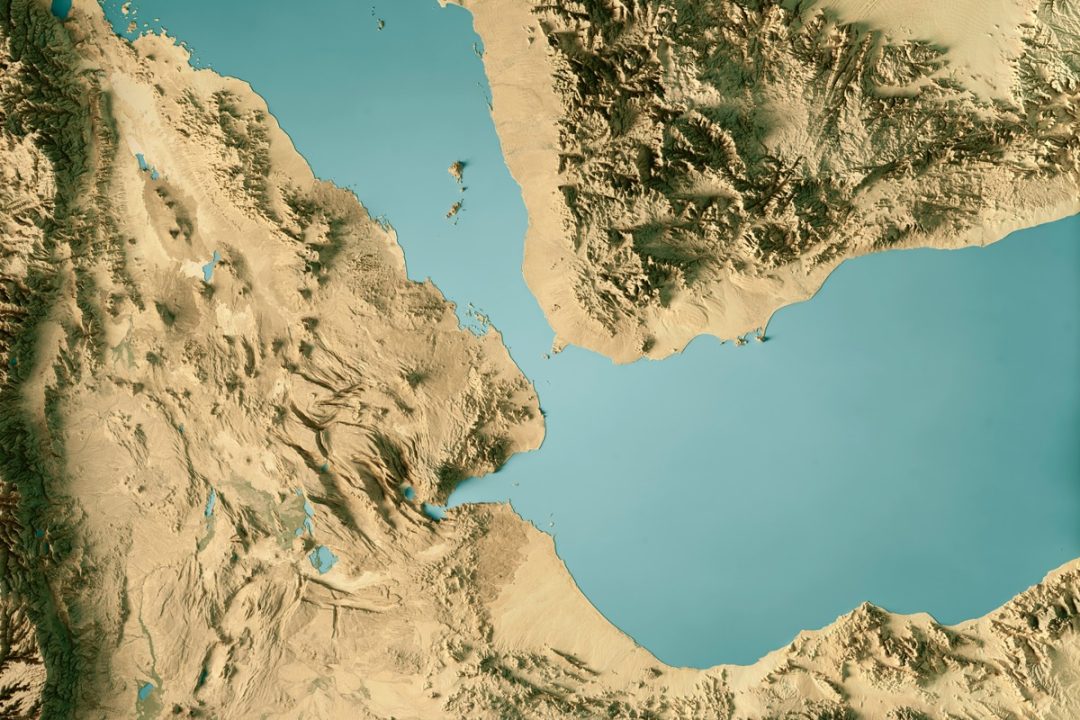
Houthis Expand Their Blockade Threat
The global economy runs through a small number of narrow channels. Two of them have been under simultaneous strain for different reasons, in different countries, but with the same basic lesson: Instability at a single strait or port city can ripple across the entire world’s supply chains.
On July 20, Yemen’s Iran-aligned Houthi movement declared a full naval blockade of Saudi Arabia, warning shipowners that any vessel calling at Saudi ports on the Red Sea would be treated as a target.
Saudia Arabia’s Bab el-Mandeb
The Houthis said it was retaliation for a Saudi strike on Sanaa Airport meant to block a plane returning Houthi mourners from the funeral of Iran’s assassinated supreme leader. Iranian leadership had reportedly urged the Houthis to close the nearby Bab el-Mandeb Strait if the United States struck Iran’s power grid — which Trump had threatened, and which Iran said the United States then did.
The Bab el-Mandeb choke point, just 18 miles wide at its narrowest point, sits at the mouth of the Red Sea and carries a large share of the world’s oil-tanker traffic. Saudi Arabia had been routing extra oil through the Red Sea specifically to work around the Strait of Hormuz disruption caused by the Iran war. This means that the kingdom’s backup route is itself now under threat.
Shipping data already show tankers reversing course rather than risk the passage, even though the Houthis have not yet attacked a vessel to enforce the threat.
Sudan’s El Obeid
Nearly 2,000 miles away, Sudan’s civil war between the Sudanese Armed Forces and the paramilitary Rapid Support Forces (RSF) is entering what analysts call a new, more-dangerous phase. Following the RSF’s brutal capture of El Fasher last year — which international monitors have documented as involving ethnic-cleansing-level atrocities — the RSF has spent 16 months encircling El Obeid, a historic trading hub the UN warns could face the same fate. El Obeid is the commercial gateway for roughly 70 percent of the world’s gum arabic supply (a key ingredient in soft drinks, pharmaceuticals, and printing) and much of Sudan’s livestock export trade.
Meanwhile, the RSF’s long-range strike capability increasingly threatens Port Sudan itself, the country’s main outlet to the Red Sea — the same corridor the Houthi blockade now menaces from the opposite shore.
Major Choke Points
Though neither Yemen nor Sudan is a major economic power, what makes both crises globally significant is geography. The countries sit astride, or directly beside, choke points the rest of the world depends on and has no easy way to route around.
Meanwhile, there has been a notable surge in U.S. military logistics activity. Dozens of U.S. Air Force transport flights have been relocated from key European bases to the Middle East. This suggests significant logistical buildup in the region, and has drawn attention as a potential indicator of escalating strategic positioning by the United States, as a wider theater of conflict may be shaping up.
This article is part of The New American’s weekly online newsletter Insider Report, which is emailed to TNA subscribers each week. Click here to subscribe to The New American to receive the Insider Report and access exclusive content.