

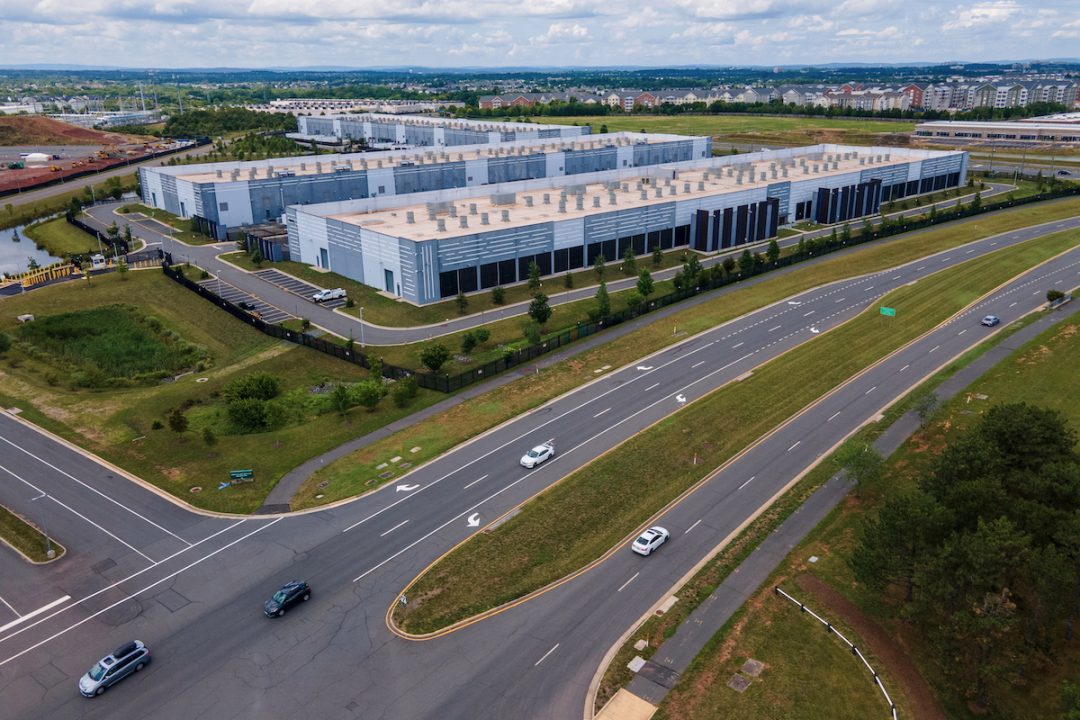
Data Centers Become a Midterm Liability as Trump Keeps Pushing Them
President Donald Trump thinks data centers have a “public relations” problem, meaning the public simply does not understand how “great” they are.
Candidates facing voters are confronting a different reality: Data centers are becoming politically toxic.
The president doubled down Wednesday on the sprawling facilities that power artificial intelligence and cloud computing. He said mayors and governors should welcome them. His argument was simple: jobs, investment and tax revenue. But those claims do not withstand much scrutiny.
Across the country, politicians in both parties are discovering that the sales pitch is getting harder to make. Data centers consume enormous amounts of farmland, electricity, and water. They also draw complaints about noise, pollution, tax subsidies, and industrial sprawl. Even more consequentially, they serve as a physical backbone of the rapidly expanding digital control grid, to use a term coined by activist Catherine Austin Fitts.
Now data centers are becoming a midterm issue. The Associated Press reported Thursday that candidates in competitive races are increasingly distancing themselves from projects the president still wants to accelerate.
Trump’s Pitch
Trump made his case at the White House while meeting with cryptocurrency and technology oligarchs:
If I were the mayor of a town or the governor of a state, and I had a chance to get a big plant in, an AI plant or a data center, I would absolutely want it because the jobs are enormous and the money paid, the taxes paid, are just enormous.
He then suggested the industry needs “a little public relations help,” meaning, in plain English, better propaganda.
In July, he suggested a similar approach, signaling that the buildout is inevitable. Speaking at EPA headquarters while promoting his Ratepayer Protection Pledge, Trump said,
You have to convince your communities how great these things [are]. You can’t fight it. You have to go with it.
Trump has made AI infrastructure a national priority. A July 2025 executive order directed federal agencies to accelerate permitting for large data centers and supporting infrastructure. It also opened federal land to qualifying projects and told agencies to streamline environmental reviews.
And earlier, just days into his second term, the president unveiled the $500 billion Stargate project, aimed at building a vast network of AI data centers and computing infrastructure across the United States.
And while the administration treats the buildout as a matter of national security, many Americans increasingly see data centers as both voracious consumers of precious local resources and a growing threat to liberty.
What Is Actually “Enormous”?
Trump’s claims about jobs and tax revenue deserve a closer look.
Data centers require armies of workers to build them. But they require far fewer people once the servers start running.
A Virginia legislative study found that a typical 250,000-square-foot data center employs about 50 full-time workers, roughly half of them contractors. Construction can employ about 1,500 workers at its peak, but usually lasts only 12 to 18 months.
Meta’s massive Louisiana complex shows the disparity. The 2,250-acre project was expected to employ more than 5,000 workers at peak construction, but only about 500 permanent workers after completion.
The tax argument is also weaker than Trump suggests.
The National Conference of State Legislatures reported in April that 38 states offered tax subsidies specifically for data centers. Many exempt equipment, electricity, and other purchases from taxation. Some also provide property-tax relief.
In early August, the Center on Budget and Policy Priorities r–ported that lawmakers in at least 25 states introduced bills this year to repeal or restrict data-center tax subsidies. Only eight states passed such measures, and Maine alone repealed all available subsidies. Governors in Illinois, Massachusetts, and Ohio also paused data-center specific tax breaks, while Nebraska blocked the facilities from tapping its main business incentive program.
What data centers consume can be far greater.
They consume land (including farmland), and staggering amounts of water and electricity.
Last but not least, they provide the computing backbone for digital IDs, digital finance, mass databases, and other surveillance technologies such as police drones and Automatic Licence Plate Readers (ALPRs).
Trump is right about one thing: Something here is enormous.
It is the cost being pushed onto ordinary Americans.
Support Collapses
A new Heatmap Pro poll, conducted by Embold Research and published on Wednesday, found that
Three-quarters of Americans now say that they would oppose a new data center being built near where they live … and more than six in 10 Americans say they would strongly oppose such a proposal.
The speed of the shift is striking.
When Heatmap asked the same question last August, 43 percent supported a nearby data center and 42 percent opposed one. Opposition rose to 51 percent in February. It hit 70 percent in May. Now it stands at 75 percent.
Only four percent strongly support a local project.
The August survey covered 2,045 registered voters in all 50 states and Washington, D.C. It ran from August 8 through 13. The margin of error was 2.3 percentage points.
The backlash crosses the political map and nearly every major demographic divide:
The shift against the facilities is represented across age, gender, income, partisan ID, and the rural-urban divide. Data centers are 43 points underwater with Republicans, 65 points underwater with independents, and 75 points underwater with Democrats.
That helps explain why Trump’s enthusiasm sounds increasingly different from the language of candidates who have to defend these projects at home.
The Midterm Problem
The National Republican Senatorial Committee (NRSC) has already sounded the alarm.
In a private memo obtained by Axios, the committee warned that data-center anger could cost Republicans a Senate seat in Ohio. It singled out Republican Senator Jon Husted, who faces former Democratic Senator Sherrod Brown.
Brown has spent heavily to portray Husted as the “face of data centers in Ohio.”
The NRSC warned that the political fallout could spread far beyond Ohio:
“If [Husted] loses and data centers get the blame, politicians across the country will take notice — and they will not go near the next one,” the memo says. “This has become a sleeper issue for the entire election cycle.”
Republicans are now reportedly asking the industry “to do whatever it takes to stem the public backlash.”
And the internal numbers may be even worse than public polling. Per the outlet,
AI CEOs and top Republicans share in the rising panic. They tell us internal polls show data centers are as popular as spent nuclear waste, and more broadly have become a proxy for feelings about AI. The industry appears to be responding much as Trump suggested.
Axios says that tech giants are “scrambling to pull together media campaigns to try to shift opinion before it hardens locally and nationally.”
Politicians Flip
Politicians, meanwhile, are changing course as the electoral risk grows.
Ohio has paused a major data center tax break, while opponents collect signatures for a statewide referendum that would ban new construction.
The retreat is visible elsewhere.
In Texas, Republican Governor Greg Abbott this past November celebrated a $40 billion Google investment and declared Texas “the epicenter of AI development.” However, in early August, he paused industry-wide approvals pending greater disclosure about power and water use, while also calling for changes to tax incentives. Trump called the shift a “mistake.”
Pennsylvania Governor Josh Shapiro, a Democrat who previously welcomed data-center investment, has also toughened his position. On Tuesday, he signed an executive order imposing what his administration calls some of the nation’s “strictest guardrails.”
In Nevada, Democrat Aaron Ford is attacking Republican Governor Joe Lombardo over data-center development. Ford has pledged to pause new tax abatements while his administration audits whether existing projects delivered the jobs, tax revenue, and other benefits they promised.
In Wisconsin, Republican Tom Tiffany is attacking Democrat David Crowley as “Data Center David Crowley”, despite calling data centers “exciting new technology” in February and supporting legislation designed to speed major infrastructure reviews.
The pattern is increasingly bipartisan. Politicians still want the investment. What they increasingly do not want is ownership of the higher utility costs, subsidies, and local backlash that can come with it. Associated Press has documented similar shifts across several states.