
House Shelves Hegseth Impeachment, Exposing Washington’s Uniparty
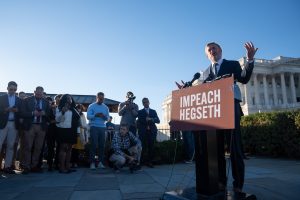
Representative Thomas Massie of Kentucky tried to hold Defense Secretary Pete Hegseth accountable for alleged illegal warfare and constitutional violations. Instead, Congress demonstrated just how little appetite either party has for confronting executive overreach.
On Tuesday, 210 Republicans voted to bury his impeachment resolution in committee, while the absence of 11 Democrats helped seal its fate. The House voted 211 to 204 to avoid deciding the charges.
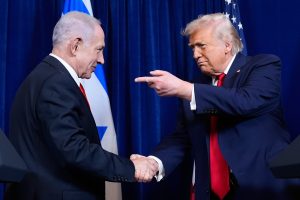
Hegseth dismissed his Republican accuser as “disgruntled” and “resentful.” President Donald Trump stood firmly behind his defense secretary, awarding him an “A PLUS, PLUS, PLUS” for taking on “LOSER” Massie.
A Vote on How Not to Vote
The showdown centered on House Resolution 1655, containing eight articles of impeachment. Massie introduced it Monday as a privileged measure, forcing House action within two legislative days.
Representative Darrell Issa (R-Calif.) offered an escape route: refer the resolution to the House Judiciary Committee. The House adopted his motion Tuesday evening.
The official roll call was revealing. A total of 210 Republicans supported referral, with Massie alone opposing. All 203 Democrats who voted rejected the maneuver. Independent Representative Kevin Kiley of California sided with Republicans. Seven Republicans and 11 Democrats did not vote.
In other words, lawmakers never voted on whether Hegseth committed impeachable offenses. Instead, they sent the allegations to committee, effectively shelving the resolution for the remainder of the congressional session.
That spared Republicans a choice between loyalty to Trump and their constitutional responsibility to authorize war and oversee the executive branch. It also allowed Hegseth to claim victory without Congress resolving a single accusation.
According to The Associated Press, House Speaker Mike Johnson (R-La.) dismissed the impeachment effort as a “political gambit for attention.” Representative Don Bacon (R-Neb.), who has criticized Hegseth, said he disagreed with the “merits” of the charges and favored hearings instead.
The White House left little doubt about its position. In a formal policy statement, it urged lawmakers to support referral, portrayed Massie’s charges as an attack on the military, and defended Trump’s authority to direct the disputed operations.
The Democrats Who Did Not Show Up
The Democratic absences proved just as consequential.
Had eight of the 11 missing Democrats voted against referral, the motion would have failed, assuming every other vote remained unchanged. Their absence supplied the margin needed to shelve Massie’s resolution.
The missing Democrats were former House Speaker Nancy Pelosi (Calif.), Julia Brownley (Calif.), Lou Correa (Calif.), Laura Gillen (N.Y.), Steven Horsford (Nev.), Jonathan Jackson (Ill.), Brittany Pettersen (Colo.), Melanie Stansbury (N.M.), Haley Stevens (Mich.), Marilyn Strickland (Wash.), and Frederica Wilson (Fla.).
They offered varying explanations. Gillen, Jackson, Stansbury, and Strickland blamed traffic delays in Washington. Pelosi attended a veterans’ event in California. Correa was preparing for a medical procedure, and Horsford’s office cited a personal emergency.
Several insisted they would have opposed referral. Their explanations do not establish deliberate support for Hegseth, but whatever their intentions, the outcome was the same.
California Democrat Sydney Kamlager-Dove was less forgiving:
We knew that this vote was coming, so people should have gotten their raggedy selves up these steps to vote.
House Democratic leader Hakeem Jeffries (N.Y.), who is poised to become the next House speaker, had publicly declared himself a “hard yes” on Hegseth’s impeachment. Yet he failed to muster enough members of his own caucus to keep the resolution alive.
The Accusations Against Hegseth
Massie’s eight impeachment articles allege violations extending far beyond disagreements over military strategy.
The first three concern the War Powers Resolution. They accuse Hegseth of conducting unauthorized hostilities against Iran, disregarding congressional demands for withdrawal, and exceeding statutory limits on military operations.
The 1973 law generally requires the withdrawal of American forces after 60 days without congressional authorization, subject to limited exceptions and extensions. By Tuesday, the war against Iran had continued for 256 days.
Another article accuses Hegseth of dismantling safeguards designed to protect civilians. The resolution cites a deadly strike on an Iranian school in Minab, where as many as 168 people died, almost all of them children. Massie alleges that Hegseth weakened Pentagon protections intended to prevent such tragedies.
The remaining charges concern lethal attacks on suspected drug-running boats, including alleged strikes on survivors; retaliation against Senator Mark Kelly (D-Ariz.) for warning against unlawful military orders; the seizure of Venezuelan President Nicolás Maduro; and unauthorized military operations in Yemen.
An A+ From Trump
At a Pentagon news conference Tuesday, Hegseth lashed out at Massie, dismissing his impeachment effort as “a political spectacle” fueled by personal resentment.
He insisted that the disputed military operations were lawful, ordered by Trump, and reported to Congress. The charges, he argued, reflected mere “policy disagreements.”
Hegseth then cast the attempt to hold him accountable as an attack on American troops:
If they want to come for the warriors, they’re going to have to come through me.
He condemned the impeachment effort as “not patriotism” but “sabotage.”
Addressing service members directly, he urged them, “Don’t blink, ignore the noise, never hesitate.” He dismissed the controversy as “all politics.”
He reserved particularly lavish praise for Trump:
We’ve never had a better commander in chief, full stop.
Trump promptly returned the compliment:
Pete Hegseth gets an ‘A’ PLUS, PLUS, PLUS for his defense against a disgruntled, angry, defeated, former Congressman, Thomas Massie, a TOTAL LOSER!
On Monday, the president had already promised to “stand by” Hegseth even if impeached, offering his own assessment of the secretary’s record:
He won two wars. He was in charge. We all won.
After the vote, Trump celebrated what he called the “EXONERATION of a Great American Patriot.”
He also portrayed the impeachment effort as a Democratic attack, conveniently overlooking two facts: A Republican introduced the resolution, and the absence of 11 Democrats helped defeat it.
The Constitution Comes Last
Massie, who lost his Republican primary to a Trump-backed challenger heavily supported by pro-Israel political groups, leaves Congress in January.
The pro-Israel lobby also surfaced in discussions of the Democratic absences. Social media observers quickly noticed a common thread. According to campaign finance records, 10 of the 11 absent Democrats had received generous contributions through AIPAC. The overlap attracted scrutiny.
Massie, meanwhile, compared Republican leaders to passengers determined to remain aboard a sinking ship. Yet he also urged Trump to replace Hegseth before Democrats take control of Congress, warning that they will pursue hearings and trials.
Coming from a lawmaker who just accused Hegseth of grave constitutional violations, that suggestion is astonishing. Since when does replacing an official absolve him of alleged crimes?
Democrats won both chambers in the November 3 midterms. House Democratic leader Hakeem Jeffries promised to revisit impeachment in January. Yet he could not even muster enough members of his own caucus to prevent Tuesday’s defeat. Even if Democrats eventually impeach Hegseth, removing him will require a two-thirds Senate majority.
The episode offers a revealing reminder of how readily constitutional principles yield to partisan loyalties and political calculations.
Republicans rallied behind Trump rather than allow a direct vote on serious allegations of executive overreach. Democrats loudly demanded accountability but failed to show up in sufficient numbers to keep the resolution alive.
Congress neither proved nor disproved Massie’s charges. It simply avoided voting on them.
And so the familiar Washington spectacle continues. Both parties invoke the Constitution when politically convenient. But when upholding it requires confronting their own leaders, even the most solemn constitutional principles suddenly become negotiable.