
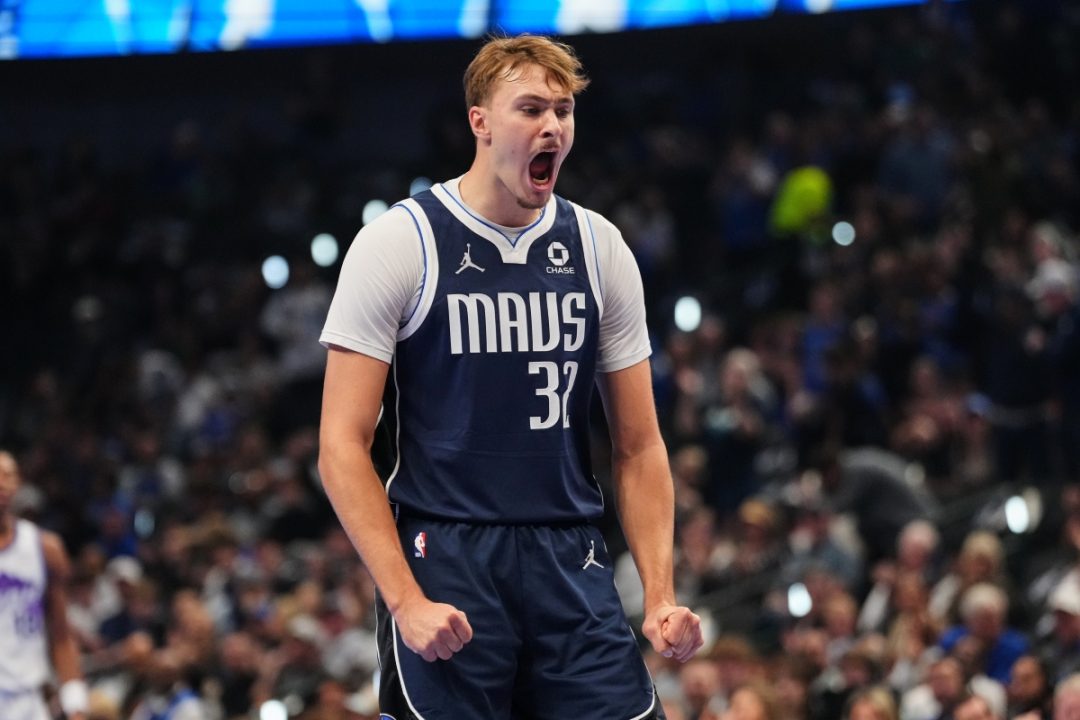
Fashionable Racism: The New White Athlete Wokesters Love to Hate
Move over Caitlin Clark. There’s a new basketball phenom being told, essentially, he doesn’t belong, even though he has been called a “generational” talent. The problem apparently is that the National Basketball Association (NBA) is a “black league,” as an observer put it.
The hoops star in question is 6’9” Cooper Flagg, a Dallas Mavericks forward who, at 19, is already one of the world’s best players. This doesn’t appear to sit well with some of his black competitors (i.e., the type of players who have called Luka Doncic, another white NBA baller, a “b**ch a** white boy.”).
It all reflects, too, a larger, society-wide issue: the anti-white prejudice that has become not just acceptable today, but fashionable.
Reporting on the Flagg story Monday, The Sporting News writes:
With Cooper Flagg’s hot start to his second NBA season, he’s already emerged as one of the NBA’s best players.
After winning Rookie of the Year honors in 2025-26, Flagg has looked like an All-NBA contender early in 2026-27, averaging 26.8 points, 6.6 assists and 6.0 rebounds per game in his first five matchups of the season.
As Flagg has continued his ascension toward star status, however, one former Mavericks player received backlash for his comments about the rising Dallas forward.
… [Charlie] Villanueva, who played in the NBA from 2005-16 with a late Mavericks stint, was speaking on the “To The Baha” podcast with Thoe [sic] Pinson and other former NBA players when he made a comment about Flagg that resulted in some backlash.
“This might sound crazy, but I don’t think in 2026 a white dude could be — I’m gonna be real — could be the face of the league, if I’m being honest,” Villanueva said [tweet below]. “Because it’s a Black league, right?”
The retired hooper stuck to his guns, too, after pushback during the podcast.
Spirit of the Age
As mentioned earlier, Flagg isn’t the first white player to get a red flag. Standout WNBA player Caitlin Clark has been called names, viciously fouled, and has been accused of “white privilege.” Never mind that she’d begun to put the women’s league — which has lost money its entire existence — on the map.
In fairness to Villanueva, though, he was likely delivering analysis and not hatred. As he later stated on X after getting blowback, he doesn’t believe a white player can’t be the NBA’s best. (Tweet below.) He also said that Flagg was one of his favorite players.
So if Villanueva’s analysis is just analysis, it says nothing bad about him. If it’s correct, however, what does it say about our society?
Commentator Bobby Burack has some idea. Writing at Fox News earlier this week, he presented the bigger picture:
ESPN analyst Kendrick Perkins falsely accused NBA MVP voters of favoring Nikola Jokic because he is white, likely costing him the award in 2023.
More recently, Stephen A. Smith claimed a team could not win a championship built around white players. Former broadcaster Mark Jones has posted several bigoted messages about Jokic. Gilbert Arenas has joked about exiling white players from the league.
… The pattern is obvious. Anti-white bigotry has become accepted and, at times, rewarded in public discourse.
… Notice Villanueva’s wording: The NBA is “a Black league, right?”
That view echoes comments from Arenas and others who refer to the NBA as “our” league. These Black players appear territorial about the sport and seem threatened when white players succeed.
For context, consider what activist and social media influencer Dr. Umar Johnson said about Eminem in 2023. Johnson claimed Eminem should be excluded from the conversation about the greatest rappers of all time because of his skin color.
“No non-African can ever be the best of anything African. It’s an insult to the ancestors. It’s an insult to the race and it’s an insult to every black person.”
Johnson then claimed the black community should never have allowed Eminem into hip-hop.
A Place Where There Is No Reason
Burack notes the irrationality of claiming “black spaces.” Regarding basketball, for example, he points out that a “White man created it.”
Moreover, under “woke” logic, wouldn’t this render non-whites who play basketball guilty of “cultural appropriation”?
But, okay, the NBA is approximately 75 percent black — fair enough. The PGA Tour (golf), however, is about 80 percent white.
Should Tiger Woods have been disallowed from being its face for more than a decade?
The WTA Tour (tennis) is also about 80 percent white.
Should the Williams sisters have been its face for 20 years?
Of course, though, if we’re really going to follow woke “logic,” then something must be recognized.
Unjust, irrational double standards are the order of the day. Wokeness, after all, is a social-code paradigm built on emotion and prejudice, not reason and Truth.
And the Truth is this: Anti-white sentiment reigns today. This is why, when whites displace non-whites in a neighborhood, it’s called “gentrification” or even a “bleaching out.”
When non-whites displace whites, however, it’s labeled blessed “diversity.”
And it’s why, a 2021 study found, more than a third of white students claim racial-minority status on college applications. They’re not doing this because they’re masochists.
The Face That Launched a Thousand Deals
Speaking of masochists, we could wonder if the NBA and WNBA want to kneecap themselves. Consider the aforementioned “privileged” Caitlin Clark.
Clark’s being white does enhance her marketability and helps explain why she’s now the world’s highest-earning female basketball player. For sure.
But so what?
The issue isn’t “white privilege,” which doesn’t exist — but being a novelty.
There are other examples of this, too. Consider Tiger Woods. His race also enhanced his marketability, greatly, because he was history’s first dominant “black” (he calls himself “Cablinasian”) golfer. Then there’s ex-race-car driver Danica Patrick, who, though rarely winning a race and perhaps best known for crashing, was marketed relentlessly and enjoyed lucrative endorsements because she was a woman in a man’s realm.
In the early ’80s, there was boxer Gerry Cooney, who received great press and purses not just because he was destroying fellow heavyweights for a time, but also because he enjoyed the novelty status of being a “great white hope” chasing a title that had for decades been held almost exclusively by black fighters. Novelty sells — big.
So who should be a business endeavor’s “face.”
The person who can attract the largest market should — full stop.
That will be an observer’s position, anyway, if he’s not something like a communist.
Or if maybe, just perhaps, he’s not someone whose dogmas and self-image are threatened by the novelty’s existence. (I addressed that here.)
The bottom line is that anyone who thinks Cooper Flagg can’t be the NBA’s face because he’s the wrong skin color has not just missed the mark — he has thrown an airball into the stands and hit a DSA member.