
Study: To Stop School Shootings, Arm Teachers
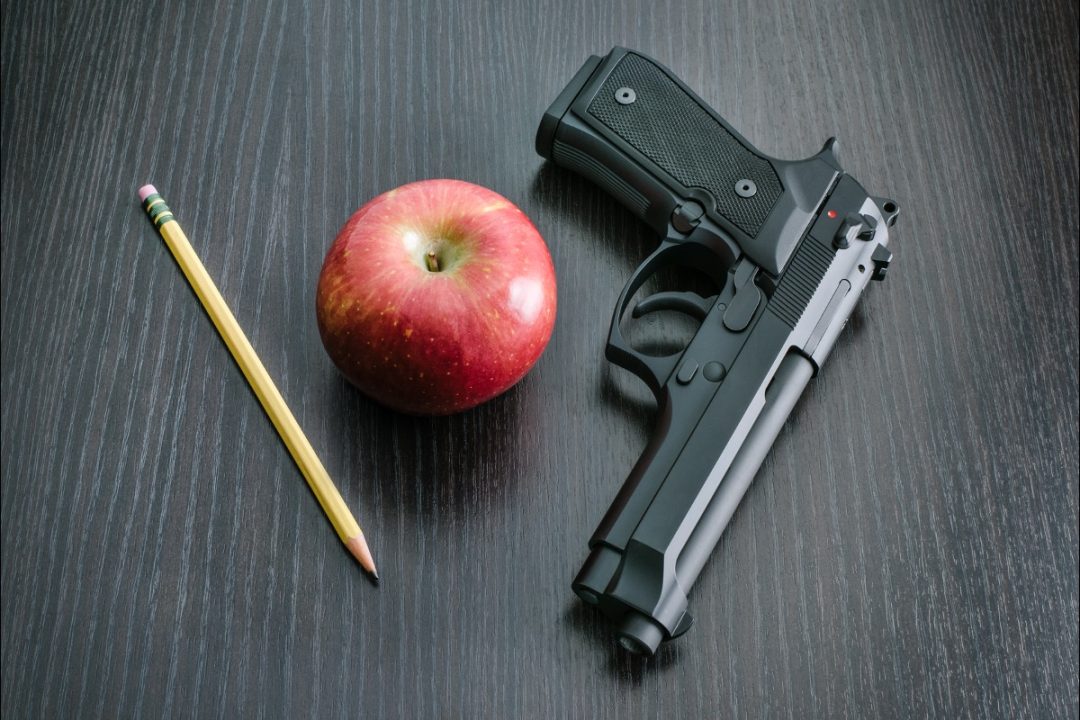
Although school shootings claimed ever more victims in the first quarter of the 21st century, schools that allowed teachers to carry guns were immune from the trend, a recent study found.
According to study co-authors John Lott Jr., president of the Crime Prevention Center, and David Mustard, economics professor at the University of Georgia:
There hasn’t been a single mass public shooting in any school that allows teachers and staff to carry guns legally. Since at least as far back as January 2000, not a single shooting-related death or injury has occurred during or anywhere near class hours on the property of a school that allows teachers to carry.
Alarming Disarming
The authors mustered a lot of data to bolster their case, from state and school-district gun policies to mass-shooting statistics from schools with varying degrees of security. The results: Mass shootings are most likely to occur at schools with neither armed officers nor armed teachers, and are least likely to occur at those with armed teachers. Armed officers are far more likely to accidentally fire their guns than armed teachers, and they have also been known to shoot the wrong person, sometimes with tragic results.
The co-authors wrote:
While still small compared to the number of students, the rate of shootings and people killed by these shootings has increased significantly since 2000. The yearly average number of people who died between 2000 and 2012 versus 2013 and 2025 has increased by 169% for all cases and 214% when suicides and gang-related attacks are excluded.
This increase occurred during a period in which fewer teachers were permitted to carry than was historically the case. “Before the early 1990s, no state law specifically restricted concealed carry on K-12 property, so teachers may have commonly carried guns throughout much of our history,” penned Lott and Mustard.
Currently, 28 states allow teachers and school staffers to carry firearms on campus. Some require teachers to take specialized training before being permitted to carry, while others have no such requirement. Still others let school districts set their own policies.
Gunning for the Gun-free
About 13 percent of all public schools allow teachers to carry. While the researchers were unable to obtain statistics on daily firearm presence on each of these schools’ campuses, they noted, “authorization may also deter attacks by creating uncertainty about armed resistance…. Even a sign warning that authorized teachers or staff may be armed could discourage an attacker, regardless of whether anyone is carrying at that moment.” After all:
Diaries and manifestos of mass public shooters show a chilling trend: They explain that they deliberately choose gun-free zones, knowing their victims can’t fight back. It’s no coincidence that 93% of mass public shootings happen in places where guns are banned.
It comes as little surprise, then, that, according to Lott and Mustard,
the average rate of death or injury from a shooting is 0.039 per 100,000 students across all schools (so the rate is even higher among schools that don’t allow teachers to carry), while it is 0 per 100,000 in schools with armed teachers.
Officer Safety?
Armed officers in schools serve as something of a deterrent to would-be mass shooters, but they come at a price both to taxpayers and to officers themselves. The authors calculated that schools spend about $3.3 billion a year on armed officers, the equivalent of roughly 44,000 teachers’ salaries. Meanwhile, when shooters do attack schools with armed officers, the officers themselves are often the first victims. As Sarasota County, Florida, Sheriff Kurt Hoffman explained:
A deputy in uniform has an extremely difficult job in stopping these attacks. These terrorists have huge strategic advantages in determining the time and place of attacks. They can wait for a deputy to leave the area or pick an undefended location. Even when police or deputies are in the right place at the right time, those in uniform who can be readily identified as guards may as well be holding up neon signs saying, “Shoot me first.”
Furthermore, while critics of allowing teachers to carry worry about such things as accidental discharges, shots hitting the wrong person, and attackers taking others’ guns, those incidents occur much more frequently with armed officers. Over the 2000-2025 period, “there were 20 cases of officers accidentally discharging their firearms, two additional cases where they discharged their weapons when they were struggling with someone, and six accidental discharges by private guards,” Lott and Mustard found. “There was also one instance where a student got [an officer’s] pistol and accidentally discharged it.” Among teachers, there was but one case of accidental discharge (before the school day, in a restroom, where the teacher was only “slightly injured” by toilet shrapnel). There were no cases of a student getting hold of a teacher’s gun.
Oh, Shoot!
The usual suspects, of course, will still claim that, despite the irrefutable evidence presented in the report, the real solution to school shootings is to tighten gun laws, by imposing universal background checks, for instance. However, observed the authors, “there is not one mass public shooting this century that would have been stopped by universal background checks, even with a perfectly enforced law.”
Because a good guy with a gun is the best defense against violent criminals, the idea of armed teachers should not frighten anyone. Instead, quipped Lott and Mustard, “the term ‘gun-free zone’ is what should make people nervous.”