

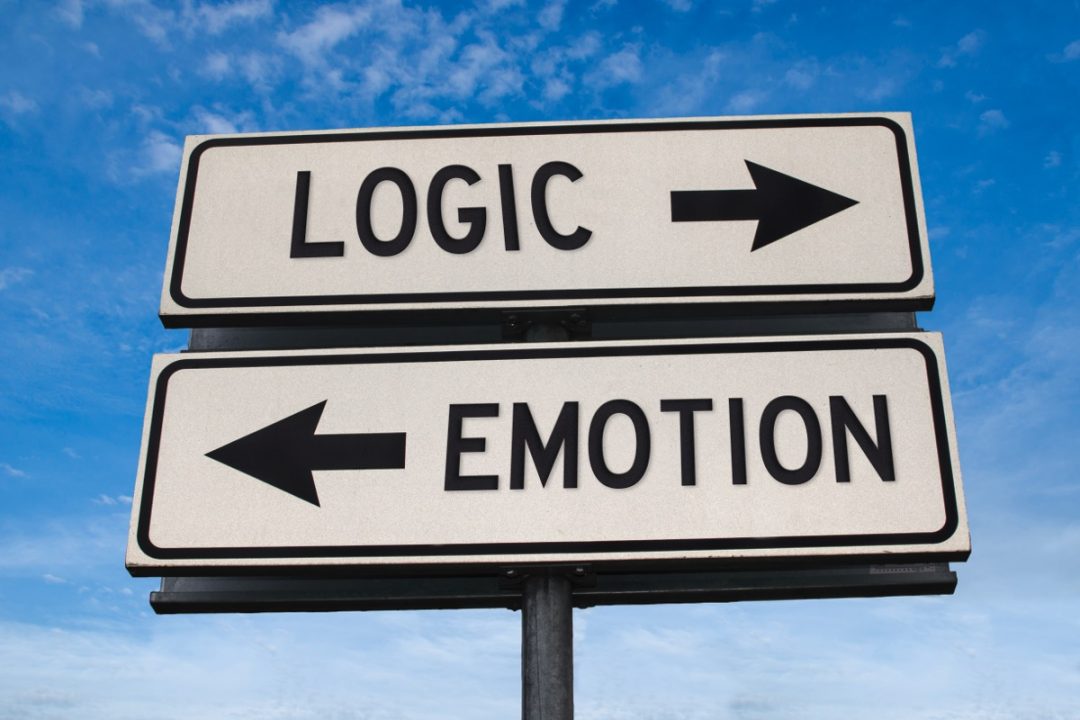
Liberal Scientist Neil deGrasse Tyson Claims Logic Is “Overrated”
Mr. Spock would be shocked. Since the 1980s, critiques, and sometimes dismissals, of logic as “white” and “male” have become increasingly common. It finally got so bad that the Biden administration, giving us identity-politics science, instructed federal agencies to incorporate “Indigenous Knowledge” (often superstition-based) into their endeavors. Now Ph.D. astrophysicist Neil deGrasse Tyson, who makes a career of playing a scientist on TV, has called logic “overrated.”
This matters because it corresponds with a larger attack on the West and its great success at identifying objective reality. For example, a 2022 feminist academic paper argued that mathematics shouldn’t be solely governed by reason. Rather, drawing explicitly on intersectional feminist theory, it should incorporate practices of feeling, acting, and reimagining. (You know, it was more honest when years ago, after interviewing girls on how they felt about various matters, Mattel programmed a Barbie doll to say what really rankles the feminists: “Math class is tough!”) Then there were the professors arguing in 2020 that 2+2 could sometimes equal five. (Note: This proposition is something the story 1984’s tyrannical government declared as dogma.)
Returning to Tyson, it’s perhaps no shock that he diminishes the objective. He has, after all, also claimed that disallowing “trans” men from women’s sports reflected an “older view of the world.” And perhaps valuing logic does, too.
Who Needs Logic When You’ve Got Fashions?
As to this, the current story relates to comments Tyson made with Joe Rogan in 2021. They were posted years later on YouTube under the title “Is Logic Overrated?” American Thinker’s Arnold Cusmariu said that this assertion had him scratching his head and then wrote Thursday:
Tyson’s comments have suddenly gained relevance thanks to an October 2026 study in Scientific Reports that challenges his dating of the celestial configuration in Van Gogh’s Starry Night, identifying July 22, 1889, rather than June 21 as a likely match. But it’s Tyson’s comments about logic that particularly interest me.
Cusmariu then provided a transcript of Tyson’s remarks:
Logic is overrated, I think. My favorite paintings in the world could not have possibly been drawn via logic. There is a creative spark that comes from nowhere. The painting Starry Night on the back of my phone: Is this logic? No. Is that what he saw? No. Although I can identify the day and the time of day when this image was in his head that he painted. I could find out what latitude it was that corresponds to where he was. It’s the phase of the moon and the location of Venus, at that angle relative to the horizon. So I got it for June 21st 1889. Turns out that was the year he painted. There is some basics of it that are factual. The rest, clearly, the sky doesn’t have curlicues in it and I’m told where he painted it there is no town so he made up a lot of stuff that’s in this picture. But that’s not what he saw; it’s what he felt. A world of just logic? I don’t want that.
Amusingly, the top commenter under the Tyson video notes: “I love how he jumps straight into logic.” Moreover, as Cusmariu states:
The art that everyone admires “could not possibly have been drawn via logic.” Would Leonardo da Vinci, who was a scientist as well as an artist, have taken on the challenge of painting the Mona Lisa according to rules of inference? We’ll never know. Though AI artworks on Google are mediocre knockoffs, this doesn’t mean art produced by a computer program “couldn’t possibly” at some point rival established masterpieces.
I’ll add that we should be careful about predicting what computers “can’t do” (for good or for ill). World chess champion Garry Kasparov once famously boasted that a computer would never be able to beat him. Then he lost to IBM’s Deep Blue in 1997.
Regarding art, it can transition into science as our understanding of it deepens. Or as a computer, Copilot AI, put it very “artfully”:
What we call an “art” is often a domain in which expertise exists before theory exists.
Medicine is an example; it was described as “the art of healing” for most of history. Physicians would rely heavily on their own discernment and intuition to attempt remedy. But the development of fields such as anatomy, physiology, microbiology, and biochemistry made it increasingly scientific.
Another case is alchemy, which eventually became chemistry.
(For that matter, could science conceivably prove “religion”? That is, science is the study of the material world. But what if one day, somehow, we discovered a way to observe the incorporeal — and hence the spirit world — directly? It would be a bad day for atheism, that’s for sure.)
Not a Competition
Really, though, the most significant point here concerns what those who attack logic would replace it with: emotion. As Cusmariu also writes:
Van Gogh didn’t paint what he saw; he painted what he felt. Ah, yes, the old reason-versus-emotion conundrum, which goes back to Socrates. History, however, is full of examples of what happens when reason is considered “overrated” and emotion is allowed to run amok.
This is true even in art. Elevate feelings to ultimate-arbiter status, and a crucifix immersed in urine or a Virgin Mary picture smeared with dung may be deemed “art.”
In reality, however, is the reason-emotion matter really a “conundrum”? During a debate I had decades ago with an emotional young woman, she exclaimed, “Why is logic better than emotion?!” Being young at the time, I didn’t quite have the ideal answer. But it’s not a competition — or shouldn’t be. Rather, it’s a matter of each having a different role.
It’s as if the intellect is the engine and emotion the fuel. An engine alone is an impressive mechanism with great potential. But without fuel it has nothing to animate it, rendering it impotent. Fuel alone is powerful and explosive, but without an engine has nothing to channel its power. So it can only be destructive. It’s only when you have both together, each performing its proper function, that the desired result is achieved.
Literally put, the emotions’ role is to provide the impetus to act (the passion) once the intellect has determined what that action should be. The intellect also has the dreadfully difficult job of restraining the emotions when they, overstepping their bounds, prescribe wrong action.
Of course, the intellect must be well formed so that it’s a wise parent — not an enabler of that impulsive child we call emotion.