

Poland vs. Brussels: The Fight for a Sovereign Nation
On the 30th of October, Polish Prime Minister Donald Tusk orchestrated a coup. With police deployed around the building, Tusk’s camp moved to take control of Poland’s Constitutional Tribunal, the country’s highest constitutional court. Inside, Judge Anna Korwin-Piotrowska — a judge long active in the campaign against the previous conservative government and elected to the court by Prime Minister Tusk’s majority in March and never sworn in by the president — declared herself in charge of the tribunal and suspended its president and vice president. This coup, the takeover of an institution, took place while President Karol Nawrocki was on his way out of the country for a trip abroad.
One doesn’t have to look far to understand why this court plays such a significant role: It is the court that ruled that the Polish constitution stands above EU law. Tusk justifies the takeover by calling it restoring the rule of law, and Brussels has given him its blessing.
Brussels Versus Poland
On one side stands Prime Minister Donald Tusk, a committed pro-European. Before returning to Warsaw, he served as president of the European Council in Brussels, which tells you where his loyalties lie. When he won power again in 2023, Brussels was delighted.
On the other side stands President Karol Nawrocki, a true patriot who stands for love of country, for God, and for Polish identity. He vetoed Poland’s implementation of the EU’s Digital Services Act, warning it would create a state-run “Ministry of Truth,” and he simply doesn’t play by Brussels’ rules. He’s also one of President Trump’s strongest allies in Europe. When Nawrocki won, President Trump wrote, “Congratulations Poland, you picked a WINNER!”
How Did We Get Here?
Tusk accuses Nawrocki of refusing to swear in judges who were legally elected by the Polish Parliament. Tusk argues that the oath is just a formality, and that by not accepting them, Nawrocki blocked the court and obstructed the rule of law.
But the reality shows a very different picture. Tusk’s coalition left six seats on the court empty for more than 15 months, then rushed through all six appointments in a single day, with barely any scrutiny. Nawrocki swore in three of them and held back on the the other three because there were real doubts about how they had been picked. Instead of letting the judges be vetted properly, Tusk’s people staged their own swearing-in ceremony in front of the speaker, something Polish law doesn’t even allow. The judges loyal to the government simply refused to sit with the others, so the tribunal could never rule on who was actually legitimate. Tusk’s government installed its own judges through a procedure it made up on the spot, and then used the chaos it created to stage a coup.
The Real Agenda
In October 2021, Poland’s Constitutional Tribunal ruled that the Polish constitution stands above EU law, and that parts of the EU treaties, as Brussels interprets them, conflict with it. This decision respects the country’s sovereignty.
For Brussels, that was unacceptable. The European Commission took Poland to court, and last December the EU’s Court of Justice ruled that the Polish tribunal had violated European law by declaring parts of the EU treaties incompatible with the Polish constitution, and that Poland may not rely on its constitution to avoid complying with EU law.
This tribunal was the one thing standing in Brussels’ way. And this is exactly why Tusk’s claim about restoring the rule of law doesn’t hold up. When Poland had a conservative government, Brussels froze billions of euros in EU funds earmarked for Poland, in the name of supporting judicial independence. Now police stand outside a constitutional court, and the European Commission’s main concern is that Warsaw respects the rulings of the EU’s own court. What Brussels calls “rule of law” really just means its own law. The message to Poland is simple: We want to control you. Your constitution, your courts and your elected president come second.
The 11th of November: Patriotism Is Alive
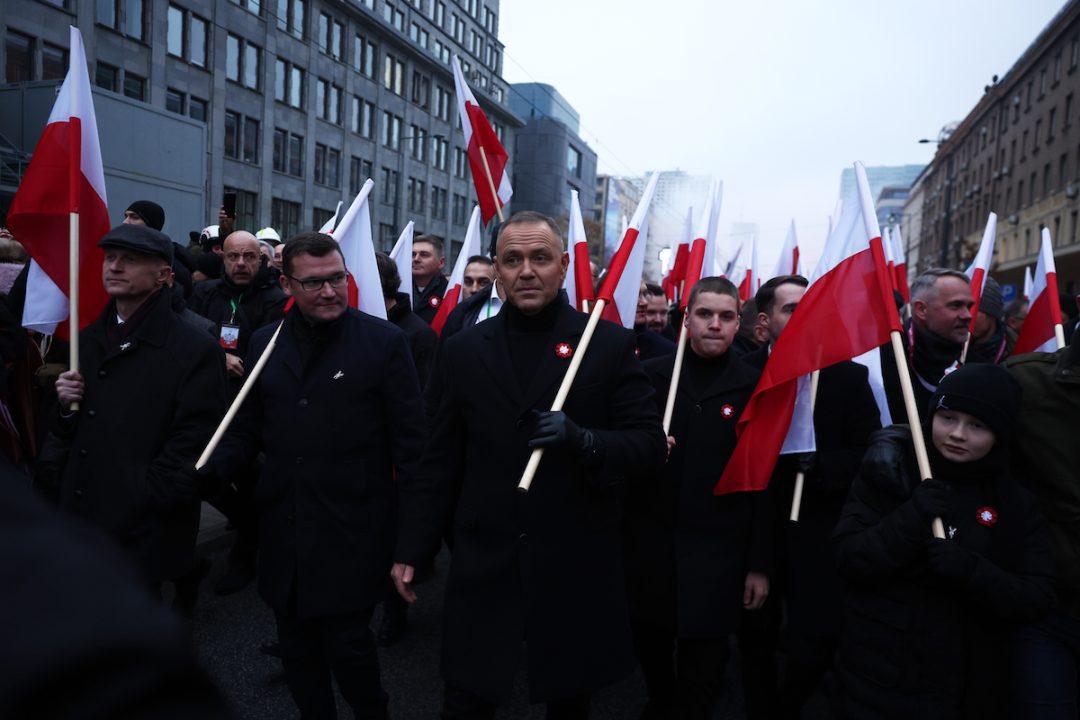
Eleven days after the coup, Poland gave its answer during the Marsz Niepodległości, its Independence Day march.
For 123 years, Poland didn’t exist. Russia, Prussia, and Austria had carved it up. The Poles kept their language and their faith alive anyway, and in 1918 they won their country back. Every 11th of November since, Warsaw turns red and white, the colors of the Polish flag.
This year, President Nawrocki walked at the front of the Independence March, flag in hand, with his son and 500,000 patriots beside him. The slogan was loud and clear: “Poles are masters in their own country.”
I was in Warsaw for President Nawrocki’s inauguration in 2025 and got to see this love of country with my own eyes. One can’t help but feel happiness when seeing how much love the Poles have for not just their country, but for their Christian identity. It is comforting to know that patriotism is still alive in Europe, and that is exactly what Brussels dreads.
What Happens Next?
What’s being decided in Warsaw is whether a nation still has the right to govern itself under its own constitution, or whether that right now belongs to Brussels. If Poland gives in, the same playbook will be used against every country that dares to put its own people and its own laws first. If Poland holds, it proves that a sovereign nation can still say “no.”
There’s a reason Polish MEP Dominik Tarczyński’s phrase “Be like Poland” has become a rallying cry far beyond Poland’s borders. In the end, only one can prevail: the sovereign nation-state or the European Union.
Poland already knows the answer.