Massie Introduces Articles of Impeachment Against Hegseth
Despite losing reelection in the Republican primary, Representative Thomas Massie’s (R-Ky.) is determined to squeeze in as much work as possible before he leaves Washington for good. He is dedicating his last weeks of congressional power to holding Secretary of Defense Pete Hegseth accountable and to push for the release of millions of Jeffrey Epstein files he says the Justice Department is illegally holding on to.
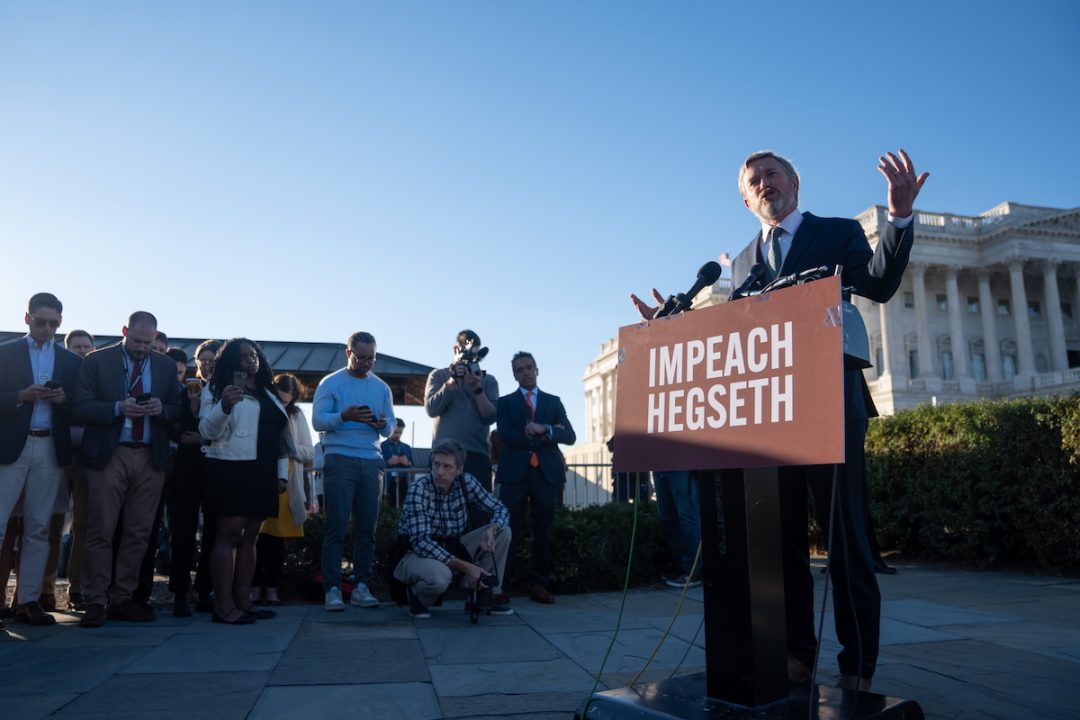
On Tuesday, the Kentucky congressman introduced eight articles of impeachment against Hegseth, charging him with high crimes and misdemeanors for illegally launching the war on Iran, flaunting laws that minimize civilian deaths, killing supposed drug dealers in the ocean without due process, and “kidnapping” a foreign leader.
Massie alleges that by heeding President Donald Trump’s order and launching the war on Iran, Hegseth carried out illegal orders that violate the Constitution and the Wars Powers Resolution of 1973. He argues that none of the three conditions that justify war under the Wars Powers Resolution were met. Congress had not declared war against Iran, it had not enacted any specific legal authorization to start the war, and there was no national emergency triggered by an Iranian attack to warrant a reprisal. Moreover, there was no threat of imminent attack, he adds.
The impeachment resolution calls what Hegseth did “subversive of constitutional government, to the great prejudice of the cause of law and justice, and to the manifest injury of the people of the United States of America.”
Civilian Casualties
The articles also accuse Hegseth of ignoring laws that minimize civilian casualties. The charge is based on the 200-plus civilians, most of them children, the U.S. military killed when it struck an elementary school in Iran. In this article, Hegseth is accused of creating a reckless and barbaric culture of death. Per the resolution:
Hegseth also cultivated a warmaking culture at the Department of Defense which he boasts as being dismissive of “stupid rules of engagement” with preference for “maximum lethality, not tepid legality.” Such combination chilled and rendered ineffective components of the Department of Defense responsible for preventing, mitigating, and responding to civilian harm.
Massie also alleges that Hegseth dismantled civilian-protection infrastructure. He justifies the charge this way:
Secretary Hegseth eliminated funding for the Army’s casualty-tracking database — the institutional system for recording and verifying civilian harm reports — so that, should civilians be harmed as a result of United States military action, there would be no functioning system within the Department of Defense to review, verify, and report on such harm.
Venezuela
Furthermore, the resolution targets Hegseth for the boats that were destroyed in 2025, in what turned out to be the buildup for the Venezuela operation. Hegseth is accused of “extrajudicial killings of at least 243 persons aboard seagoing vessels alleged to be smuggling narcotics in the Caribbean Sea and the Eastern Pacific Ocean, principally in international waters.” He did this illegally, and by doing so he carried out actions that were in the jurisdiction of the Coast Guard and law-enforcement agencies.
The resolution also takes issue with the military’s refusal to rescue shipwrecked survivors. Throughout this entire ordeal of blowing up boats, Hegseth made himself “judge, jury, and executioner.”
Then there’s the Venezuela operation, described as “an act of war against a sovereign country executed under the guise of narcotics law enforcement, though in actuality intended to assert U.S. control over Venezuela’s oil reserves.” The resolution repeats the point that this was all about oil. By carrying out this operation, Hegseth “gambled the lives of Army, Navy, Air Force, and Marine Corps personnel in order to facilitate the illegal taking of national oil.”
The document also makes a strong case for why the Venezuela operation was an act of war:
Hegseth directed United States Armed Forces into hostilities in and around Caracas, Venezuela, employing more than 200 United States special operations personnel on the ground and more than 150 aircraft and drones, including fighter aircraft, bombers, armed helicopters, and electronic warfare aircraft, supported by a substantial naval force that included the Iwo Jima Amphibious Ready Group and the Gerald R. Ford Carrier Strike Group, which together penetrated Venezuelan territory, suppressed and destroyed Venezuelan air defenses, struck multiple targets in the Caracas area, inserted an armed ground force into Caracas to seize Maduro, successfully kidnapped Maduro, killed at least 83 people, including several civilians, and caused 7 American casualties.
Yemen
The last article focuses on Trump’s strike on the Houthis in March 2025, which apparently killed up to 600 Houthis and more than 200 civilians. “The operation comprised more than 1,100 strikes against targets in Yemen over approximately 52 days,” says the resolution. “In less than eight weeks, there were nearly as many civilian deaths in Yemen as United States military actions had caused in that country during the preceding twenty-three years.” The attacks on the Houthis happened despite Constitutional authority or the presence of an imminent threat.
All this, therefore, makes Hegseth a threat to the Constitution, a threat to civilians, and renders him “grossly incompatible with his duties and the rule of law.” The resolution calls for his impeachment, trial, and firing.
“Political Spectacle”
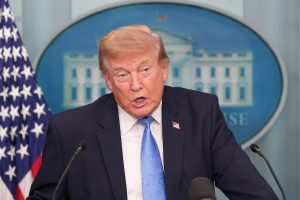
Hegseth responded during a White House briefing Tuesday morning. He called the articles a “political spectacle” carried out by a “disgruntled and defeated congressman” during his “final days in Congress.” He defended the military’s operations as lawful, citing unilateral military actions by other presidents as support. “Iran, the cartels, Maduro, Yemen — every one was a lawful operation ordered by the Commander-in-Chief, then ordered by myself, notified to Congress, and executed by American warriors who did their jobs,” said Heseth, adding:
In the 250 years of our American republic, no Secretary of War or Secretary of Defense has ever been impeached for carrying out lawful military operations — and in our case, successful ones at that. Not once. War Powers Resolution or not. Not under Reagan in Lebanon. Not under Clinton in Kosovo. Not under Obama in Iraq and Syria. Not under Biden in Iraq and Syria. That’s the standard.
This has nothing to do with crimes. According to Hegseth:
That’s what it is: policy disagreements. Not high crimes, not misdemeanors, not treason, not bribery, not the kinds of offenses the founders intended when they wrote the impeachment clause.
That is, indeed, the norm. But that doesn’t mean they’re lawful.
The secretary predicted the impeachment effort would fail.
Massie said during a press conference on Tuesday that it would be better for Hegseth to resign than stick around and wait for the Democrats to come for him. He didn’t express a lot of confidence that the vote would pass.
Epstein Files Transparency Act II
Massie is also trying to get more Epstein transparency before he leaves. His main gripe is that the Justice Department is still holding on to about 3 million files it should have released. Because the government has refused to fully comply with the first Epstein Files Transparency Act, he is spearheading a second act. Back in July, he introduced the Epstein Files Transparency Act II with cosponsors Representative Ro Khanna (D-Calif.) and Representative Teresa Leger Fernández (D-N.M.). There is also a Senate companion bill, co-sponsored by Senators Jeff Merkley (D-Ore.) and Ben Ray Luján (D-N.M.).
Last week, Massie suggested he had enough signatures to force a vote on the bill. He said on X, “When we return next week, we’ll get 218 signatures for Epstein Files Transparency Act II, which guarantees a vote.” As of this writing, the count is still stuck at 216.
The new proposal lets states and victims sue the DOJ over unlawful withholding, redactions, delay, concealment, or failure to publish or hand over covered records. It gives victims access to records about themselves, although not files on other victims. Prosecutors will get access to documents not available to the public that they could use in investigations and cases. The Act strengthens individual lawmakers’ access and enforcement powers. It is intended to make it harder for the DOJ to get away with the many excuses it uses to withhold information, including attorney-client privilege, attorney work product, deliberative-process privilege, or law-enforcement privilege. It would also subject DOJ officials to criminal penalties for hiding, destroying, falsifying, withholding, or lying about the files.
A reporter asked Massie during a press conference this week if he still thought he had the two extra votes he needed for the second Epstein bill. He said, “I think so. It’s just two Democrats that we need, not two Republicans.”