
Trump Credits Stocks for His $3 Billion Wealth Surge. Most of the Windfall Came From Elsewhere
President Donald Trump got $3 billion richer over a single year spanning his reelection and return to the White House. That works out to roughly $8.2 million a day, more than 20 times the annual presidential salary that Trump proudly does not collect.
If your bank account has not enjoyed similar growth, the president has a simple explanation: You should have bought stocks.
But the unprecedented expansion of Trump’s fortune involves considerably more than Wall Street. And while the president’s stock trading raises questions of its own, it apparently played only a minor role in his enrichment. Cryptocurrency ventures, foreign investors, and businesses bearing the president’s name tell a much more revealing story.
“Doing Fine”
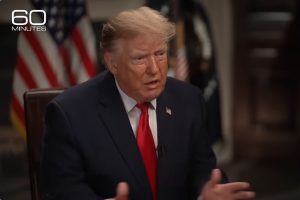
In a 60 Minutes interview broadcast Sunday, CBS correspondent Ross Douthat questioned the president about his growing personal fortune.
The exchange began when Trump praised his administration for creating unprecedented wealth.
Douthat noted that Forbes had estimated a $3 billion increase in Trump’s net worth since his return to office. (The analysis actually covered September 2024 through September 2025.)
Trump interrupted:
Well, so did everyone.
When Douthat pointed out that his own fortune had not increased by $3 billion, Trump replied:
You should’ve had stock.
He repeated the advice before Douthat asked him to explain the extraordinary increase.
Trump answered:
I devote almost no time to my net worth. I don’t care…. I have a lotta money, and far more than I ever thought I’d have. And I guess it’s gone up. I don’t even know. I have a son who’s a very straight, good guy. He watches over money. I don’t even talk to him about it.
Trump also emphasized that he did not collect his presidential salary, claiming to have forgone $2.5 million.
When Douthat observed that he appeared to be doing well financially, Trump readily agreed: “I’m doing fine.”
Crypto and Foreign Investors
Douthat then turned to World Liberty Financial, the cryptocurrency venture associated with the Trump family.
He asked Trump to confirm that he was a co-owner. The president acknowledged that he was.
Douthat pointed out,
This company is also partially owned by investors connected to the government of the United Arab Emirates. I think if I told you that story and it was about the Biden family, if I said Joe Biden is the part owner of a company and it has all of these investments from the Middle East, you would say, “That sounds corrupt.”
Trump insisted that his situation was “different”:
Because I know nothing about it.
Douthat pressed further. If Trump had already accumulated enormous wealth, why not simply divest his interests?
He claimed that he had done so. Douthat immediately disputed that assertion.
The president pivoted to his Wall Street investments, explaining that major financial firms managed much of his money. He claimed his portfolio involved roughly 40,000 stocks held through index funds.
Douthat acknowledged the explanation, but returned to the foreign investors.
Trump instead defended his sons, who, he said, had been “building buildings” long before he entered politics:
My sons run the company. It’s hard to say to them, “Don’t do anything anymore for four years because I’m president.”
Since Trump returned to the White House, his sons have expanded their business interests far beyond real estate, venturing into cryptocurrency, prediction markets, data centers, AI, and defense contracting.
Douthat pointed out that Trump could divest his own interests without preventing his sons from conducting business.
But the president again returned to his stock portfolio, this time describing some 50,000 trades conducted through computerized systems:
I have no idea what the hell they’re buying.
Douthat finally returned to the central question: Did Trump believe that foreign investors putting money into a company he co-owned with his sons, while seeking favors from his administration, thought they were buying political influence?
Trump replied, “I don’t know.”
Precedent That Wasn’t
The president then broadened his defense, arguing that conflicts involving money and political power were nothing unusual.
This is true for every president… Going back to George Washington.
Washington indeed retained substantial business interests while serving as president. He continued operating his Mount Vernon plantation, owned extensive landholdings, and even purchased property in the developing federal capital in 1793. Yet there is no documented equivalent to Trump’s ventures attracting substantial foreign investments during his presidency.
Douthat observed that previous presidents had not owned cryptocurrency companies.
Trump countered:
You know, there’s crypto and before that there was oil.
He may have been referring to the Bush family. George H.W. Bush founded an oil company but left its management in 1966, more than two decades before becoming president. His son, George W. Bush, also had oil interests but sold most of his Harken Energy shares in 1990, a decade before entering the White House.
Neither example establishes a precedent for the business arrangements Trump was defending.
The Obama Deal
The president then shifted to presidential aides who leave government for lucrative positions in defense contracting, finance, and other industries.
He outlined how trusted officials depart the White House and capitalize on their connections in the private sector:
No matter what they do there’s a conflict, because the president is all-encompassing.
The comparison overlooked a crucial distinction: former officials profiting after leaving office versus a sitting president profiting from businesses attracting foreign investment.
Trump then invoked Barack Obama’s agreement with Netflix, claiming the former president received $100 million for a movie project.
Douthat pointed out that Obama’s entertainment ventures came after he left the White House.
Trump insisted:
He made the deal during his presidency.
Except that Obama left office in January 2017, and Netflix announced the agreement in May 2018, nearly 16 months later. Industry estimates valued the undisclosed deal at $50 million to $100 million.
Thus, Trump’s defense of his expanding fortune rested on an unusual collection of “precedents.” None quite explained his own financial arrangements.
Forbes Follows the Money
Dan Alexander, a senior editor at Forbes who calculates the president’s net worth, offered a very different explanation.
In a thread on X, Alexander stated:
I’ll explain exactly how this happened because I’m the person at Forbes who calculates these numbers…. The president’s answer here is nonsense.
Alexander began with the numbers. In fall 2024, Forbes estimated Trump’s fortune at $4.3 billion. A year later, it stood at $7.3 billion.
But the journalist argued that even this comparison understated Trump’s financial gains from politics.
In March 2024, Trump was worth approximately $2.3 billion. His fortune subsequently surged as Trump Media, the company behind Truth Social, went public. Its valuation reflected investor enthusiasm for Trump rather than conventional business fundamentals.
That alone added approximately $1.8 billion to his estimated fortune before the election.
Then came cryptocurrency.
World Liberty Financial launched shortly before the 2024 election. Under its original financial arrangement, Trump was entitled to 52.5 percent of token-sale proceeds after the first $30 million, with additional shares allocated to family members and an affiliate of Steve Witkoff.
Chinese cryptocurrency billionaire Justin Sun invested $30 million shortly after Trump’s election victory, then another $45 million the day before his inauguration.
More investments followed, including from interests connected to Abu Dhabi.
Alexander calculated that World Liberty Financial and Trump’s meme coin together generated approximately $1.425 billion in liquidity by the end of 2025.
Trump also retained substantial cryptocurrency holdings. Forbes valued those tokens at approximately $1 billion in fall 2025, although that represented estimated asset value, not realized cash.
The Profits of Politics
Meanwhile, Trump’s international licensing business expanded dramatically. Its estimated value jumped from $100 million to $500 million in a year, largely through overseas branding agreements.
A New York appeals court also eliminated nearly $500 million in penalties imposed in Trump’s civil fraud case, substantially improving his estimated net worth.
The stock market, meanwhile, contributed remarkably little.
In fall 2024, Forbes estimated Trump’s liquid assets at $415 million, with only about 10 percent invested in stocks.
A 14-percent increase in the S&P 500 would have added approximately $6 million to those holdings. Alexander estimated that Trump’s stake in Trump Media lost $226 million in value during the same period. Together, those changes suggested a net stock-related loss of roughly $220 million.
Alexander concluded:
Almost none of Trump’s $3B in gains from the fall of 2024 to the fall of 2025 came from stock.
The breakdown leaves little support for Trump’s suggestion that ordinary stock-market gains explained his extraordinary enrichment. Cryptocurrency ventures, international licensing, and the elimination of a massive legal penalty accounted for most of the increase.
Perhaps the most revealing explanation came from Trump himself. He told Forbes in 2015:
Politics is great because you don’t spend any money… You can’t make a bad deal, you understand.
A decade later, his personal fortune offers a striking illustration of that philosophy. Whether ordinary Americans can say the same is another matter entirely.