
Democrat, Dark MAGA, Moderate: Musk’s Politics Change, His Agenda Doesn’t
Elon Musk, a former Democrat, spent at least $288 million helping elect Donald Trump and other Republicans in 2024. Two years later, he poured roughly $474 million into the midterms, again backing Republicans. Now he says he is not MAGA. He is not even sure what MAGA means.
An innocent misunderstanding, surely. Who among us has not spent three-quarters of a billion dollars supporting a movement without understanding its defining slogan?
Yet beneath Musk’s almost comical political zigzagging lies a remarkable consistency: His companies have remained deeply intertwined with Washington, securing billions of dollars in federal business while advancing ambitious technological projects that expand government power, regardless of which party holds office.
Meet the Moderate Musk
The revelation came November 18 at The New York Times’ DealBook Summit. Musk joined remotely from China, where he was accompanying Trump.
Interviewer Andrew Ross Sorkin challenged him about campaigning and immigration rhetoric. Musk replied, “I’m not MAGA.” Then came the clarification: “I’m not sure what MAGA means.”
If MAGA meant blind adherence to Republican policies, he explained, that was not his position. He saw positives and negatives in both parties and described himself as “ideologically quite moderate.” He denied extreme views.
Yet his previous political identities tell another story.
From Democrats to Dark MAGA
Musk supported Barack Obama and said he voted for Hillary Clinton in 2016 and Joe Biden in 2020. In 2018, he donated $70,300 to Democratic fundraising committees, while also supporting Republicans.
He backed Democratic priorities, too. In 2017, he quit Trump’s advisory councils over the withdrawal from the Paris climate agreement. In 2021, he said he was “super fired up” about Biden’s climate agenda, which aligned with Tesla’s business.
By May 2022, Musk had renounced the Democrats, calling them divisive and hostile. Two years later, he embraced Trump with considerable enthusiasm.
For all his political shifting, Musk has remained consistent on one issue: universal basic income (UBI). He has advocated it since at least 2016 as a response to automation-driven unemployment. More recently, he has gone further, proposing “universal high income” through federal payments to Americans displaced by artificial intelligence.
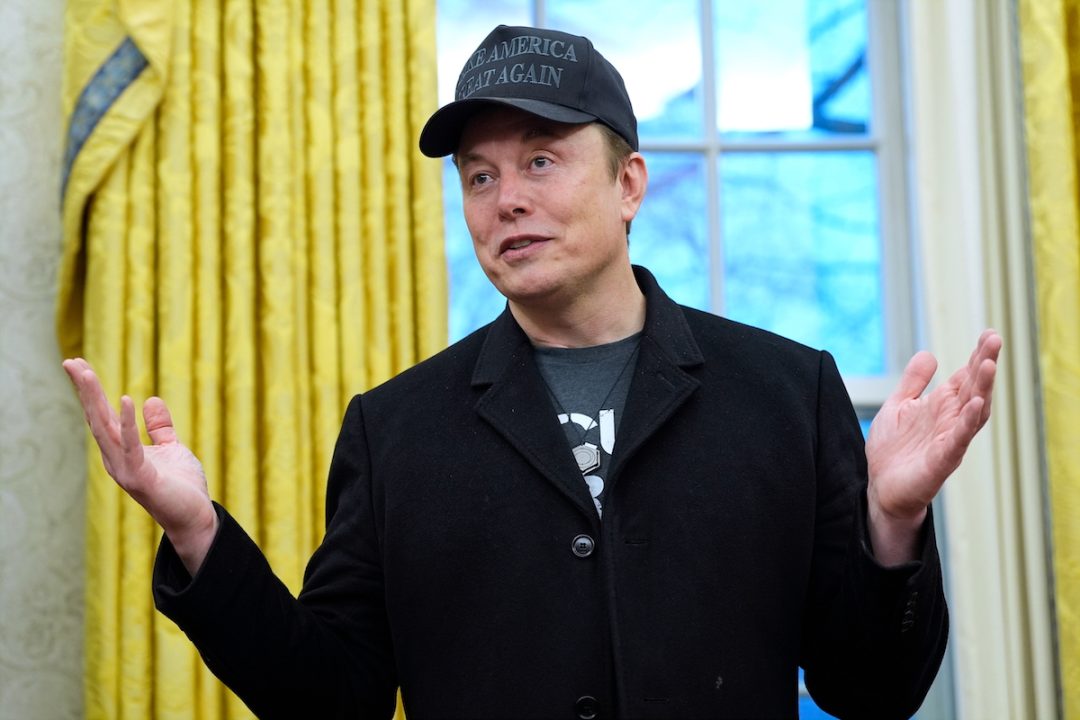
At Trump’s October 2024 Butler, Pennsylvania, rally, Musk wore a black MAGA cap and proclaimed,
I’m not just MAGA, I’m dark MAGA.
Some commentators link the phrase to the Dark Enlightenment, an intellectual movement associated with Curtis Yarvin and Nick Land. It views representative government as inefficient and favors replacing it with a corporate-style system ruled by a powerful executive, supported by technocrats who exercise authority largely beyond public accountability.
As a proponent of the movement, Musk, in the best Machiavellian tradition, warned that Trump had to win to preserve the Constitution, or America might face its last election.
Soon, the alliance brought Musk far more than a place on the campaign stage.
From DOGE to Epstein Accuser
After Trump’s victory, Musk took charge of DOGE, tasked with “modernizing” federal computer systems in line with the administration’s “AI first” agenda. By the time he departed in May 2025, he had fallen far short of his promised savings but made substantial progress in reshaping federal operations around AI and paving the way for centralization of the previously siloed databases.
The Government Accountability Office (GAO) later found that DOGE teams accessed more than 23 systems at four agencies. Auditors could not verify some access safeguards.
Days later, Musk denounced Trump’s signature spending bill as a “disgusting abomination.” He claimed Trump would have lost without him and backed impeaching him in favor of JD Vance.
Then came the Epstein allegation.
“Time to drop the really big bomb: @realDonaldTrump is in the Epstein files,” Musk wrote June 5, suggesting this explained why the records remained withheld.
Musk deleted the post and, on June 11, wrote: “I regret some of my posts about President @realDonaldTrump last week. They went too far.”
Trump, meanwhile, found a vulnerability in his then-former ally’s finances. On July 1, he declared:
Elon may get more subsidy than any human being in history, by far, and without subsidies, Elon would probably have to close up shop and head back home to South Africa. No more Rocket launches, Satellites, or Electric Car Production, and our Country would save a FORTUNE.
Trump suggested DOGE investigate those benefits.
But the feud faded. By November 2026, they were traveling together again, and Musk was heavily funding Republicans.
The $474 Million Election Lesson
A New York Times analysis traced $474 million in Musk’s 2025 and 2026 political contributions. About $216 million went to America PAC, $168 million to the Senate Leadership Fund, and $30 million to the Congressional Leadership Fund.
Musk spent roughly $212 million supporting Texas Republican Ken Paxton, who lost his Senate race to Democrat James Talarico. Democrats also won the Texas governorship and took both chambers of Congress.
“Obviously the Republicans were routed in this election,” Musk admitted at DealBook. He felt “pretty foolish” about the money spent and said he would spend less if he could rewind the clock.
His stated “goal,” he explained, was 51 Republican Senate seats in 2029, preventing unified Democratic control.
On Election Day, Musk had urged his followers to “Vote red today!” After the defeats, he removed that post and an October 29 appeal for Republican Senate candidates.
Government Contracts Outlast Political Slogans
Whatever Musk’s political loyalties, his companies have enjoyed lucrative relationships with Washington under presidents of both parties.
Under Obama, Tesla received and repaid a $465 million federal loan. NASA awarded SpaceX a $2.6 billion crew transportation contract. Under Biden, NASA awarded SpaceX $2.89 billion to develop a lunar lander.
The federal business expanded considerably under Trump.
In April 2025, the Space Force awarded SpaceX a national security launch contract with an anticipated value of $5.92 billion.
SpaceX also secured a role in Trump’s controversial Golden Dome initiative. In April 2026, it was named among 12 companies developing orbital interceptor prototypes under agreements with a combined ceiling of $3.2 billion.
The following month, the Space Force awarded SpaceX $2.29 billion for a military satellite communications network and another $4.16 billion for space-based tracking capabilities.
NASA added $946 million in crew transportation contracts in 2026. Musk’s xAI also secured a Pentagon contract with a $200 million ceiling.
A Washington Post investigation identified at least $38 billion in government contracts, loans, subsidies, and tax credits benefiting Musk’s companies over two decades.
Democrats now plan to investigate his government role. Senator Ruben Gallego of Arizona responded to Musk’s MAGA disclaimer: “You are still getting a subpoena.” Meanwhile, Trump still calls Musk a friend.
For taxpayers, the question is not whether Musk remembers what MAGA means. It is whether either party can meaningfully separate public power from private fortunes when billions flow between them to advance globalist technocratic agendas, from climate policy and AI-driven governance to robotics, transhumanism, UBI, and the militarization and surveillance of space.