Trump Accounts: A Gateway to Universal Basic Income?
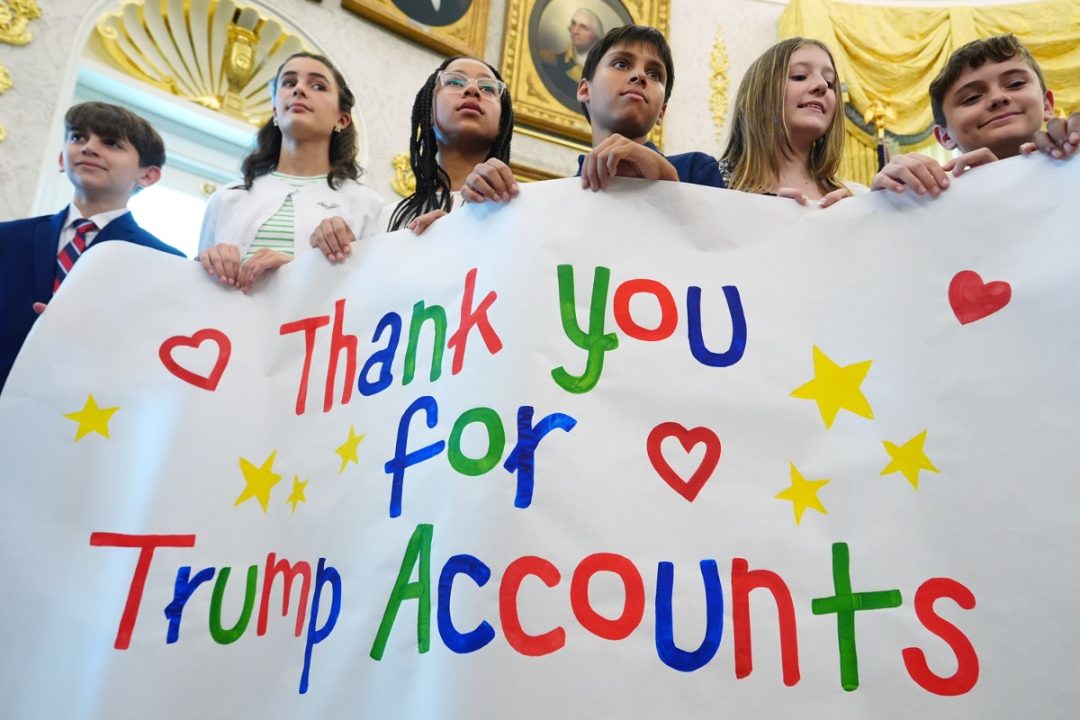
While Americans were distracted by billionaire Susan Dell’s admittedly peculiar appearance at a White House ceremony earlier this month, the event marked a far more consequential development: the Trump administration had automatically enrolled nearly every eligible American child in its government-backed investment program, creating some 70 million accounts.
Now, Washington wants to bring adults into the system.
On Tuesday, Senator Bernie Moreno (R-Ohio) announced plans to extend eligibility to Americans under 40. Hours later, President Donald Trump confirmed that the White House was considering an adult version.
The accounts already enjoy enormous financial support from billionaire investors and major global corporations. Trump has even celebrated wealthy donors for “adopting” entire states.
Increasingly, however, what is presented as philanthropy appears to be laying the groundwork for a system of universal income distributed through digital accounts, financed by corporate fortunes, and potentially linked to Washington’s expanding infrastructure for digital identification, financial surveillance, and personal data collection.
Trump Accounts: How They Work
Congress established Trump Accounts through the One Big Beautiful Bill Act, which Trump signed on July 4, 2025.
As we reported in December, the program created tax-advantaged investment accounts for children under 18. Eligible American children born from 2025 through 2028 qualify for a one-time $1,000 Treasury contribution.
Families and other contributors can deposit up to $5,000 annually, including eligible employer contributions.
Under Treasury’s investment rules, the government determines where the money can be invested. Treasury selected State Street’s S&P 500 fund as the default, and approved four alternatives managed by BlackRock, Vanguard, and State Street. Parents have no initial choice and will eventually be limited to these government-approved funds. Thus, children’s savings flow only into major corporations through some of world’s largest asset managers.
Withdrawals face restrictions until adulthood. Traditional IRA rules largely apply afterward.
On October 1, Treasury announced the automatic enrollment of more than 60 million additional children, bringing the total to approximately 70 million accounts.
The government creates these accounts without parental consent, and the regulations provide no explicit procedure to opt out of automatic enrollment.
Parents must verify their identities through the official app to claim the accounts, manage contributions, and secure the $1,000 payment for eligible children.
The Expansion to Adults
The program may soon extend far beyond childhood.
Billionaire investor Brad Gerstner, founder of Altimeter Capital and a key architect of Trump Accounts, told the New York Post Monday that he was working to extend the program. Per the outlet,
Gerstner said he is working to expand the remit of Trump Accounts to make it accessible to anyone under 40. That updated legislation could come within months. Similarly, those accounts could be used for retirement, education or starting a business. Gerstner says the proposed legislation would also seek to make funding permanent.
Moreno announced Tuesday that he would lead legislation supporting the expansion, potentially adding roughly 100 million Americans.
Asked about the proposal, Trump said, “We haven’t thought of it.” He added, though, that the White House was “looking at something as an alternative,” describing the adult version as “something different.”
Globalists “Invest” in America
Behind Trump Accounts stands Invest America, the nonprofit Gerstner founded to advance the initiative.
Its corporate backers read like a Who’s Who of the Davos establishment: BlackRock, JPMorgan Chase, Goldman Sachs, Morgan Stanley, Bank of America, BNY, Citigroup, Mastercard, Coinbase, Nvidia, Intel, IBM, Dell Technologies, Charles Schwab, and Robinhood, among others.
Invest America encourages employers to finance accounts for workers’ children, advertising benefits such as employee loyalty and corporate goodwill. Its business pledge is nonbinding and does not establish how much each company has contributed.
Many supporters are, indeed, partners of the World Economic Forum (WEF), which signed a strategic partnership with the United Nations in 2019 to accelerate implementation of Agenda 2030.
The UN’s Agenda 2030, under Goal 1.3, calls for:
Implement nationally appropriate social protection systems and measures for all, including floors, and by 2030 achieve substantial coverage of the poor and the vulnerable.
The WEF is actively promoting a universal basic income (UBI), particularly as a way of “helping” younger people.
The convergence is striking. The same globalist corporate giants that help shape international economic and financial policies are now financing government-created investment accounts for millions of Americans.
“Adopting” America: Technofeudalism
The program also carries distinctly feudal overtones. Billionaires are offering to become financial patrons of entire states.
At a Trump Accounts event in January, Trump proudly announced:
Legendary investor Ray Dalio has pledged to adopt the entire state of Connecticut.
A founder of Bridgewater Associates, one of the world’s largest hedge funds, Dalio is a prominent Davos insider and climate alarmist. (He even co-chaired one of the WEF’s initiatives, alongside WEF founder Klaus Schwab, mobilizing philanthropic and private capital to advance global “environmental” goals.)
Trump also celebrated Gerstner’s promise to “adopt his home state of Indiana.”
For now, these pledges involve financial contributions, not actual political control. Yet the language is remarkable. In a republic founded on individual liberty, wealthy patrons now speak of adopting entire populations.
The arrangement recalls warnings from Joel Kotkin in The Coming of Neo-Feudalism and Yanis Varoufakis in Technofeudalism: What Killed Capitalism. Both describe an emerging economic order in which powerful oligarchic elites control essential assets while ordinary people become modern-day serfs, increasingly dependent on their masters for their livelihoods.
Musk’s Universal High Income
Perhaps the most recognizable advocate of universal income is Elon Musk.
On Monday, Musk pledged one SpaceX share to every American child beginning in 2027. The gift could exceed $10 billion at current stock prices.
Trump thanked Musk on Tuesday, confirming that the shares would enter Trump Accounts. Musk called the initiative “the first of many.”
The latest Treasury regulations permit qualifying donations of individual corporate shares, allowing companies to distribute their stock through the program.
Musk’s pledge takes on greater significance in light of his predictions about the future of work — or rather, a future without it.
The world’s largest beneficiary of corporate welfare, Musk believes that AI and humanoid robots will make much human labor unnecessary. His Optimus project aims to manufacture a “legion” of robots capable of replacing workers.
Musk offers something more appealing than UBI, a term burdened by political baggage. He promises “universal high income.”
Echoing the utopian visions of 20th-century communists, Musk said in September:
My prediction is that there will be effectively universal high income…. In fact, it’s not clear to me that money will even matter in the future.
That same month, standing alongside Trump, Musk again pitched a universal income. He also promised an “age of abundance,” when automation could supposedly provide extraordinary prosperity and healthcare for everyone.
All that remains is to trust that the few owners of this abundance will distribute it without demanding anything in return.
The Infrastructure of Control
The stakes become clearer when viewed alongside other initiatives advancing under Trump.
In March 2025, he signed an executive order dismantling barriers to federal data sharing. As we previously reported, Palantir has worked to integrate government databases, raising concerns about comprehensive profiles of American citizens.
In September, Trump launched America.gov, a unified federal portal linked to Login.gov’s digital identity system.
Meanwhile, Washington is promoting dollar-backed stablecoins, expanding digital financial infrastructure even as Trump formally bans a federal central bank digital currency.
These initiatives remain legally separate. Yet their underlying technologies could easily be linked.
The resulting picture would terrify America’s Founders: machines replacing workers already struggling to make ends meet; a handful of globalist oligarchs controlling production; and government-connected systems distributing the resulting wealth.
All of this comes alarmingly close to the WEF’s much-discussed vision of a future in which people “own nothing” and are supposedly “happy” about it. Not long ago, American patriots would have unmistakably recognized such a project as a profound threat to individual liberty and self-government.