

Arsonist Who Ignited L.A.’s Most Destructive Wildfire Found Guilty
The man who started the most destructive fire in Los Angeles’ history is going to prison.
A jury found Jonathan Rinderknecht guilty of intentionally starting the Palisades Fire, the larger of the two major blazes that decimated southern California at the time. He is guilty of one count of destruction of property by means of fire, and one count of arson affecting property used in interstate commerce.
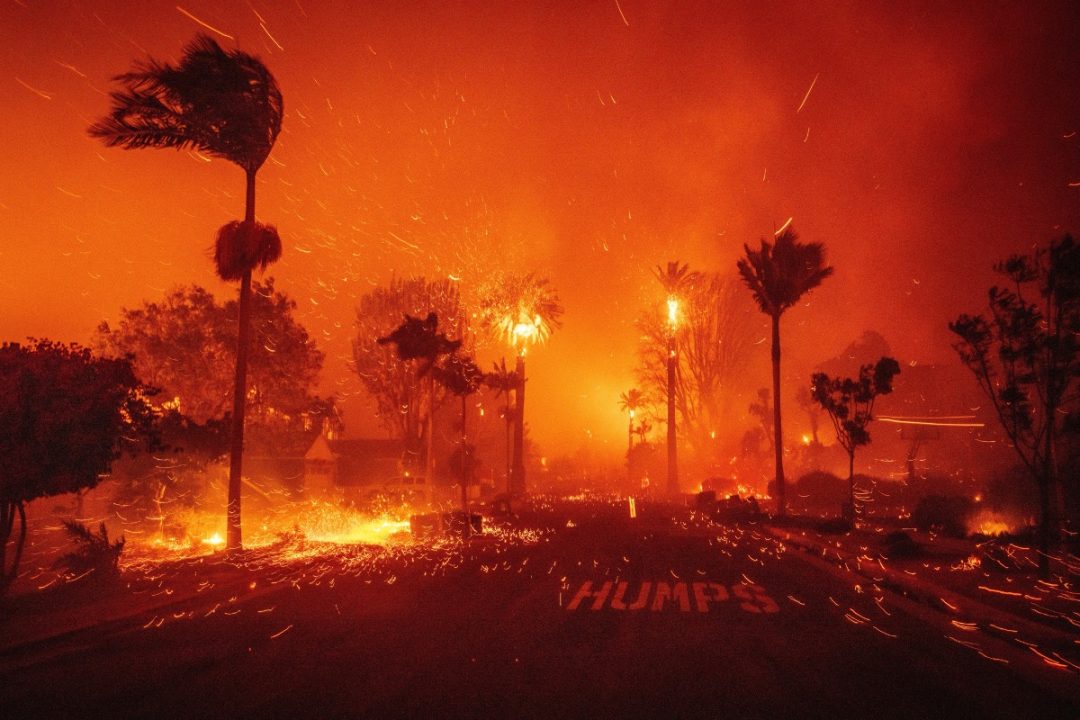
The Palisades Fire consumed 23,000 acres, razed 68,000 homes, and, most tragically, left 12 people dead. And according to Bill Essayli, First Assistant United States Attorney for the Central District of California, it racked up $25 billion in damages.
The other major fire in that January 2025 outbreak, the Eaton Fire, killed 19 people and consumed 9,400 structures. The official determined cause was “electrical arcing events that took place on an out-of-service Southern California Edison (SCE) tower,” according to reports.
Motive and Method
Regarding Rinderknecht, Essayli’s office portrays a young man who was angry at the world because he couldn’t find romance on New Year’s Eve. “In the days leading up to the Lachman Fire [a related blaze begun by Rinderknecht], Rinderknecht exhibited extreme anger, indignation, and frustration about being unable to find companionship on New Year’s Eve 2024 and about a former co-worker whom he briefly dated in March 2024,” according to a press release from Essayli’s office. “Alone on New Year’s Eve, Rinderknecht drove several Uber passengers, nearly all of whom remembered him being angry that night.”
On December 31, 2024, Rinderknecht used a trail to walk up Hidden Buddha Hill in Pacific Palisades, and put on a rap song that included a music video of things being lit on fire. He then sparked a fire. He called 911 once he had descended and was in cellphone range, but a nearby resident had already reported the blaze by then.
According to Essayli’s office, the arsonist went out of his way to get video of what he had done:
Rinderknecht then fled in his car, passing fire engines driving in the opposite direction. He then turned around and followed the fire engines to the scene, driving at a high rate of speed. Rinderknecht walked up the same trail from earlier that night to watch the fire and the firefighters. At approximately 1:02 a.m. [on January 1], he used his iPhone to take more videos of the scene.
Although firefighters put out the fire, it “continued to smolder and burn underground within the root structure of dense vegetation,” according to officials. A few days later, on January 7, “heavy winds caused the underground fire to surface and spread above ground in what became known as the Palisades Fire.”
Other Arson Around the World
Arson has been suspected or proven in some of the most destructive fires, not only in America, but Canada and Europe as well.
A man named Aaron F. Farinacci was recently indicted on charges of first degree arson in the Old Trails Fire, the most devastating of the Spokane Fires a few months ago.
Arson is also the determined cause of one of the largest fires in Arizona history, the 2002 Rodeo-Chedeski Fire. Leonard Gregg, a tribal firefighter, told police he set the fire hoping to get hired by the Bureau of Indian Affairs to fight it. And that’s what happened.
In Canada, 560 fires in British Columbia alone over the last decade are considered to be arson or “suspicious,” according to reports.
And in France, hundreds of people have been arrested for fueling a particularly busy fire season. “According to the French interior ministry, since the start of a summer in which a record 115,000 hectares of forest, scrub and heathland have gone up in flames, 514 people — including 198 minors — have been arrested on suspicion of starting wildfires,” noted The Guardian.
Rinderknecht was found guilty on Friday, and is scheduled for sentencing on March 17, 2027. The minimum sentence is five years, and the maximum is 40 years.