
Vol. 42, No. 05
05/01/2026
Financial Conspiracy
AT A GLANCE
• Central banking permits the control of money and credit by amoral elites.
• The Bank for International Settlements (BIS) was created to globalize central banking.
• The income tax and the Federal Reserve are key Marxist agenda items.
• The Federal Reserve has conspiratorial beginnings and has virtually destroyed the dollar — and the American way of life.
In January 1939, Berlin celebrated what was to be the last New Year of peace for five years. Everywhere were signs of an impending crisis like no other: the Nazi regalia, goosestepping German troops, shattered storefronts of Jewish merchants destroyed during the infamous Kristallnacht less than two months earlier, and, above all, the sense that Germany’s Führer, with his electrifying public rallies and mesmerizing rhetoric, was plotting something much larger than national renewal. Since the rise to power of Adolf Hitler and the Nazis in 1933, Germany’s economic growth had been nothing short of miraculous, featuring a surge in manufacturing, sprawling new public works projects such as the Autobahn, dramatic advances in science and technology, and the recovery of German finances from the disastrous hyperinflation of the early 1920s. While much of the rest of the Western world was wallowing in the Great Depression, Hitler’s Germany appeared to many to be the hope of the future.
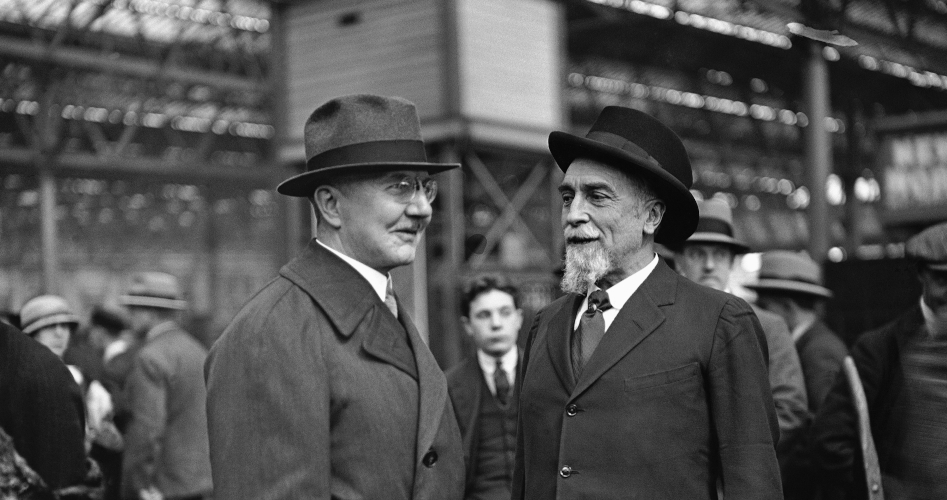
On January 5 at Berlin’s Zoologischer Garten train station, two men unknown to the public at large met — one of them a small man sporting a Van Dyke beard who had traveled all the way from England; the other a thickset man with round-rimmed glasses and a neatly trimmed mustache who embraced his English friend warmly. Little did any of the passersby suspect that these two men, close friends and professional associates for many years, were mostly responsible for Hitler’s economic miracle, and were quite likely the two most powerful men in Europe. They were Montagu Norman, longtime head of the Bank of England, and his German counterpart, Hjalmar Schacht, appointed as president of the Reichsbank (for the second time) in 1933.
Schacht, a close confidant of Hitler, was also in charge of the Ministry of Economics, where he was able to direct public funds toward various industries favored by the Third Reich. As a younger man, Schacht had implemented the Rentenmark scheme (a novel form of currency backed by land) that was perceived as having ended Germany’s ruinous hyperinflation in the early 1920s. Now, he was widely admired for having been the real brains behind Germany’s economic recovery in the 1930s. He had achieved this “miracle” by extremely dubious means, including repudiating government debt; confiscating the assets of foreigners’ bank accounts, along with their cash holdings; and inventing novel ways for the Reichsbank to loan vast sums to the government. He had invited his longtime friend Montagu Norman to Berlin to attend the christening of his grandson, who was named after the British banker. Once the ceremony was over, however, the two men departed together for Basel, Switzerland, for the real business of their visit: the all-important monthly board meeting of the Bank for International Settlements.
Premium Content
Sign in with your ShopJBS.org account to read the full article, or subscribe below for unlimited digital access.
Log In to Continue Reading
- 12 Issues Per Year
- Digital Edition Access
- Digital Insider Report
- Exclusive Subscriber Content
- Audio provided for all articles
- Unlimited access to past issues
- Cancel anytime
- Renews automatically
- 12 Issues Per Year
- Print edition delivery (USA) *Available Outside USA
- Digital Edition Access
- Digital Insider Report
- Exclusive Subscriber Content
- Audio provided for all articles
- Unlimited access to past issues
- Cancel anytime
- Renews automatically