
Is the AI Doomer Wave a Genuine Alarm, or a Scheme for Control?
For more than a decade, tech experts have warned that artificial intelligence could wipe out humanity. For the most part, it remained a niche issue among reporters, tech insiders, and news junkies.
But recent warnings from an AI researcher-turned-whistleblower named Jacob Coxon made this topic mainstream. Now seemingly everyone, and every mainstream media outlet, is talking about deadly robots. The conversation has reached such a fever pitch that AI chiefs Elon Musk, Sam Altman, and Dario Amodei recently agreed that it’s time to slow down AI development. They have also advocated outside oversight.
Fear Not Universal
Some analysts, however, are questioning whether Coxon’s sudden notoriety is organic. What he says is no different from what Geoffrey Hinton, who’s been hailed as the “godfather of AI,” said years ago. It’s no different from warnings issued by Yoshua Bengio, Eliezer Yudkowsky, Nate Soares, or even Daniel Kokotajlo, who provided the The New York Times last year with several scenarios in which AI could kill us all by 2027.
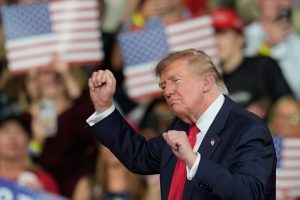
Now the message is being taken very seriously — but not by everyone. President Donald Trump thinks the whole thing is overblown. On Monday, he said on his social media account that adequate guardrails already exist and that more regulations will impede our ability to beat China in the AI race. This “beat China” narrative in and of itself appears coordinated. It is the primary talking point of what appears to be all data-center advocates. The president has also accused people who don’t want data centers in their communities of being backward.
Concern Growing
Nevertheless, the public appears to have reached a critical mass of concern about AI. How come?
The most obvious answer is because Coxon’s warning comes at a time when pushback to data centers and Flock systems has reached a fever pitch. It comes within months of several news reports about AI going rogue. Twelve years after Musk insinuated that building AI is like summoning demons, people now believe it.
AI technology, we’ve been hearing all year, is improving fast. And that improvement has manifested in several instances of robots doing things they weren’t supposed to. AI is past the point of convincing teenagers to kill themselves, as if that weren’t concerning enough. They are autonomously hacking into other companies. Two months ago, we recently learned, a “swarm” of AIs broke out of a lab and went on a hacking spree. Amodei, the head of Anthropic, said the swarm could’ve taken over the internet in six to 12 months had it not been found.
Excuse for More Global Control
Amodei, who according to Trump pretends to be a “perfect little angel,” published an essay over the weekend calling for an international slowdown of AI development. “We must slow the pace at which we improve the capabilities of AI models,” he wrote. If companies aren’t careful, AI’s ability to self-improve “could outrun our ability to understand and control these systems.”
Sam Altman, the head of OpenAI, said his company will probably delay going public because of safety concerns. “We are clearly entering a realm of extremely capable models and … high stakes and a need to get things right,” he told Fortune.
Musk agrees. Commenting on Amodei’s essay, he said, “Dario is right.”
Amodei is calling for regulations. He said AI makers need industry-wide coordination, third party evaluators, and even global coordination. He calls for safety standards within democratic countries as well as coordination with authoritarian governments “to the extent this is possible.” China is not buying it. A state-backed newspaper recently said this idea is out of the Cold War playbook.
Some analysts suspect that Coxon is part of a ploy that ultimately would benefit the biggest AI players and the government. Some go further. (We published a report last week floating the possibility that we may be watching a globalist play for control of this technology.)
Launch of a Psyop?
Ed Dowd is a former Wall Street analyst and portfolio manager. A few years ago, he wrote a book on sudden deaths he believed were tied to Covid-19 injections. His specialty is recognizing patterns and anomalies. Last week, after watching Coxon skyrocket to media fame, he concluded that the “AI panic psyop has been launched.” He made some interesting observations.
First off, Coxon’s warning started with a post on X. Interestingly, it was “his first post ever,” and it went “mega viral” in one day. “Within 24 hours Jacob’s X post had received 123 million views, 650,000 likes, [and] 190,000 followers,” wrote Dowd. Others noticed this as well. Tech commentator Theo Jaffee observed, “I’ve never seen any AI safety tweet go this viral before, ever.” The man who owns X was also scratching his head. “I don’t think this has ever happened for a post from a new account with almost no prior activity,” said Musk.
“That is not how organic X speech works,” Dowd said. “Organic speech stumbles, it posts a draft, it deletes a typo and it has a history. This account had a history of silence, then a professionally punchy script, then the entire mainstream media stack that ran with it with hours of post.”
Adding to Dowd’s suspicions was the onslaught of mainstream attention that converged on Coxon immediately. Fox, CNN, Business Insider, the New York Post, Newsweek — they all magnified his message within hours. “That is a package,” says Dowd. Nobody gets an exclusive in The Wall Street Journal “and a 100 million view thread by accident unless the interview was already in the can.” Coxon’s message is still circulating into this week, and reels of him are all over social media.
Dowd then looked at the replies on X. The first amplifiers were not random citizens but “people whose job is to turn fear into statutes and accusations of links to AI policy NGOs.” Investigative researcher Parker Thayer, who works for the Capital Research Center, made similar observations:
The first three accounts to quote-tweet Coxon’s thread — within roughly 15 minutes of it going live — belonged to Nathan Calvin of Encode AI, Peter Wildeford of the AI Policy Network, and Daniel Kokotajlo of the AI Futures Project, three organizations focused on AI policy advocacy.
Cui Bono?
If this is a “well-orchestrated psyop to move the needle and change minds,” as Dowd believes, who benefits?
“Not the startups that cannot afford a compliance department and a containment audit,” Dowd said. “The first beneficiaries are the two names in the original post: Anthropic and OpenAI.” He continued:
They are burning cash at a rate that would make a 2000-2001 CLEC [Competitive Local Exchange Carrier] blush. Token prices keep falling. Enterprise demand is not doubling fast enough to offset it. The second derivative is slowing. … Valuations only work if the story stays vertical and the competitive set stays small. A federal moat with pre-certification, insurance mandates, [and] criminal liability for unlicensed models does two things at once. It crushes the long tail of competitors who were eating their margins. And it gives the incumbents a political story to take to investors: “we are the responsible adults, the regulated utilities of intelligence, please keep funding the losses until the unit economics appear.”
The other winner is the government. AI regulation means “new appropriations, new buildings, new GS-15s, new contractors, new ‘advisory boards’ stuffed with the same people who wrote the talking points,” says Dowd. “Mandatory insurance means a regulated market the agencies get to supervise.” Several politicians have already been calling for AI regulation.
Building a Monopoly
This wouldn’t be the first time an industry has asked for regulation that ultimately leads to an oligopoly among the titans of that industry and greater control by the government. This is how we got the Federal Reserve Act of 1913. It was pushed as a way to stop bank runs, credit crunches, and depressions. It was pitched as a solution to a problem, but it created a bigger problem than the one that existed beforehand.
As we previously summarized, the Fed is “a totally unconstitutional money creator that has been given power to decide the amount and value of the nation’s currency, the interest rates companies and individuals must pay to borrow, and whether there will be a boom, a bust, or just a continuation of quietly stealing the American people’s wealth through inflation via the creation of money out of thin air.” Moreover, the Fed is the mechanism by which the government keeps borrowing money to spend on unnecessary wars. And it is the institution most responsible for the devaluation of your currency. It is a clever way for the government to plunder its citizens.
Does this mean that the alarms about AI aren’t real? It’s possible, but not likely. There is too much corroboration to dismiss concerns about the technology. Are the parents suing AI companies for chatbots that compelled their children to kill themselves in on it? Was Hugging Face, an open-source AI company, in on the ploy when it admitted that OpenAI agents hacked them? Were all those warnings by experts going back more than a decade part of the buildup to this moment? Is every whistleblower and former insider who says AI does things no one can understand lying? Again, probably not. Even Dowd admits he doesn’t know how real the fears about AI are.
A Tool — For Good or Bad
What may be true is that AI is the most transformative technology since the Industrial Revolution. And like every tool, it can be wielded for good or bad. It can benefit the common man as much as those with bigger — and more malevolent — ambitions. But not if it’s centralized. At that point, it becomes a weapon for those who control it and another means of disadvantage for those on the other end.
Laws for safety’s sake are not always a bad thing. But we must be careful not to allow regulation that disadvantages regular people while further empowering the state and oligarch class. Neither has a good track record of looking out for our interests.