“We’re Making a Freaking Fortune”: Trump Cheers Oil Profits Amid Gas Price Surge
For millions of Americans, filling up the gas tank has become an increasingly painful expense. On Saturday, however, President Donald Trump found plenty to celebrate in soaring fuel prices. Conflating the enormous profits of oil and gas companies with the prosperity of the nation as a whole, he enthusiastically declared, “We’re making a freaking fortune.”
The president even acknowledged that Americans were “paying a little higher.” But that hardly dampened his excitement. Apparently, what matters is not how much Americans are paying, but how much a fortunate few, including Trump himself, stand to gain.
The Remarks
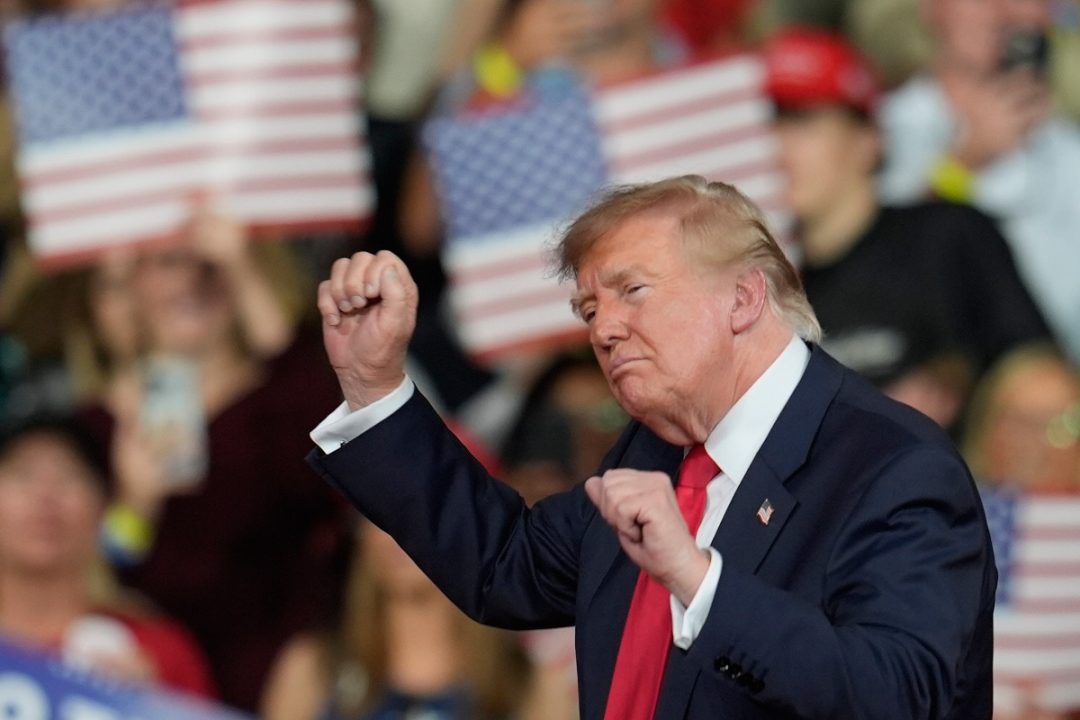
Speaking in Perry, Georgia, on Saturday, Trump praised the booming American oil industry.
He began by assuring Americans that high oil prices were temporary and would fall dramatically once the war ended. Ships carrying oil, he explained, were waiting to pass through the Strait of Hormuz, which he had repeatedly declared open on previous occasions.
Then came the good news, at least for the oil industry:
The United States oil and gas business is making hundreds of billions of dollars.
Trump attributed the windfall directly to the war, which had driven buyers toward American suppliers:
Our country is making hundreds of billions of dollars because of what’s happened in the Middle East because they’re coming to Texas and they’re coming to Oklahoma and they’re coming to Louisiana and they’re taking that oil.
The president then added Venezuela and Greenland to his increasingly expansive accounting of America’s petroleum riches:
So we’re making hundreds and hundreds of billions, trillions of dollars.
Trump acknowledged that his advisors had cautioned him against boasting about such profits:
Please don’t mention that, sir, because people are paying a little higher.
He nevertheless insisted:
What we’ve done for this country, we’re making money like this country has never made before.
Trump even anticipated the media reactions his enthusiasm might produce:
I could just see the fake headlines: “President Trump is talking about all the money they’re making while people are suffering at the pump.” That’ll be the headline. But I said, I don’t give a damn. I’m going to say it. We’re making a freaking fortune.
Remarkably, however, the supposedly unfair headline to which the president professed indifference would have captured the reality rather accurately: Ordinary Americans are struggling with soaring fuel costs, while the fortune Trump celebrates flows into the pockets of a select few.
The Price of “Prosperity”
The numbers explain why Trump’s enthusiasm might sound rather different to motorists filling their tanks.
According to AAA, regular gasoline averaged approximately $4.28 per gallon on Sunday. Before the United States and Israel launched their war against Iran on February 28, the national average stood near $2.98.
That represents an increase of roughly 44 percent.
Diesel prices have climbed even faster, rising from about $3.67 before the war to more than $6.34 per gallon.
The impact extends far beyond individual drivers. Diesel powers trucks, agricultural machinery, and much of the nation’s freight transportation. Higher transportation costs eventually reach grocery stores, manufacturers, and consumers.
Brown University’s Iran War Energy Cost Tracker estimates that Americans have paid approximately $143.7 billion in additional gasoline and diesel costs since the conflict began.
That amounts to roughly $1,097 per household. The researchers compare actual fuel expenses with estimated costs in a scenario without the war.
For households already struggling with inflation, Trump’s promise of eventually falling prices offers little relief. Families pay their fuel bills now. The promised savings remain somewhere in the future.
The larger picture is hardly more encouraging. According to the Iran War Cost Tracker, U.S. military operations have already cost taxpayers an estimated $46.9 billion, with the bill still growing.
Whatever fortunes the war generates for oil companies, Americans are paying for it twice: at the pump and through their taxes.
Who Exactly Is “We”?
Trump repeatedly equated oil industry profits with money that “our country” was making. But there is a crucial distinction: American oil companies are private businesses. While the government collects a portion of their earnings through taxes, the profits themselves belong to shareholders, not the American public. Higher corporate earnings, therefore, do not automatically translate into prosperity for households struggling with fuel costs.
And those profits are, indeed, staggering.
ExxonMobil reported $14.5 billion in second-quarter profits, more than double its earnings a year earlier. Chevron reported $12 billion, up from $2.5 billion in 2025, a staggering 380-percent increase.
Together, the two companies pocketed $26.5 billion in just three months.
Trump himself has a financial stake in the industry’s success. A CNBC analysis found that his nine largest oil and gas holdings gained between $1.5 million and $4.4 million in value during the war’s first six months. They include investments in ExxonMobil, Chevron, ConocoPhillips, and major refiners and pipeline operators.
That puts the president among those who stand to benefit from the very price increases burdening everyday Americans.
The benefits of this arrangement appear to have escaped most voters. An October New York Times/Siena poll found that 73 percent disapproved of Trump’s handling of gas prices. Similarly, Pew Research found that 74 percent of Americans were very concerned about energy costs, up sharply from 43 percent in January.
Is It “Too Much Money”?
Trump’s latest enthusiasm also marks a striking reversal.
In August, he sharply criticized ExxonMobil and Chevron for profiting excessively from wartime energy shortages. He told reporters:
They are making too much money, okay?… Chevron: too much money. ExxonMobil: too much money…. They’re going to give some of that back to the public and they better cut the retail price, the consumer price. Too much money. You’re surprised I’m saying it? I’ll say it loud and clear: I’m not happy about it.
On October 14, however, he offered a rather different assessment at an Arizona rally:
Our country is making more money than it’s ever made, because of the fact that oil is so high.
He anticipated criticism then, too:
I care more about the little person than I care about the big person. I care about the little person like crazy.
But he returned to the same conclusion:
Because of the price of oil, Texas and Oklahoma, North Dakota and all these places, we’re making a fortune.
Yet excessive corporate profits do not become national prosperity simply because the president describes them as such.
War’s Winners and Losers
The deeper economic problem is that the administration’s unconstitutional war severely disrupted global oil supplies. And despite America’s vast domestic petroleum production, consumers remain vulnerable to rising prices on global crude markets.
Higher prices therefore benefit some domestic producers while burdening millions of households.
Meanwhile, Washington is further depleting the nation’s Strategic Petroleum Reserve (SPR), already severely diminished under President Joe Biden. His administration released 180 million barrels in 2022 following Russia’s invasion of Ukraine. Trump has now authorized another 172 million barrels to counter disruptions from the Iran war. Of that amount, approximately 132.5 million barrels had already been withdrawn by mid-October.
As of October 16, the reserve held just 282.2 million barrels, less than 40 percent of its authorized capacity. Unlike Biden’s emergency sales, Trump’s current releases largely involve exchanges requiring companies to return the borrowed oil with additional barrels later.
On Thursday, Trump also invoked the Defense Production Act to encourage additional oil production, refining, and infrastructure development. His administration increasingly relies on federal intervention to manage an energy crisis aggravated by its own military policies.
The arrangement is remarkable. Washington helps create the disruption. Oil companies collect windfall profits. Americans pay more for fuel while the nation’s emergency reserves shrink. Then Washington intervenes again to address the consequences, and the president presents the whole affair as an extraordinary success.
Related Articles:
Trump Urges Xi to Help Boost Global Fuel Supply
Trump Says Venezuela’s Oil Generated Over $13 Billion. Where Did It Go?
U.S. Oil Reserve Falls to 43-year Low as Trump Drawdown Nears Its Limit
Lockdowns 2.0? IEA Rolls Out “Sheltering” Plan as U.S.-Israel War on Iran Hits Oil Supply