

Ford Foundation: $60 Million to “Nonpartisan Nonprofits” to Protect “Election Integrity”
A Ford Foundation press release on April 14 proclaimed, “Ford Foundation Adds $60 Million in New Funding to Strengthen Democracy.”
The sub-headline for the release states that “Grants will support nonpartisan nonprofits and veterans organizations working to protect the rule of law, fortify voting rights, and increase civic participation.” (Emphasis in original.)
Rule of law, voting rights, civic participation: sounds great, yes? However, as Humpty Dumpty told Alice in Through the Looking Glass, “When I use a word, it means just what I choose it to mean — neither more nor less.” And when folks at the Ford Foundation use words such as “rule of law,” “voting rights,” and “civic participation,” we can be sure from past experience that they mean something very different from most Americans’ understanding of those words. Poll after poll (Gallup, Pew, Monmouth, Rasmussen, Center Square) shows that a huge majority of American voters (80 percent of Americans overall, including 62 percent of Democrats, 87 percent of Independents, and 91 percent of Republicans) support requiring photo identification for voting. But the Ford Foundation and the NGOs it funds consider this basic security measure, which is required in almost every other country, to be a form of “voter suppression,” claiming that it discriminates against “people of color,” as if acquiring a government-issued photo ID is an insurmountable obstacle and an active measure of “racial oppression.”
The Ford press release proudly boasts, “In the last ten years alone, the foundation’s Civic Engagement and Government program has provided more than $1 billion in grants to nonpartisan organizations within the United States.” It further notes that “among the organizations receiving funding are Pillars of the Community, Veterans for all Voters, All Voting is Local, Campaign Legal Center, and We the Veterans Military Foundation.”
Let’s look at the self-proclaimed “Pillars of the Community,” which is co-chaired by Ben Ginsberg (Republican) and Bob Bauer (Democrat). This duo is “nonpartisan” in the sense that both men are longtime servitors for the Repub-Demo Uniparty that has beguiled the American public into believing that alternating between a Democrat and a Republican in the White House demonstrates real citizen empowerment and honest government. Ginsberg has been a veteran counselor to the Bush-Romney wing of the GOP, serving as counsel to the Republican National Committee (RNC) and many other GOP organizations. He also served as national counsel to the Bush-Cheney 2000 and 2004 campaigns, as well as the Romney campaigns in 2008 and 2012. Ginsberg was a signatory to the amicus curiae brief in support of same-sex “marriage” submitted to the U.S. Supreme Court in the 2013 Hollingsworth v. Perry case. President Barack Obama selected Ginsberg and Bauer to chair the Presidential Commission on Election Administration, which was supposed to investigate election problems. Their report was a whitewash. Not surprisingly, Ginsberg became a vocal Never-Trumper RINO and was one of the principal GOP voices disputing and disparaging efforts to expose the massive voter fraud of the 2020 elections.
Bob Bauer, Ginsberg’s co-chair at Pillars of the Community, is the perfect Uniparty counterpart. He was Obama’s personal attorney, general counsel of Obama’s 2008 presidential campaign, and Obama’s White House Counsel. Following his White House stint, Bauer returned to private practice with the now-notorious Perkins Coie law firm. Perkins Coie, while representing the Hillary Clinton campaign and the Democratic National Committee (DNC), funneled $168,000 from the Clinton campaign and the DNC to Fusion GPS, which then paid for the phony Steele Dossier that was used to foment the “Russia, Russia, Russia” campaign against Trump.
“For 90 years, the Ford Foundation has been steadfast in its commitment to advancing the ideals and principles of democracy,” said Heather Gerken, president of the Ford Foundation, in announcing the $60 million funding spree. “As we look ahead, it is an honor to deepen this commitment and support the remarkable work taking place around the United States to strengthen democracy and the rule of law at this urgent moment.”

Some of the “nonpartisan” groups Ford has funded over that 90-year period include the American Civil Liberties Union (ACLU), Planned Parenthood, the Center for Constitutional Rights (CCR), the NAACP Legal Defense & Education Fund, Amnesty International USA, the National Immigration Law Center, Democracy Now Productions, the Tides Foundation, the Black-Led Movement Fund (BLMF, affiliated with Black Lives Matter), the Brookings Institution, Public Citizen, Friends of the Earth, Rainforest Action Network, the Center for Reproductive Rights, the National Organization for Women (NOW), Make the Road New York, the Feminist Majority Foundation, the Center for Popular Democracy, the National Council of La Raza, the Mexican American Legal Defense and Education Fund (MALDEF), the Puerto Rican Legal Defense and Education Fund, the Migration Policy Institute, the Urban Institute, Oxfam America, the Anti-Defamation League (ADL), and numerous UN organizations and UN-related NGOs.
While not as large as the $418 million infusion of “Zuckerbucks” injected into the 2020 election by Meta/Facebook CEO Mark Zuckerberg and his wife, Priscilla Chan, to nonprofits such as the Center for Tech and Civic Life (CTCL) and the Center for Election Innovation & Research (CEIR), the Ford infusion will similarly aim at skewing the elections in the same leftward direction.
For the better part of a century, the Ford Foundation has been a leading force among the big tax-exempt foundations in funding subversive organizations and individuals bent on the destructive transformation of the United States into a mere cog in a collectivist New World Order. By the 1950s, the funding records of foundations such as Ford, Rockefeller, Carnegie, and others had become so alarming that the House Select Committee to Investigate Tax-Exempt Foundations was set up under Representative B. Carroll Reece (R-Tenn.). These foundations, the committee found, “promote ‘internationalism’ in a particular sense — a form directed toward ‘world government’ and a derogation of American ‘nationalism.’” The 2,086-page Reece Report also observed that major foundations “have actively supported attacks upon our social and government system and financed the promotion of socialism and collectivist ideas.”
As we reported in 2017, “One of the most astounding revelations to come out of the Reece Committee investigation came from Ford Foundation President H. Rowan Gaither (a Council on Foreign Relations member), who admitted, in a private meeting with committee investigator Norman Dodd, that he and others inside and outside of government were working ‘to so alter life in the United States that we can be comfortably merged with the Soviet Union.’ When the shocked Norman Dodd asked if he would repeat that statement in public testimony, Gaither replied, ‘This, we would not think of doing.’”
For a synopsis of the tax-exempt foundation threat (and particularly that of the Ford Foundation), see “Foundations: Cutting Off the Toxic Funding Flow” and “Silk Hats and Brown Berets.” — William F. Jasper
Pentagon Seeks Automaker Shift to Military Production Amid Stockpile Concerns
Retired U.S. Army Colonel Douglas Macgregor posted on social media April 16, saying: “BREAKING: Pentagon approaches GM, Ford and other large auto manufacturers to discuss shifting from auto development to weapons and military supply production.” Macgregor’s announcement referred to reporting from The Wall Street Journal, which first detailed the discussions. Senior Pentagon officials have held preliminary talks with executives from General Motors (led by CEO Mary Barra) and Ford Motor (led by CEO Jim Farley), among others. The conversations explore repurposing commercial manufacturing capacity to produce weapons, munitions, tactical hardware, missiles, and counter-drone systems. These wide-ranging discussions began before the escalation of conflict in Iran and reflect the Trump administration’s push to expand the defense industrial base beyond traditional contractors.
The initiative draws explicit parallels to World War II, when U.S. automakers converted assembly lines to produce tanks, aircraft, and other war materiel under the “Arsenal of Democracy” model. Today, the urgency stems from depleted munitions stockpiles. Ongoing operations, including support for allies in Ukraine and direct involvement in the Iran theater, have accelerated consumption of precision-guided weapons such as THAAD interceptors (Terminal High-Altitude Area Defense), Patriot missiles, and cruise missiles. Earlier in 2026, the Pentagon secured framework agreements with major defense firms, including Lockheed Martin, BAE Systems, and Honeywell, to quadruple production of key systems. Yet officials now seek additional capacity from non-traditional manufacturers.
Automakers possess large-scale factories, skilled workforces, and supply-chain expertise that could be rapidly redirected. GM, for instance, already produces infantry squad vehicles for the military; Ford and others have supplied components in past emergencies. Talks remain exploratory, focusing on whether commercial facilities could shift output without full-scale retooling. No binding contracts have been announced, but the outreach signals a broader “wartime footing” strategy outlined in recent Pentagon budget priorities.
Colonel Macgregor, a combat veteran and former senior advisor to the secretary of defense, is known for candid commentary on national security. His comments highlighted the move without endorsing or criticizing it. Public reaction to the reporting ranged from concerns about escalating conflict to pragmatic support for bolstering domestic production.

The situation spotlights problems with sustaining high-intensity operations. For instance, due to the expenditure of munitions on Ukraine, support for Israel, and ongoing tensions in the Strait of Hormuz, critical munitions shortages have dogged U.S. capabilities. Wargames and studies (e.g., from the Center for Strategic and International Studies and the Heritage Foundation) have repeatedly shown that in a high-intensity scenario against a near-peer adversary (such as China over Taiwan or sustained operations against Iran), stocks of precision-guided munitions could be depleted in days to a few weeks.
While redoubling efforts to bolster munitions stockpiles could strengthen U.S. deterrence and resupply capabilities, it also raises questions about impacts on civilian auto production, workforce allocation, and long-term economic priorities, though the Pentagon aims to diversify its supplier base and reduce reliance on a handful of prime contractors. The outreach to automakers represents either a works program for an industry that has not been doing well, or a suggestion that the conflict in Iran may not be winding down (as the Trump administration has been assuring). Only time will tell. — Rebecca Terrell
CCP in the Heartland
Representative John Moolenaar (R-Mich.), chairman of the House Select Committee on China, has sent a letter to the United States Heartland China Association (USHCA) requesting verifiable assurances that the organization is not acting as an unregistered agent of the People’s Republic of China or facilitating covert foreign influence in the United States. Representative Moolenaar’s letter, addressed to Robert Lee Holden, Jr., chairman and president of USHCA, also expresses concern that the organization is an instrument of the Chinese Communist Party’s (CCP) United Front Work Department, which directs CCP influence operations worldwide. He refers Holden to the Select Committee’s 2023 report on the United Front Work Department (UFWD) titled United Front 101.
Holden, a former Democratic governor of Missouri (2002-2005), is joined on the USHCA board of directors and board of advisors by a bevy of pro-Beijing former governors, diplomats, academics, and business men and women, such as Susan A. Thornton (CFR, formerly of the State Department, currently with Brookings Institution); former Democratic Governor of Oklahoma Brad Henry (2003-2011); former Democratic Governor of Mississippi Ronnie Musgrove; former Republican Governor of North Dakota Edward Schafer; former President of the US-China Business Council Craig Allen; and Dan Wright, who served as U.S. Treasury Secretary Hank Paulson’s managing director for China and the Strategic Economic Dialogue (SED), which facilitated the disastrous U.S.-China trade expansion under Republican President George W. Bush.
What should be of particular national security concern is the large number of Chinese nationals who serve on the United States Heartland China Association’s boards and staff who grew up in Communist China, attended CCP-run universities, have family in China, and frequently visit the People’s Republic (PRC). Among them are:
- Dr. Yawei Liu, director of the China Program at the Carter Center in Atlanta, Georgia, adjunct professor at Emory University, and associate director of the China Research Center in Atlanta. He is a member of the Council on Foreign Relations (CFR), and still holds research and teaching positions at the CCP-controlled Fudan University and Shanghai Jiaotong University.
- Qiaoni “Linda” Jing, who serves as president, CEO, and a board member of Illinois-based Genective, one of the world’s largest genetically modified-seed companies. She plays a major business role in the Midwest and nationally, with the St. Louis Business Journal honoring her as one of the “Most Influential Business Women” in 2019. She epitomizes the USHCA’s stated mission to build a “positive, productive, and mutually-beneficial relationship” between the U.S. heartland region and China — except that the “mutually-beneficial relationship” is lopsidedly in Beijing’s favor.
- Qun “James” Xue, deputy director of the liberal-left, Illinois-based Adlai Stevenson Center on Democracy, is a former professor at China’s Renmin University. He is the founder of the China-based CANbridge Pharmaceuticals Inc., and currently serves as chairman and CEO of the company. He is also deputy director general of the Shanghai Foundation for Rare Disease and deputy director general of China’s Alliance for Rare Disease (CHARD).
- Min Fan, executive director of USHCA, got her education/indoctrination at Peking University before jumping into the U.S. corporate world (Hewlett Packard) and then to non-profits promoting “bridge building” between the PRC and the United States, always aimed, of course, at obtaining targeted technologies and investments for Beijing. As executive director/chief operating officer of the US China Innovation Alliance (UCIA), she recruited more than 100 U.S. companies to visit China on sponsored trips.
Like many other Chinese groups operating throughout our country — the US-China Peoples Friendship Association (USCPFA), the China-America Friendship Association (CAFA), the National Committee on US-China Relations (NCUSCR), the US-China Education Trust (USCET), the US-China Business Council, and the US-China Chamber of Commerce (USCCC) — the U.S. Heartland China Association is almost certainly an important arm of the CCP’s United Front Work Department, whose work is directed by the Ministry of State Security (MSS), China’s version of the KGB.
The USHCA partners with the China-U.S. Exchange Foundation (CUSEF), founded by Tung Chee-hwa, former vice chairman of the Chinese People’s Political Consultative Conference (CPPCC), a principal arm of the CCP’s United Front system. Chairman Moolenaar of the House Select Committee on the CCP sent a letter to the acting president of Columbia University in 2025 alerting her to intelligence information that the CUSEF is funded by the CCP and should be considered a “malign influence” with which Columbia should not be associated.
USHCA notes that it plays a facilitating role in bringing Chinese students to America, with 76,710 PRC students and scholars attending heartland universities in 2022. According to Statista, around 266,000 Chinese graduate and undergraduate students were enrolled at U.S. colleges and universities in the 2024-2025 academic year. By contrast, fewer than 900 U.S. students were studying in China during the same period. But the USHCA does its best to connect U.S. students, teachers, business leaders, and politicians to the indoctrination experts at CCP-run businesses and universities. The Heartland Leaders Delegation organized by USHCA took local leaders to China for a 10-day tour in November of 2025. Among the stops on their itinerary were visits to Zhejiang University, West Lake University in Hangzhou, Hubei University, and Tsinghua University. The photos and commentary about the trip on the USHCA website paint a glorious picture of Chairman Xi Jinping’s regime. The delegation, led by Mayor Kim Norton of Rochester, Minnesota, included Mayor Deborah Feinen of Champaign, Illinois; Mayor Shaundel Washington-Spivey of La Crosse, Wisconsin; Mayor Dan Gibson of Natchez, Mississippi; State Senator Hillman T. Frazier of Mississippi’s 27th District; and Commissioner Erika Sugarmon of Shelby County, Tennessee; as well as Dr. Michael Prendergast, a vascular surgeon from Chicago.

But, behind the smiling faces, VIP treatment, and carefully staged propaganda excursions is the steel-fisted control of the CCP and MSS. It is unlikely that the pampered delegates are aware of the fact that since 2023 the CCP has implemented unprecedented control and surveillance over colleges and universities throughout China, integrating Marxist-Leninist theory, Mao Zedong thought, and Xi Jinping’s guiding ideology into all academic and administrative functions. (See here, here, and here.) But, perhaps these Beijing bobbleheads would remain obstinately oblivious to the danger they are embracing even if they were presented with the hard, cold truth. — William F. Jasper
The “School of Kings” and the Overproduction of Elites
Institut Le Rosey, founded in 1880 in Switzerland, is more than just a school; it’s a breeding ground for the powerful. Commonly dubbed the “School of Kings,” it enrolls roughly 460 students from more than 60 countries on dual campuses: a lakeside estate in Rolle for spring and autumn terms, and a winter campus in Gstaad equipped with private ski facilities. Admission is ferociously selective; wealth alone is insufficient. Candidates undergo interviews, assessments, and legacy considerations. The school enforces a deliberate cap; no single nationality exceeds 10 percent of the student body. Its bilingual English-French curriculum, small classes, and extensive extracurriculars (equestrian centers, sailing, arts, and cultural programs) prioritize socialization more than academics. Le Rosey’s explicit purpose is to forge a pre-university global network among the children of billionaires, royals, and dynastic fortunes. Alumni receive lifelong contact lists and move seamlessly into positions of influence; past students include King Juan Carlos of Spain, Prince Rainier of Monaco, King Albert II of Belgium, the Aga Khan, and heirs of historic industrial and financial families. The institution is an incubator not of creative thinking, but of “consensus thinking” among the elite. It seeks to create not geniuses, but dynasties.

Grandfathering the children of the powerful Davos crowd into the halls of power may have drawbacks, however. When one creates a factory of group-think, it not only becomes harder to solve serious problems on an international scale, it also endangers the new bumper-crop of junior oligarchs when they are confronted with creative upstarts from different corners of society.
A brief explanation may be helpful. The model of deliberate elite formation sits at the heart of a larger sociological pattern identified by the Italian economist Vilfredo Pareto. In his theory of the “circulation of elites,” Pareto argued that history is “a graveyard of aristocracies.” Revolutions don’t primarily happen due to mass revolts from the lower orders. Aristocracies are displaced when a new, more vigorous elite supplants the old. Pareto emphasized that regime changes and revolutions are almost always the work of rival elite factions, not the common people. Aristotle made a similar observation in Politics (Book V): Revolutions in oligarchies and aristocracies arise overwhelmingly from internal turf wars among the powerful, rather than grassroots pressure from the lower classes.
Modern mass higher education has dramatically intensified this dynamic through elite overproduction. Universities now generate far more credentialed aspirants than there are elite positions available, producing intra-elite competition, resentment, and conflicts. In the 19th and early 20th centuries, industrial magnates such as the Rockefellers sat atop the social pyramid through control of steel, oil, and railroads. By mid-century, financiers — Wall Street banks and legacy houses — had displaced them by mastering capital markets and global institutions. Financial capital displaced productive capital at the top of the global power pyramid. Today, Silicon Valley’s tech faction is challenging that particular 20th-century order. Figures such as Peter Thiel and Elon Musk, veterans of the PayPal revolution, have built fintech platforms, digital payments, and cryptocurrencies, and proposed “everything apps” (such as X Money) that directly threaten traditional banking rails. These innovations render older financial intermediaries obsolete and shift power from inherited financial dynasties (Rothschilds, Rockefellers) to tech-native disruptors who control data, networks, and new forms of value transfer. Pareto would view the current upheaval as textbook circulation: Overproduced elites from expanded higher education fuel competitive displacement. Creative thinkers from the Ivy League (fostered by government grants and subsidies) are mounting a threat to the pampered alumni of the Le Rosey school. The resulting turf wars among oligarchical factions — embodied by the fight between digital currency systems and the older fiat money model — will determine the contours of the global order as the 21st century progresses. — Rebecca Terrell
Rothschild-Epstein Memory Hole: Wikipedia-Media Censorship
Is Wikipedia censoring information showing links between convicted pedophile/sex trafficker Jeffrey Epstein and members of the uber-rich Rothschild banking dynasty? It sure looks that way. The Wikipedia page titled “Epstein files” carries not a single mention of any of the Rothschilds, even though the Rothschild name appears in the Department of Justice’s Epstein Library more than 12,000 times. Among those prominently named are Ariane de Rothschild, Edmond de Rothschild, Lady Lynn Forester de Rothschild, Jacob Rothschild, “Lord Rothschild,” Sir Evelyn de Rothschild, Annabelle Neilson (formerly Rothschild), and Nathaniel Rothschild. Lynn Forester de Rothschild and Ariane de Rothschild had extensive business and personal relations with Epstein over many years, even after his 2008 conviction. Ariane is CEO of the Edmond de Rothschild Group, which paid Epstein $25 million for a “consulting” contract. Lynn Forester de Rothschild is credited with introducing Epstein to many political, business, and high-society contacts.
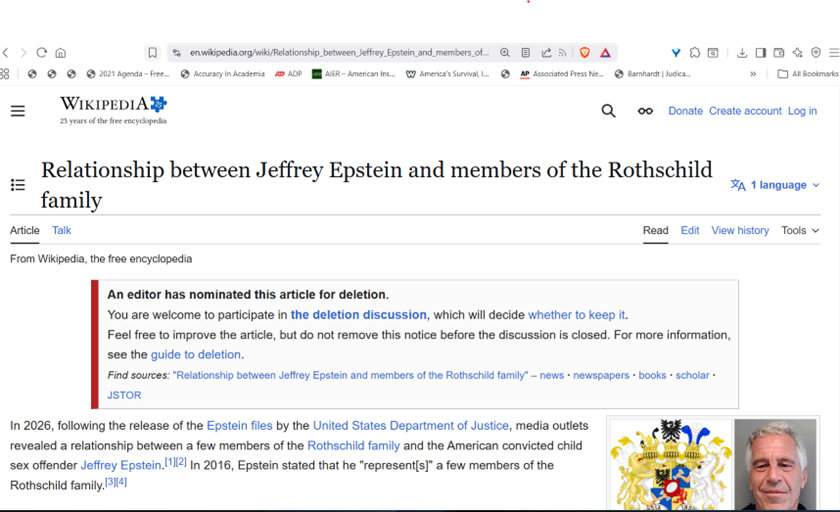
The Wikipedia page mentions Bill Clinton, Donald and Melania Trump, Andrew Mountbatten-Windsor, Peter Mandelson, Les Wexner, and others — but no Rothschilds. It gets more interesting. The Orwellian Memory Hole is alive and well. On March 27, 2026, we accessed the Wikipedia page titled “Relationship between Jeffrey Epstein and members of the Rothschild family.” At the top of the article, we were concerned to see an editor’s box (see screenshot below) stating, “An editor has nominated this article for deletion.”
And it has been deleted. If you try to access the “Relationship between Jeffrey Epstein and members of the Rothschild family” page now, you are told:
The page “Relationship between Jeffrey Epstein and members of the Rothschild family” does not exist. You can create a draft and submit it for review or request that a redirect be created, but consider checking the search results below to see whether the topic is already covered.
If one follows the Wikipedia instructions to check “the search results below,” one finds that there are indeed three Rothschilds mentioned: Ariane de Rothschild, Lynn de Rothschild, and Annabelle Neilson — with links to each of their individual Wikipedia pages that contain truncated, sanitized versions of their relationships to Epstein. Epstein watchers were hopeful that the Epstein-Rothschild connection would be fully investigated and aired when news stories broke on March 24 that French investigators had raided the Paris offices of Swiss bank Edmond de Rothschild. The search was carried out in the presence of bank CEO Ariane de Rothschild. Did Ariane go off in handcuffs? Of course not; we learned that the investigators were searching for documents related to one Fabrice Aidan, a mid-level French diplomat (and alleged child pornographer) who had contacts with Epstein while serving at the United Nations before being hired by the Edmond de Rothschild bank. Sure looks as if Monsieur Aidan has been set up for sacrifice. Henceforth when anyone brings up the Ariane-Epstein connection, the expected response will be, “Oh, yeah, that turned out to be some low-level guy working in the bank who was connected to Epstein.”
The Rothschilds have the resources to hire the best reputational protection/rehabilitation firms, and they undoubtedly have several working full-time on L’Affaire Epstein. In addition, they have the media connections and political clout to squelch and/or misdirect official investigations. Wikipedia, of course, has been notorious for blatant leftward bias and censorship across the board on just about any topic one might name. Wikipedia co-founder Larry Sanger is an outspoken critic of what the website has become, denouncing it as a platform for establishment propaganda. (See Alex Newman’s interviews with Sanger here and here.) But Wikipedia is not alone in this censorship game. Take New York Magazine, the glossy left-wing culture and politics mag and its sidekick, Intelligencer. On February 26, New York Magazine/Intelligencer published “The Updated Epstein List: Who Is Named in All of the Files?” So, who did they name? A long list, including Leon Black, Michael Bloomberg, Alec Baldwin, Richard Branson, Sultan Ahmed bin Sulayem, Sergey Brin, Noam Chomsky, Alan Dershowitz, Bill Gates, Elon Musk, Bill Richardson, Woody Allen, Bill Clinton, Donald Trump, etc. More than 250 in all, including many who were merely listed in Epstein’s black book but with no other evidence of any relationship with him. Ah, but somehow the journalistic sleuths at New York Magazine/Intelligencer missed the 12,000-plus citations on Rothschilds in the Epstein files. And in the weeks that have lapsed since, they have not bothered to update their reporting to fill in that enormous gap. It has been much the same story with many of the usual suspects in the establishment mediascape regarding the Rothschild-Epstein memory hole: either total omission or a brief, one-time gloss-over so they can say, “We already covered that, end of story.” But we haven’t seen the end of this story — yet. — William F. Jasper
Did a Recent Revolt in Congress to Renew the FISA Surveillance Rider Give Insight Into Why Silicon Valley Wanted Vivek Ramaswamy to Be Governor of Ohio?
FISA Section 702, a U.S. surveillance law that allows warrantless collection of foreign communications but has been heavily criticized for “incidentally” sweeping up Americans’ data, was set to expire on April 20. Instead, on that day, Congress approved a 10-day extension as a stopgap. While the White House wants it renewed, the suggestion is being met with friction by some members of Congress, who are reluctant to permit the Trump administration to possibly use it in a way that will create a digital-ID surveillance state.
A coalition of concerned Republicans, including members of the House Freedom Caucus such as Representatives Lauren Boebert (R-Colo.), Andy Biggs (R-Ariz.), and others, joined with some Democrats to oppose the clean reauthorization. They demanded reforms, particularly a warrant requirement for U.S.-person queries, citing Fourth Amendment concerns and past abuses.
Critics charge that a giant technocratic system is being quietly constructed through a chain of Big Tech data companies — namely, data centers (for physical infrastructure), Oracle (for cloud computing), OpenAI (for artificial intelligence applications), Datavant (to link health-related records into the larger system), and Palantir (for data analytics, tying everything together). In short, all Americans’ personal data will be stored centrally, with Ohio becoming the main “hub.”

Vivek Ramaswamy, the Republican front-runner for Ohio governor in the 2026 election, has made expanding AI data centers and Bitcoin mining operations a centerpiece of his campaign platform. As a biotech entrepreneur and former co-leader of the Department of Government Efficiency under President Trump, Ramaswamy has repeatedly stated that he wants these facilities in Ohio, describing them as essential for economic growth and energy infrastructure. In a March 2025 speech in Jefferson County, he declared, “It takes two years to build an AI data center or Bitcoin mining firm or whatever — all of which I want in the state, by the way.”
Ohio has already emerged as one of the nation’s leading data-center hubs, with more than 200 facilities, many clustered around Columbus. Since 2017, the state has granted approximately $2.5 billion in tax incentives for data-center construction. Major tech companies, including Amazon, Google, and Microsoft, have announced large projects, drawn by relatively low energy costs, available land, and business-friendly policies. Supporters argue these investments position Ohio as the “next Silicon Valley,” creating jobs and modernizing the economy along the Ohio River Valley.
Ramaswamy’s enthusiasm aligns with his personal and financial ties to healthcare data mining and the cryptocurrency sector. His companies have significant footprints in both, and his campaign has received millions in donations from industry players. Ramaswamy also boasts connections to a network of Silicon Valley investors. Peter Thiel, founder of Palantir Technologies (a major data-analytics firm with government contracts), has been a key backer of Vice President J.D. Vance, Ohio’s former U.S. senator and a close Ramaswamy ally from Yale Law School. (The two were so close that Vance literally named his son Vivek, after Ramaswamy.) Vance’s political team has assisted Ramaswamy’s gubernatorial bid, and Thiel’s orbit has supported both men’s rise. While the official narrative is that Vivek Ramaswamy “stepped down” from co-leading President Trump’s Department of Government Efficiency (DOGE) in January 2025 to pursue the 2026 Ohio governorship, some privacy-focused analysts and online constitutionalists allege a deeper motive. They claim the same Silicon Valley “tech bros” network that propelled J.D. Vance wanted Ramaswamy installed as Ohio’s chief executive to serve as the on-the-ground point man for concentrating AI data centers and related infrastructure in the state. This infrastructure, they argue, could function as a de facto national data-mining nexus, potentially feeding into expanded warrantless surveillance under FISA Section 702, the controversial program that incidentally sweeps up Americans’ data from domestic tech providers. — Rebecca Terrell
States Must Deal With AI Risks Despite Executive Order: Senator Joe Nicola
Despite an executive order by President Donald Trump purporting to prohibit any state-level regulation or controls over artificial intelligence, state governments must put in place guardrails to ensure accountability and protect the public, explained Missouri State Senator Joe Nicola (R) in this interview with The New American’s Alex Newman on Conversations That Matter.
Senator Nicola has a bill — now in its 14th iteration — to put in place what he describes as common-sense policies. Among them: ensuring that a human is always responsible and liable for AI. However, the White House is now reviewing it to determine whether the federal government would cut federal funding to the state over it. “We’re running out of time,” he said. “We only have four weeks left in this session.”
Nicola, who also serves as a pastor, does not want to stifle innovation or hamper the development of AI, he said. However, this is among the most powerful technologies ever developed, and it is critical that government not allow it to run wild — especially considering how rapidly it is moving. He hopes to receive a green light from the White House soon.
Before wrapping up the interview, Senator Nicola discussed his legislation to ban foreign laws in the state. From sharia to the United Nations, all of it would be prohibited. Listen to this important conversation at TheNewAmerican.com.
Whistleblower Claims and Excess Mortality Data Spark Debate on Covid-19 Vaccine Safety
On March 19, former Pfizer toxicologist Dr. Helmut Sterz addressed the German parliament, stating that the Comirnaty vaccine, also known as the Pfizer-BioNTech Covid-19 shot, should never have been approved. He cited skipped long-term toxicology studies, incomplete carcinogenicity testing, and use of a different manufacturing formula in mass production versus clinical trials. He estimated 20,000 to 60,000 vaccine-related deaths in Germany alone, referencing Pfizer’s early post-marketing data and underreporting factors at the Paul Ehrlich Institute.
In related news, on April 15, Nicolas Hulscher, an epidemiologist, posted U.S. Centers for Disease Control and Prevention (CDC) data showing what he described as a greater-than-50-percent excess infant mortality rate, years after the 2021 mRNA vaccination campaign targeting young women. He noted Mississippi’s recent public-health emergency declaration over rising infant deaths, and linked the trend to “transgenerational” effects of mRNA products. Hulscher cited a reversal of a 30-year decline in U.S. infant mortality that began immediately after the rollout, with causes mirroring those seen in vaccinated adults. He referenced a recent study suggesting possible transfer of mRNA genetic material to offspring.
The German testimony occurred during an ongoing parliamentary review of the pandemic response. Meanwhile, the CDC is trying to downplay infant-mortality statistics by saying that they involve multiple factors, including healthcare access. (One ploy is assigning “institutional racism” as the underlying cause for excess mortality rates, blaming historical discrimination as the reason for diminished healthcare access for minorities.) In the meantime, scientific literature on potential mRNA transgenerational effects remains limited and contested.
Health authorities are still doubling down and maintaining that Covid-19 vaccines had benefits deemed to outweigh risks for most populations during the pandemic. Critics, however, argue for greater transparency on manufacturing differences, informed consent, and underreported injuries. — Rebecca Terrell

How “Imminent” Was Iran’s Nuclear Threat?
When the United States attacked Iran on February 28, President Trump said that “our objective is to defend the American people by eliminating imminent threats from the Iranian regime.” But how imminent is “imminent”? Trump was not specific at the time, but he was more specific later.
On March 23, before boarding Air Force One, a reporter brought up former Director of the National Counterterrorism Center Joe Kent’s assertion that Iran was not an imminent threat. “I think it was an imminent threat,” the president responded. “I think that Iran, if they — if we didn’t bomb them with the B-2 bombers, now that set them back, but if we didn’t hit them with the B-2 bombers, they would have had a nuclear weapon within two weeks to a month. And if they had a nuclear weapon, they would have used it as soon as they got it.”
This is being written almost two months after we launched Operation Epic Fury on February 28. That means, according to Trump, Iran would already have attacked us with nuclear weapons weeks ago if we did not intervene militarily to prevent this from happening. But is that true? Is that what U.S. intelligence showed?
The 2026 Annual Threat Assessment of the U.S. Intelligence Community, which used information available as of March 14 of this year, states: “Prior to Operation Epic Fury, Iran was pursuing increasingly capable missile systems, was non-compliant with its Chemical Weapons Convention obligations, had not abandoned its intention to conduct R&D of biological agents and toxins for offensive purposes, was intending to try to recover from the devastation of its nuclear infrastructure sustained during the 12-Day War [June 2025], and refused to live up to its nuclear obligations with the IAEA [the International Atomic Energy Agency], including refusing to allow IAEA access to key nuclear facilities.” Of course, this assessment that Iran was “intending to try to recover from the devastation of its nuclear infrastructure” falls far short of Trump’s remarkable assertion that, as of February 28, Iran was “within two weeks to a month” of having a nuclear weapon.
This year’s intelligence assessment of Iran’s pre-Epic Fury nuclear capabilities is what one would expect, based on assertions the Trump administration made after the United States attacked Iran on June 21 of last year. In fact, the very day of that attack, Trump said that “Iran’s key nuclear enrichment facilities have been completely and totally obliterated.” Assuming that was the case, how could Iran have been “within two weeks to a month” of having a nuclear weapon a little over eight months later?
But was it the case that Iran presented an imminent threat prior to the June 2025 bombing? Not according to last year’s Annual Threat Assessment of the U.S. Intelligence Community, which stated just three months prior to the June 2025 bombing, “We continue to assess Iran is not building a nuclear weapon.”
Of course, regardless of who is president, the intelligence community’s assessments are not always accurate, and intel that’s made public may be skewed to fit the administration’s narrative at the time (though that’s not the case here). But there seems to be no doubt that the nuclear threat from Iran was not nearly so “imminent” as the Trump administration claimed it to be in order to justify going to war against Iran without first asking Congress to declare war, as required by the Constitution. — Gary Benoit
The Biden Administration Discriminated Against Christians in Adoptions
On April 17, HHS Secretary Robert F. Kennedy, Jr. publicly revealed that the Biden administration had deliberately restricted Christian families from adopting or fostering children. In a recorded statement, Kennedy explained that federal pressure led states to draft laws excluding families with “certain religious beliefs, mainly Christian religious beliefs,” shrinking the pool of available parents. Meanwhile, they mainstreamed and normalized adoptions by homosexuals.
It was typical of the Biden administration to prioritize progressive ideology over child welfare and traditional family formation. After Kennedy’s announcement, commentator Naomi Seibt highlighted a chilling historical parallel: the “Kentler Experiment” in West Berlin. From the late 1960s through the early 1990s, influential psychologist Helmut Kentler, backed and funded by the Berlin Senate, placed neglected and “difficult” foster boys with known pedophiles. Kentler argued that sexual contact with these men would be good for society insofar as it would create a future generation of weakened males who would be unlikely to turn into Nazis. Authorities tolerated and even subsidized the arrangement for decades; the abuses were later documented but long covered up by left-wing officials. In hindsight, the German policy has taken on the appearance of a pilot program, a beta-test that was subsequently rolled out across all the NATO nations, and then the rest of the West.

Such experiments and exclusions echo a timeless strategy of soft despotism. In The Spirit of the Laws (1748), French political philosopher Montesquieu described how the tyrant Aristodemus of Cumae deliberately cultivated weakness to neutralize potential resistance:
Aristodemus, tyrant of Cumæ, used all his endeavours to banish courage, and to enervate the minds of youth. He ordered that boys should let their hair grow in the same manner as girls; that they should deck it with flowers, and wear long robes of different colours down to their heels; that, when they went to their masters of music and dancing, they should have women with them to carry their umbrelloes, perfumes, and fans, and to present them with combs and looking-glasses whenever they bathed. This education lasted till the age of twenty; an education that could be agreeable to none but to a petty tyrant, who exposes his sovereignty to defend his life.
By sidelining the very families most likely to instill discipline, ethical instincts, and resilience — qualities Montesquieu would recognize as bulwarks against tyranny — modern policies risk producing the same enfeebled citizenry Aristodemus sought. Traditional Christian households have long supplied the majority of foster and adoptive parents precisely because their worldview emphasizes duty, stability, and child protection. Marginalizing them does not merely create a numbers problem; it advances a cultural project that weakens the family as society’s primary incubator of strength.
The reversal of this policy announced by Secretary Kennedy is therefore not a minor bureaucratic tweak. It is a rejection of the tyrant’s logic: a return to the principle that children belong in homes that fortify rather than fracture them. In an era of declining birthrates and rising institutional distrust, preserving strong families is not optional; it is the indispensable defense against the quiet despotism that prefers a docile population to a vigorous one. — Rebecca Terrell
Fixed Pricing or Price-fixing?
Corporations may be exploiting technology to fleece customers by changing the cost of products — both in-store and online — based on algorithms tailored to customer profiles and times of surging demand. The problem with this is that it reverses a trend, started in the 19th century, that made commerce flourish. The transition from negotiated prices to fixed, posted prices was one of the quiet revolutions that helped modern capitalism take root in the West. While markets and trade had existed for centuries, they were traditionally governed by haggling — each transaction shaped by bargaining skill, local knowledge, and personal relationships. This system worked in small, localized economies, but it imposed limits on scale, speed, and trust.
The move toward fixed pricing, popularized in the United States by retailers such as John Wanamaker in the late 19th century, fundamentally changed the nature of commerce. Clearly marked prices, no negotiation, and consistent treatment of customers introduced a new level of transparency to retail. Customers no longer had to wonder whether they were being overcharged or outmaneuvered. The price was the price.
This shift reduced transaction costs. Instead of spending time and effort negotiating each purchase, buyers and sellers could complete transactions quickly and efficiently. That efficiency made it possible to serve more customers, enabling the rise of large-scale retail institutions such as department stores and national chains. Fixed pricing also simplified operations: Employees no longer needed to be skilled negotiators, and businesses could standardize training and procedures.
Technology is taking us back to haggle culture, in which consumers can’t trust merchants. Walmart, for one, is engaging in an aggressive push to install digital price tags across all 4,600 U.S. stores by the end of 2026. Electronic shelf labels — already in roughly half the stores — would let Walmart change any item’s price instantly from a central system. Proponents call it operational efficiency: no more manual tag swaps, fewer errors, and faster promotions. Critics, however, see the infrastructure for “dynamic pricing,” where costs fluctuate based on demand, time of day, or inventory, much like Uber’s surge pricing but inside physical stores.
It might be good for Walmart to take a cue from the fast-food chain Wendy’s, which had a short-lived flirtation with the same concept. The fast-food giant’s CEO announced a $20 million investment in digital menu boards to enable real-time price adjustments. The backlash was immediate and brutal: Social media lit up with accusations of price-gouging, boycott calls, and comparisons to past failures such as Coca-Cola’s 1999 “hot weather pricing” vending machines. Wendy’s quickly issued a clarifying statement denying any plans for surge pricing during peak hours. The episode became a textbook case of consumer power forcing corporate retreat.
Walmart, in a reaction to similar objections from the public, has hedged, stating officially that it has no immediate plans for dynamic pricing and that shelf prices will remain consistent regardless of demand or shopper identity. Yet patents filed by the company reference AI-driven demand prediction, and similar technology is already live at competitors such as Kroger.
History shows consumers are not powerless. Wendy’s folded almost overnight after the internet drew negative attention. However, new evidence has surfaced showing that price coordination between major retailers might already be occurring. In documents made public by California Attorney General Rob Bonta as part of an ongoing lawsuit, emails and records detail how Amazon allegedly monitored competitors’ prices in real time and contacted brands such as Levi’s when items were cheaper at Walmart, Target, or other stores. Amazon flagged “styles of concern,” prompting Levi’s to direct Walmart to raise prices on specific products, such as Easy Khaki Classic fit pants, back to Amazon’s higher price of $29.99. Similar patterns were described with Hanes (which reportedly reached out to Target and Walmart to increase prices) and other brands, including Allergan and products sold via Chewy and Home Depot. Amazon is accused of enforcing compliance by threatening to suppress listings for any brand that did not comply with its demands.
So even without in-store dynamic tags, major players are already participating in systems that drive prices higher than open competition would allow. This alleged scheme, now the subject of multiple antitrust actions, with three separate trials scheduled for 2027, would also quietly eliminate the benefits of comparison shopping across retailers. — Rebecca Terrell
Global Food-security Threats From Strait of Hormuz Disruptions
While headlines focus on surging oil prices and costs of jet fuel doubling at many European airports, the closure of the Strait of Hormuz is quietly unleashing a more insidious threat: a global food-security crisis. Roughly one-third of the world’s seaborne fertilizer trade and 20 to 45 percent of key agricultural inputs pass through this narrow choke point. With shipping effectively halted since late February amid the Iran conflict, fertilizer shortages are already driving up costs and threatening crop yields for the current planting season and beyond.
European Central Bank President Christine Lagarde highlighted the danger in a recent Berlin speech. Noting that “a third of all fertilizers transit the Strait of Hormuz,” she warned that prolonged disruption could shift the economic impact “from prices to rationing,” particularly in low-income and emerging-market economies. Lagarde stressed that fertilizer shortages would raise food-production costs and risk outright shortages of staples if the blockade persists.
EU High Representative Kaja Kallas has echoed the alarm. In public remarks, she described the closure as “really dangerous” not only for energy but for food supplies, warning that blocked fertilizer shipments could cause “food deprivation next year” in vulnerable regions such as Africa. Kallas has urged the creation of humanitarian corridors modeled on Black Sea grain deals to restore the flow of fertilizers and foodstuffs.

The United Kingdom is already preparing contingency plans. Government officials have conducted Cobra exercises modeling a “reasonable worst-case scenario” in which the strait remains closed into summer 2026. The plans anticipate shortages of chicken, pork, and other supermarket staples due to effects from shortages of carbon dioxide used in animal slaughter and food preservation, alongside soaring fertilizer prices.
The UN Food and Agriculture Organization (FAO) has issued its starkest warning yet. Chief economist Máximo Torero called the situation a “time bomb,” noting that disruptions are already constraining fuel, natural gas, and fertilizer flows critical for newly planted staples. FAO analysts warn that a protracted crisis could trigger lower yields in 2026 and 2027, higher global food-commodity prices, and a cascade of effects reminiscent of post-Covid inflation, potentially pushing millions more into acute hunger. Import-dependent regions in Africa, South Asia, and parts of Europe face the heaviest risks, yet this secondary impact on hunger and inflation remains overshadowed by energy-focused coverage.
Beyond the immediate price spikes, the ripple effects on grain and commodity flows are quietly devastating. Farmers in fertilizer-importing countries are already cutting applications or switching to costlier alternatives, locking in lower harvests months from now. Global supply chains, already strained, have little slack to absorb another shock.
The United Kingdom imports roughly 60 percent of its food. Other European nations are also net importers of food, while allowing large-scale migration inflows, adding hundreds of thousands of new residents annually through asylum and labor programs. The result is a textbook mismatch: more mouths to feed amid shrinking supplies. It’s a recipe for civil unrest; history shows that when rival tribes vie for limited resources, social turmoil is the inevitable result. Will European leaders recalibrate their dedication to mass migration in the face of changing economic and geopolitical variables? — Rebecca Terrell
NYMHM: News You May Have Missed
Trump Extends Ceasefire; Iran Attacks Three Vessels in Strait of Hormuz
California Government Schools Shed 75K Students
Will the GOP Civil War End the Neoconservatism Ruse?
DOJ Must Release ALL Epstein Files or Face Criminal Liability, Rep. Massie Warns
Entire Bible to Be Read in the U.S. Capital; Trump Says Scripture ‘Illuminated’ U.S. Founding
Justice Thomas: Progressivism a Threat to America’s Founding Principles
Home Education Must Be “Equivalent” to Public School: Lawmakers
States Push Back Against Geoengineering and Cloud Seeding
Did Trump’s Cryptic “My Way” Post Signal Willingness to Use Nuclear Weapons Against Iran?
IDF Validates Photo of Soldier Sledgehammering Effigy of Jesus Christ; Outrage Continues
Iran Recloses Strait; U.S. Navy Disables Iranian Ship; Kent to Trump: Leave Iran
House Democrats Seek Hegseth’s Impeachment Over Iran and Other Issues
Carville Tells Democrats: Keep QUIET on Your Plan to Seize Permanent Power
Southern Poverty Law Center Indicted on Charges Related to Funding Hate Groups
Vanishing Minds: UFO & Nuclear Scientists Are Dying or Disappearing
[END]