

Justice Thomas: Progressivism a Threat to America’s Founding Principles
In a bold defense of America’s founding principles, U.S. Supreme Court Justice Clarence Thomas last week gave a speech upholding the Declaration of Independence and U.S. Constitution, and denouncing progressivism as inherently opposed to those documents and the principles enshrined in them.
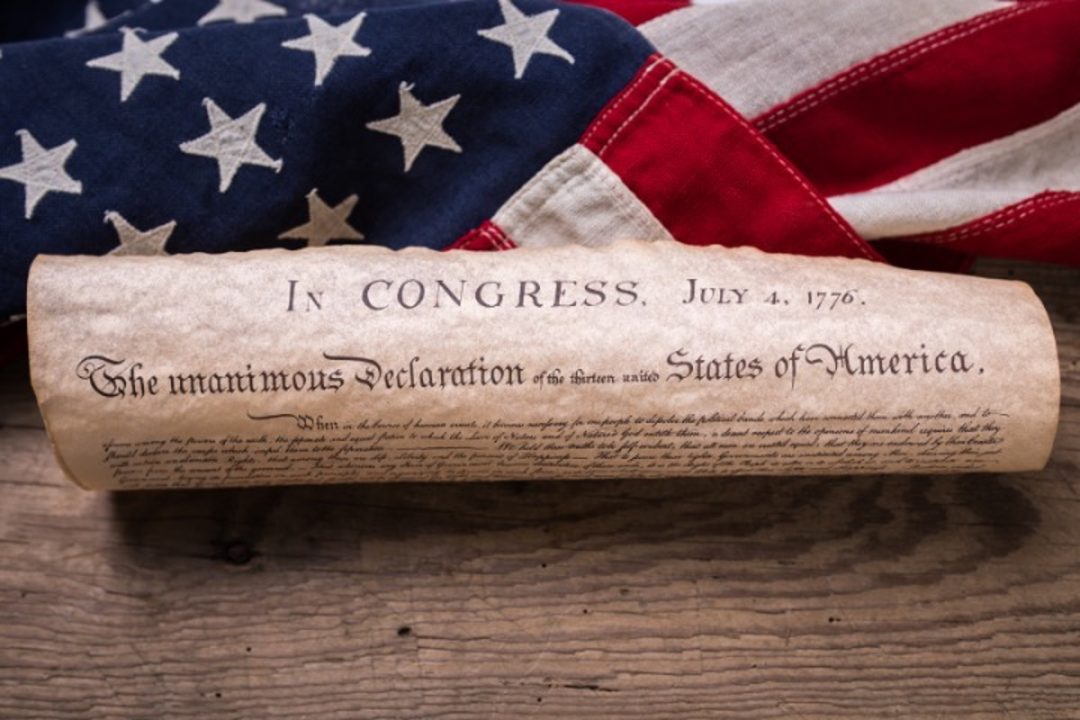
Thomas made these remarks during a lecture on April 15 at the University of Texas, Austin, which the university organized “to commemorate the 250th anniversary of the signing of the Declaration of Independence.”
America’s Founding Principles
In his remarks, Thomas explained the fundamental purpose of government, as well as the significance of the Declaration of Independence and Constitution:
[The Declaration of Independence] did not establish a form of government…. But it stated the purpose of government. The Declaration made it clear, in clear prose, that the purpose of government is to protect our God-given, unalienable rights — rights that all individuals equally possess….
We are all equally created in the image and likeness of God. We are all endowed with the natural rights to life, liberty, and happiness. Our rights and our dignity are inherent. They do not come from others, and they do not come from the government….
The Constitution is the means of government…. [It] achieves this purpose by protecting our natural rights and our liberties from concentrated power and excessive democracy. Our Constitution creates a separation of powers and federalism — truly for the first time in modern history — to prevent the government from becoming so strong that it threatens our natural rights. Federalist No. 10 proposed the idea that the great threat to our rights comes from majority faction.
Human history teaches us, alas, that numerical majorities frequently seek to control government, and use the state to violate rights of the minority. Because man is fallen and the desire for power was, as James Madison described it, “sown in the nature of man,” government had to be limited.
Thomas’ remarks are a much-needed reminder about America’s founding principles — principles that were “self-evident” to the Founding Fathers but are increasingly forgotten or rejected by Americans today, including politicians, judges, and the media.
Standing Against Progressivism
Instead of ending there, however, Thomas launched a direct refutation of progressivist ideology, which supports big government and denies the existence of God-given rights, and highlighted how its tenets are incompatible with America’s founding principles. His remarks are worth quoting at length:
At the beginning of the 20th century, a new set of first principles of government was introduced into the American mainstream. The proponents of this new set of first principles, most prominent among them the 28th president of our country, Woodrow Wilson, called it progressivism. Since Wilson’s presidency, progressivism has made many inroads into our system of government and our way of life. It has coexisted uneasily with the principles of the Declaration. Because it is opposed to those principles, it is not possible for the two to coexist forever.
Progressivism was not native to America. Wilson and the progressives candidly admitted that they took it from Otto von Bismarck’s Germany, whose state-centric society they admired. Progressives like Wilson argued that America needed to leave behind the principles of the Founding and catch up with the more advanced and sophisticated system of relatively unimpeded state power [which he claimed was] “nearly perfected.” He acknowledged that it was “a foreign science, speaking very little of the language of English or American principle,” which “offers none but what are to our minds alien ideas.” He thus described America, still stuck with its original system of government, as “slow to see” the superiority of the European system….
Progressives strove to undo the Declaration’s commitment to equality and natural rights, both of which they denied were self-evident. To Wilson, the unalienable rights of the individual were “a lot of nonsense.” Wilson redefined “liberty” not as a natural right antecedent to the government, but as “the right of those who are governed to adjust government to their own needs and interests.” In other words, liberty no longer preceded the government as a gift from God, but was to be enjoyed at the grace of the government. The government, as Wilson reconceived it, would be “beneficent and indispensable.” Progressives such as John Dewey attacked the Framers for believing that “their ideas were immutable truth, good at all times and places,” when instead they were, according to him, “historically conditioned, and relevant only in their own time.” Now, Dewey and the progressives argued, those ideas are to be displaced.
Progressivism seeks to replace the basic premises of the Declaration of Independence, and hence our form of government. It holds that our rights and our dignities come not from God, but from government. It requires of the people a subservience and weakness incompatible with a Constitution premised on the transcendent origin of our rights.
“Progressivism,” as Thomas implies, is merely a euphemistic term for socialism. His mention of Woodrow Wilson is telling: In the first year of Wilson’s presidency, 1913, the United States ratified the 16th and 17th Amendments (providing for an income tax and the direct election of senators), and Wilson signed the Federal Reserve Act into law — actions that massively expanded the size and scope of the federal government and removed vital checks and balances from its structure.
The New American has previously reported on progressivism in depth, including here, here, and here.
Progressivism’s Dark History
Thomas also highlighted the detrimental consequences of progressivism. In addition to emphasizing its role in promoting racial segregation, he noted that “Stalin, Hitler, Mussolini, and Mao all were intertwined with the rise of progressivism,” and that “many progressives expressed admiration for each of them shortly before their governments killed tens of millions of people.”
He continued:
We can argue over whether you believe in immutable, absolute, natural rights or the Wilsonian idea of ever-progressing history…. But let me ask you to consider the consequences. European thinkers have long criticized America for remaining trapped in a Lockean world, with its weak, decentralized government and strong individual rights. They say our 18th-century Declaration has prevented us from progressing to higher forms of government.
But we were fortunate not to trade our Lockean bounds for the supposedly enlightened world of Hegel, Marx, and their followers. Fascism — which, after all, was national socialism — triggered wars in Europe and Asia that killed tens of millions. The socialism of the Soviet Union and the People’s Republic of China proceeded to kill more tens of millions of their own people. This is what happens when natural rights give way to the higher good of notions of history, progress, or, as Thomas Sowell has written, the “visions of the anointed.”
Indeed, the history of socialism has been incredibly violent — the logical consequence of rejecting God-given rights and limited government. Rather than continuing down this road, the United States must return to its founding principles.
Taking Action to Defend Liberty
Thomas’ remarks are an important reminder of why the principles enshrined in the Declaration of Independence and Constitution are worth defending. If the United States abandons those principles, it will also forfeit its status as the freest and most prosperous country in human history.
Accordingly, we must recommit ourselves to America’s founding principles and hold fast to them. Specifically, we must remember that, as the Declaration of Independence rightly notes, “all men … are endowed by their Creator with certain unalienable Rights,” and “that to secure these rights, Governments are instituted among Men.” Any policies that violate our God-given rights or expand the size and scope of government outside its God-ordained purpose are illegitimate and must be opposed.
How do we restore adherence to America’s founding principles? We need to get active. First, it is essential that we create an informed electorate — one that understands and values those principles. Second, we must put pressure on our elected officials to uphold those principles. The John Birch Society has been leading the effort to mobilize Americans to do both in a concerted manner.
On the importance of taking action, we will give Thomas the last word:
As we are gathered to celebrate the 250th anniversary of the Declaration, it may be tempting to do so as if we are passive spectators…. But in my view, we must find in ourselves that same level of courage that the signers of the Declaration had, so that we can do for our future what they did for theirs….
I implore you to celebrate it by standing up for it, by defending it, and by recommitting yourselves to living up to its ideals.
To learn more about America’s founding principles, watch Overview of America or read the article “Back to Basics.” Additionally, to join the fight to protect our founding principles, visit JBS.org.