

“Democratic Socialism” Is In, but Is It an Oxymoron?
Marketing is an interesting thing. The buyer always has to beware because labels and packaging don’t always reflect ingredients. Consider the following list, for example, asking: What’s the most common word among its elements?
- Democratic People’s Republic of Korea
- Lao People’s Democratic Republic
- German Democratic Republic
- Democratic Republic of Vietnam
- Democratic Kampuchea
- People’s Democratic Republic of Ethiopia
- People’s Democratic Republic of Yemen
- Democratic Socialism
“Democratic,” obviously. Now note that 1 and 2 are communist countries, with the first (North Korea) being particularly brutal. Three through 7 were also communist countries. Number 5 (Khmer Rouge Cambodia) exterminated one-quarter to one-third of its population in just 4.5 years. They all love(d) that label “democratic,” though, even if the only democratic thing about them is/was, well…nothing.
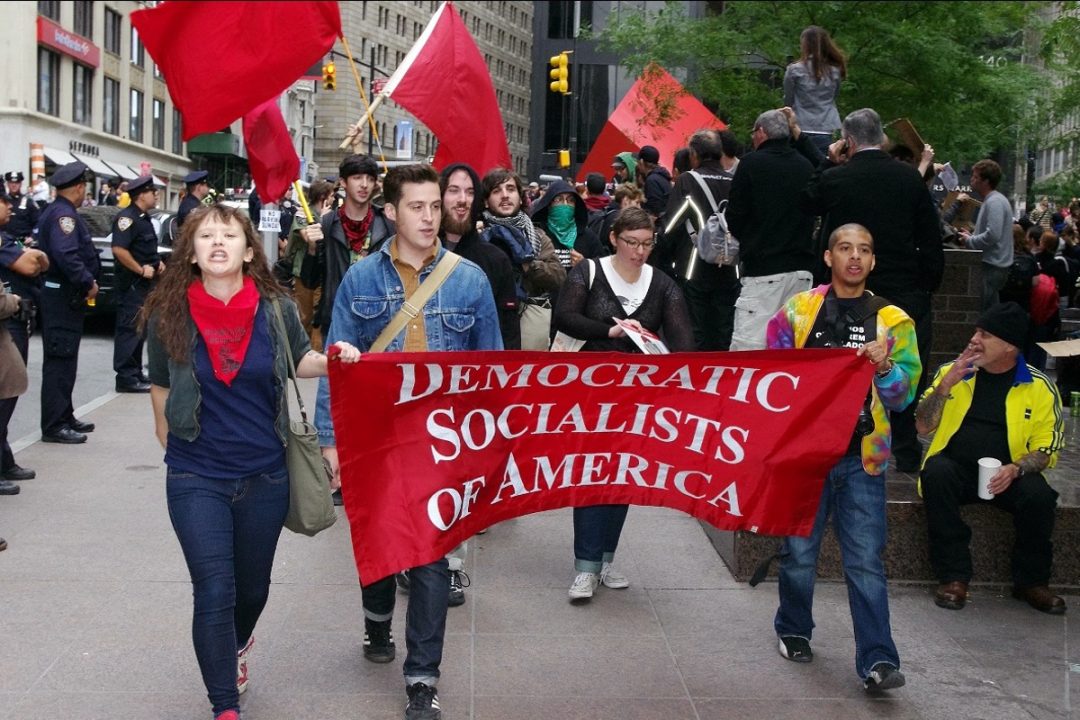
Then there’s number 8, which is all the rage in the United States. The Democratic Socialists of America (DSA) now have, in fact, more than 250 affiliated or endorsed public officeholders nationwide.
The DSA, mind you, has called for the public ownership of key economic sectors and the “means of production” — a communist tenet. It wants to replace capitalism with socialism.
The DSA also aims to abolish or radically reform institutions such as the Senate and Electoral College. Furthermore, it would reduce Supreme Court power.
You needn’t worry, however, because all this really will be done democratically this time, they say. Heck, “democratic” is in their name.
But don’t believe it, says Washington Examiner editor-in-chief Hugo Gurdon, calling democratic socialism a real “con.” The d-word here, he observes, is like “a spoonful of sugar to make the medicine of socialism go down. … All socialist systems ultimately use force.”
The Machiavellian Mask
Appearing on The Will Cain Show recently, Gurdon cited a particular DSA member, New York City Mayor Zohran Mamdani, as being archetypical of this phenomenon. As an example, he told host Cain that the mayor
controls rents so landlords don’t have the money to maintain their properties, and then when the properties are not maintained, he wants to take it away from them. It’s a one-two socialist punch.
Gurdon noted that even some European countries that experimented with socialism later resurrected free markets. They’ve discovered that socialism leads to rationing and fails to provide needed goods and services. (Hence the old economic law: “Price caps lead to shortages.”)
Yet more clarity is needed. With different definitions extant, we should ask: What is socialism?
Russian Revolution author Vladimir Lenin had his answer. Socialism, he said, was just the “first phase” of communist society, a transitional stage between “capitalism” and full communism. In fact, communists often call themselves and their creations “socialist.” Lenin thus proceeded, primarily describing himself and his faction as revolutionary socialists or “social democrats” while seeking power. And his dark creation, the USSR, stood for the Union of Soviet Socialist Republics.
Saw the Film, Know the Ending
Whatever you call the ideology, however, it has now a 200-year history of failure. Just consider Scottish “reformer” Robert Owen’s boondoggle. Often called “The Father of English Socialism,” Owen instituted a collectivist commune in New Harmony, Indiana, in 1825.
It was visibly failing, miserably, within months, and dissolved after about just two years.
It was quite unlike, you see, the 19th century’s many religious communes. They sometimes endured for decades or even more than a century. The difference is that the Owenite commune had neither the profit incentive nor the God incentive (doing divine will). Consequently and predictably, its “residents lacked the motivation to work,” related the MacIver Institute in 2020. Why, “its government was unable to manage even the town’s one general store.”
It has been, too, all flat-ground travel from there (you can’t go downhill from what’s already an economic nadir). Socialism/communism simply hasn’t worked anywhere it has been tried. For little incentive=little productivity.
Why Tyranny?
As Gurdon noted, however, socialists have great incentive to do one thing: become tyrannical. And encapsulating it well is a paraphrase of German economist Kristian Niemietz. “Socialism is always democratic and emancipatory in its aspirations,” it goes, “but oppressive and authoritarian in its actual practice.”
Why is this so? The Foundation for Economic Education (FEE) addressed this question in 2020, writing:
When most of us interface with the outside world, we expect the highest possible pay for the work we do, and when we buy things, we expect the highest quality at the lowest possible price. Economics adds up those personal tendencies over millions of people in large, complex societies and comes up with a few simple rules that describe economic behavior. Supply and demand, marginal revenue and marginal cost, the theory of money, and specialization and exchange are really just simple rules that take all people’s actions and abilities into account and arrive at a solution that balances the overall societal equation.
Communists and socialists don’t like these simple economic rules and come up with their own, such as “from each according to his ability, to each according to his needs” (your needs are generally unlimited), which conflicts with human nature. When you implement policies that conflict with human nature, you have to use force to implement them.
To drive the point home, consider that while socialism demands equality, nature’s default is inequality. To analogize it, imagine you tried thwarting the animal kingdom’s inherent hierarchies, such as a lion ruling his pride. The extreme control and invasive intervention necessary to even attempt this would be staggering. You could try suppressing the cat’s testosterone levels while injecting the females with the hormone. You could drug him into docility. But then another male would attempt a coup, so you’d have to try controlling lions beyond the pride as well. Who knows, too, what effects this meddling would have on the cats’ social structure, mating, and birth rates. For certain is that the whole silly affair would wreak havoc while not achieving equality at all.
By the way, know that the Soviets realized their ideology conflicted with man’s nature. Thus did they embrace Lysenkoism, a biological theory preaching the heritability of acquired traits. (E.g., pluck a plant’s leaves, and its descendants will be leafless.) In fact, this nonsensical idea was the USSR’s official, state-enforced scientific/biological theory through 1964. The Soviets knew that socialism couldn’t work unless man’s nature could be changed.
Crazy? Sure, but it’s perhaps no crazier than thinking socialism can work with man’s nature being what it is.