NYT: Peace Plan Includes $300B in Reparations for Iran. Trump Meets With Advisors.
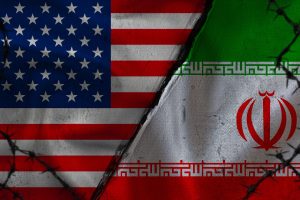
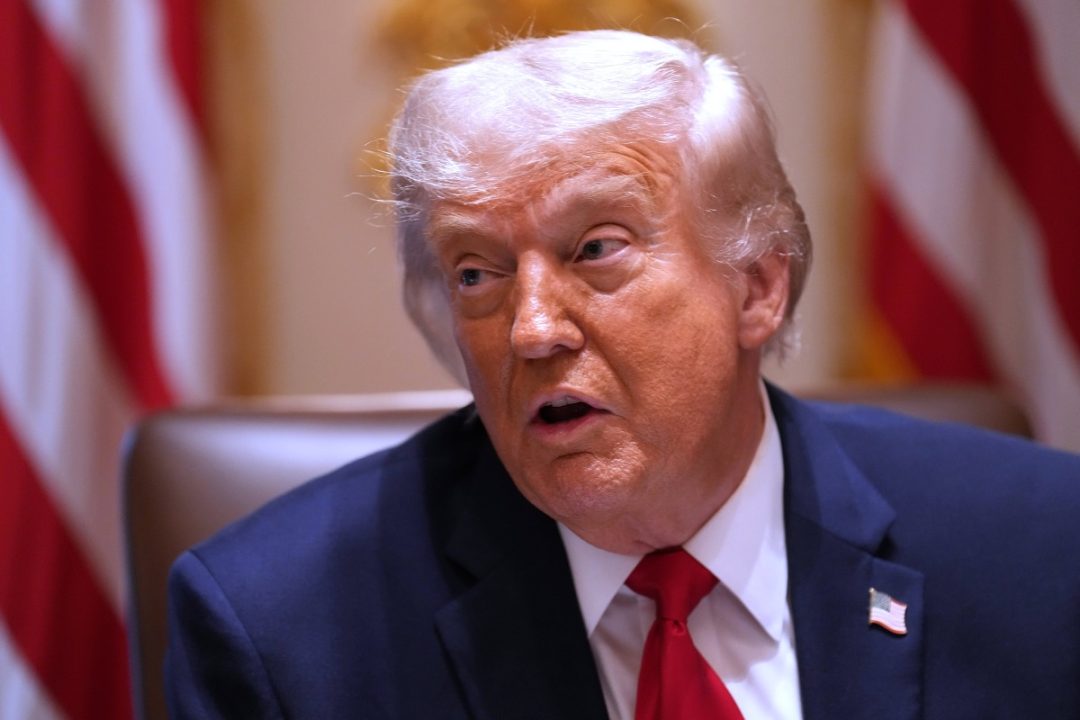
U.S. President Donald Trump has yet to sign off on the 60-day peace pact that U.S. and Iranian negotiators are discussing to end the war. The details include not only reopening the Strait of Hormuz, but also providing Iran with at least $300 billion to rebuild its shattered infrastructure.
Citing Iranian officials and diplomats involved in the talks, The New York Times provided the new details in a report published yesterday. The paper added today that Trump met with his advisors for two hours at the White House today without accepting the plan.
Just before noon today, Trump disclosed on Truth Social that he would meet with advisors in the Situation Room.
Opening the Strait
As The New American reported yesterday, Axios disclosed that Iranian and U.S. negotiators had agreed to a memorandum of understanding (MOU) that would halt fighting for 60 days, during which negotiations would continue. The memorandum awaited only the approval of Trump and top Iranian officials.
The MOU “is likely to stipulate terms for a nonaggression pact between Washington and Tehran,” the Times explained:
Mediators say it is expected to have a regional component, which Iranian officials and one of the diplomats said would include a halt to fighting in Lebanon. Despite a cease-fire there, both sides have continuously violated it. And Israel recently stepped up a military offensive against the Iran-backed militant group, Hezbollah.
Still, the Times continued, unclear is whether the Iranians and Americans are working on the same draft, and who in Iran has final approval.
The memorandum includes a “‘declaration of the end of war’ on all fronts, including Lebanon, for the duration of the negotiations,” an Iranian official told the Times.
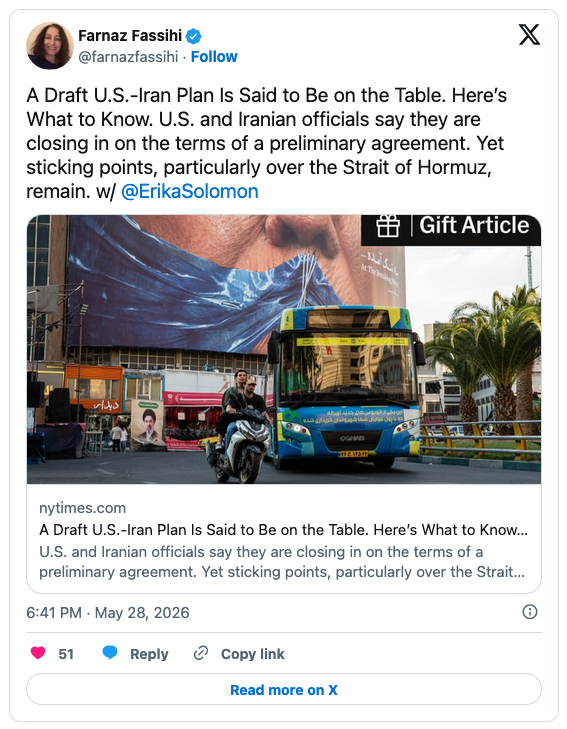
As far as the Strait of Hormuz is concerned, which Iran closed, opened, then closed again, “under the U.S. understanding of the memorandum, the strait would reopen immediately, an official said, but the U.S. blockade would remain, but reduced in stages depending how much prewar ship traffic is restored by Iran. The idea is to incentivize Iran to demine the strait quickly,” the Times reported:
The diplomat briefed on the latest framework said Iran had agreed to allow maritime traffic to return to prewar levels for 30 days, while the two sides negotiated a final deal. Despite that hope, the process of demining and opening the strait could take weeks. Tehran is still debating with Washington what would happen after that, he said.
The Iranian official said the deal would see the U.S. naval blockade lifted “within 30 days” and the Strait of Hormuz opened for the duration of the talks. The United States has placed no time frame on it, a U.S. official said.
Iran’s negotiators say their country and Oman must be permitted to impose fees to passing vessels after that month. Trump says the strait is “international waters” and must remain open to traffic without fees.
Big Bucks for Iran
The Times also disclosed that an “investment fund for Iran” was added to the memorandum. An Iranian official and diplomat put the figure at $300 billion, “but other officials involved in mediation would not confirm the amount.”
“The Iranian official described it as a ‘reconstruction program’ that would be promised to Iran in the event a final agreement was signed,” the Times continued:
Earlier in the negotiations, Tehran had demanded reparations for bombardment damage that some Iranian officials estimate at $300 billion to $1 trillion.
Two diplomats briefed on the latest draft called it an international “investment fund,” which the United States would help facilitate in the event of a final deal. Plans for such a fund would be further discussed during the negotiations period, the diplomats said.
This proposal appears to be an iteration of an earlier idea floated by Mr. Trump’s Middle East envoy, Steve Witkoff, and Jared Kushner, the president’s son-in-law. Both are real estate investors, and some mediators said they had suggested promoting real estate projects in Tehran and an investment fund in the event a deal was reached.
That raises the question of how much money Witkoff and Kushner will earn from the “investment fund” should they be involved in rebuilding Iran. That aside, Iranian negotiators told their American counterparts that “U.S. companies, including major oil and energy corporations, could enter Iran for investments and joint venture deals.”
Nuclear Deal
Talks about disposing of Iran’s enriched uranium, the Times continued, “would happen during the second phase of negotiations … and will include how to dispose of Iran’s stockpile of about 970 pounds of uranium that could be quickly enriched to weapons grade.”
The negotiators would also have to discuss another 10 tons of nuclear material “enriched to lower levels.”
“Trump initially said that those stockpiles should be sent to the United States, while Iran wants to blend down part of the enriched uranium on its own soil under international inspectors and ship other parts of the stockpile to a third country,” the Times explained:
Mr. Trump signaled some flexibility in a social media post this week, saying that diluting the enrichment under international inspectors or sending it to a third country would also be acceptable. But on Wednesday, he said he was not comfortable with either Russia or China taking it.
According to the version of the draft deal described by the Iranian official, Iran will suspend its nuclear program in exchange for a pledge from Washington not to increase sanctions while the two sides negotiate a final deal.
According to the Iranian official, existing U.S. sanctions on Iran — which were imposed largely in response to Iran’s nuclear program — would be lifted over time should a final deal be reached.
Last, the Times disclosed, the deal might free Iran’s assets frozen in banks abroad, some $24 billion.
Trump on Truth Social: No Nukes for Iran
On Truth Social this morning, Trump again said that Iran must agree never to build a nuclear weapon. As well, Hormuz must open without fees for “unrestricted shipping traffic.” And Iran must complete removing all mines from the strait.
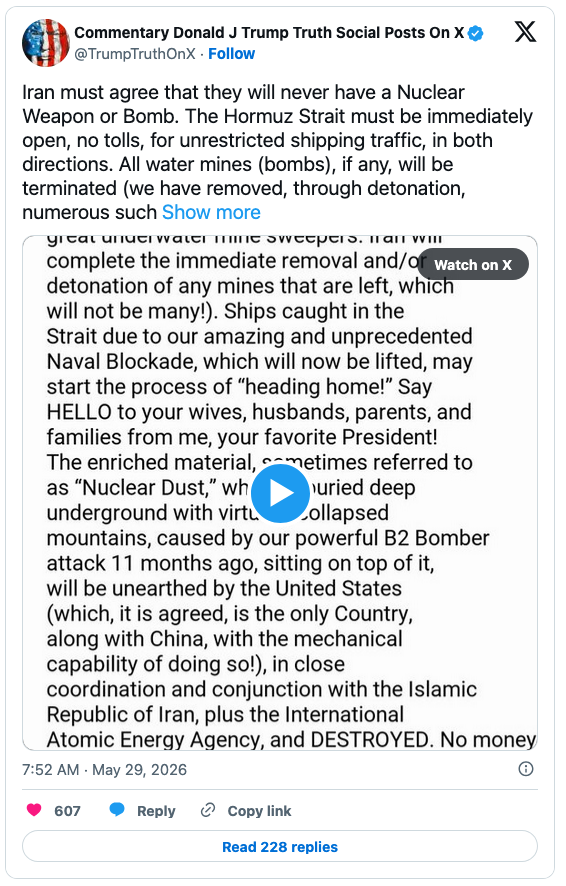
“The enriched material, sometimes referred to as “Nuclear Dust,” which is buried deep underground with virtually collapsed mountains, caused by our powerful B2 Bomber attack 11 months ago, sitting on top of it, will be unearthed by the United States (which, it is agreed, is the only Country, along with China, with the mechanical capability of doing so!), in close coordination and conjunction with the Islamic Republic of Iran, plus the International Atomic Energy Agency, and DESTROYED,” Trump wrote:
No money will be exchanged, until further notice. Other items, of far less importance, have been agreed to. I will be meeting now, in the Situation Room, to make a final determination.
Trump left that meeting without making a decision, an official told the Times. The reason is unclear.