Report: Trump’s “Board of Peace” Wants Legal Immunity in Gaza
The so-called Board of Peace, an international body chaired by President Donald Trump, is now seeking broad legal protection for itself, its officials, its security forces, and its contractors, according to a draft resolution obtained by The Guardian.
The document raises a central question: After Gaza’s profound destruction and staggering death toll raised grave legal questions of its own, why does the body anointed to govern and rebuild the enclave need to shield itself from legal accountability?
The board was authorized under a United Nations mandate to address the future of Gaza, based on the vision of the Trump administration spelled out in the “Comprehensive Plan to End the Gaza Conflict.”
However, the U.S. Senate has not ratified any treaty recognizing the body as a legitimate international organization.
The Protections
The Guardian reported on Saturday that the draft resolution would grant legal immunity to virtually everyone involved in Gaza’s proposed governance and reconstruction:
The four-page resolution, labeled “sensitive but unclassified”, extends broad protections to every member of the Board of Peace and its administrative affiliate, the office of the high representative (OHR), as well as to the Palestinian technocrats, international military forces and nonresident contractors lined up to perform work in Gaza.
What kind of protection would it entail? Per the report,
[The draft] defines legal processes from which they would have immunity as “any arrest, detention or legal proceedings in the courts or other entities in Gaza”.
The Board denies that the process aims to create impunity. An official told The Guardian, “There is no operative resolution or immunity framework of the kind described in your questions.” The official also said the Board would ensure that personnel and contractors follow applicable law and operate under “clear rules, oversight, and accountability mechanisms.”
The outlet added that “the official did not explain what the oversight and accountability would be.”
Free Facilities
The Guardian also reported that the draft would let the organization obtain public property in Gaza “free of charge”:
The final section of the Board of Peace’s draft resolution, entitled “Premises of the Board of Peace, OHR, and [International Stabilization Force, or ISF]”, says that the group “shall be provided, free of charge, public premises and facilities needed for the accomplishment of the missions in Gaza”.
That provision may sound administrative. It is not. In a devastated territory where land, buildings, and public facilities carry enormous political and human significance, free access to public premises can become a license to take. The Guardian warns,
Legal experts said that this singular phrase could open the door to illegal confiscation of Palestinian property. It’s not clear which group – Israel, Hamas or the Palestinian Authority – would be responsible for “providing” the Board of Peace with facilities, and under what terms.
The report says that the board “plans to build a base for an international military force, as well as logistics hubs to power its operations there, according to contractors involved in the process.”
At the same time, the master plan for Gaza, presented by Jared Kushner at the World Economic Forum (WEF) meeting in January, cast the devastated enclave in the language of luxury redevelopment. That included “New Gaza” with sprawling coastal tourism, high-rise towers, infrastructure corridors, and investment zones replacing the ruins.
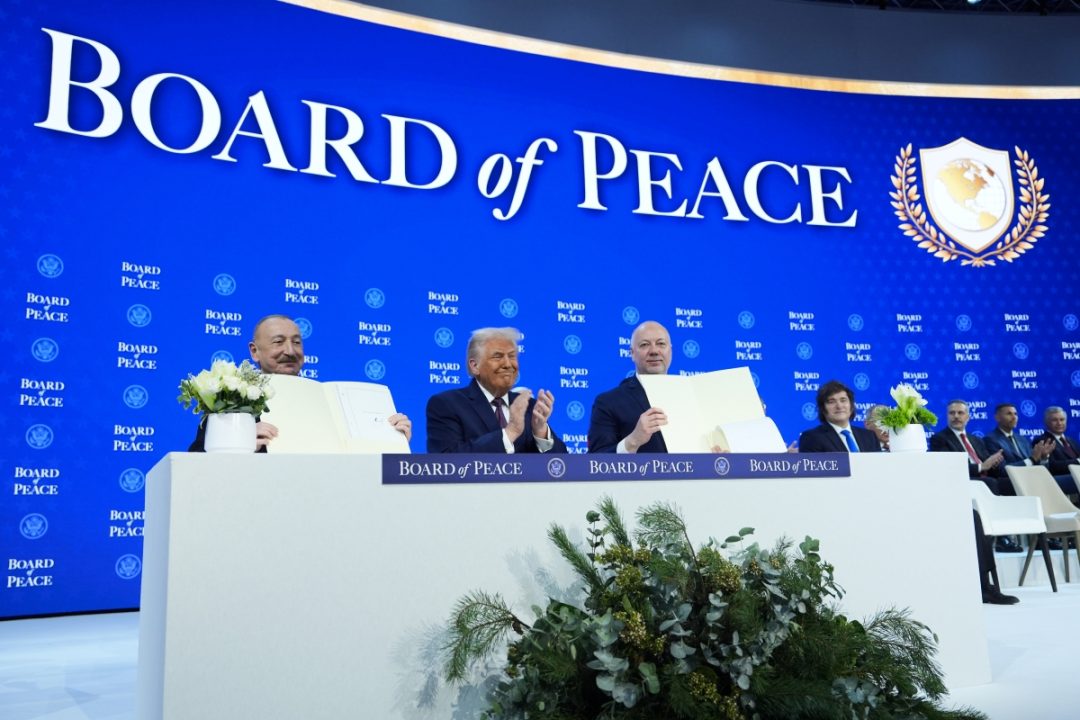
Kushner unveiled the plan at the same Davos event where Trump “ratified” the Board of Peace charter, formally presenting the body as an international organization.
The Trump Circle
The Board of Peace is chaired by Donald Trump. According to the White House, its executive board includes
- Marco Rubio, U.S. secretary of state
- Steve Witkoff, special envoy to the Middle East and a billionaire real-estate developer
- Jared Kushner, Trump’s son-in-law and private investor
- Sir Tony Blair, former prime minister of the United Kingdom
- Marc Rowan, CEO of Apollo Global Management
- Ajay Banga, president of the World Bank
- Robert Gabriel, Jr., American political advisor
The Guardian also names White House Chief of Staff Susie Wiles.
Trump tapped Nickolay Mladenov, a Bulgarian politician and veteran globalist diplomat whose career spans senior United Nations posts, to serve as the Board’s “high representative for Gaza.”
The White House explains,
In this capacity, he will act as the on-the-ground link between the Board of Peace and the NCAG. He will support the Board’s oversight of all aspects of Gaza’s governance, reconstruction, and development, while ensuring coordination across civilian and security pillars.
The board’s structure extends beyond its executive circle. Upon its inception, Trump has invited about 60 countries to join the body. The draft charter offered member states an initial three-year term, while countries contributing more than $1 billion in cash within the first year could seek extended membership, subject to approval by the board’s chairman. The board’s own website presents a roster of participating heads of state and government from 27 countries. Those include Albania, Argentina, Armenia, Azerbaijan, Bahrain, Belarus, Bulgaria, Cambodia, Egypt, El Salvador, Hungary, Indonesia, Israel, Jordan, Kazakhstan, Kosovo, Kuwait, Mongolia, Morocco, Pakistan, Paraguay, Qatar, Saudi Arabia, Turkey, the United Arab Emirates, Uzbekistan, and Vietnam.
A Legal System Unto Itself
Six lawyers specializing in U.S. contracting law and international armed conflict reviewed the draft for The Guardian. Their concern was direct:
“It looks like an attempt to exempt the board, and all of its personnel, from accountability for potential legal violations,” said Emily Schaeffer Omer-Man, an expert in litigating international humanitarian law in Israeli, American and foreign courts.
Noura Erakat, an international law professor at Rutgers University, put the issue even more sharply:
They are basically saying there’s no external oversight, including applicable international law regarding occupation.… It’s creating a legal system unto itself.
That is the danger. The Board would not merely operate in Gaza. It could become the authority that decides which complaints matter, which claims proceed, and which harms receive recognition.
The draft’s section on third-party claims reportedly lays out a system for the Board itself to consider claims for “property loss or damage and for personal injury, illness or death” arising from its work. But that is not independent oversight. That is internal review.
In other words, if a contractor damages or seizes property, if a security force injures or kills a civilian, or if a reconstruction project displaces families, the victims could be forced to seek justice from the very system responsible for the harm.
The Iraq and Afghanistan Warning
This is not a theoretical concern.
The Guardian reminds of the historic record:
US-led reconstruction efforts in Iraq and Afghanistan were often plagued by controversies of corruption or cases of civilian deaths or abuse at the hands of American contractors, including those working for Blackwater and KBR, who have since faced litigation in US courts.
Gaza could reproduce that pattern under even worse conditions.
The territory has endured mass destruction, displacement, and deep political fragmentation. Its courts and public institutions have been battered. Its people have little leverage. That makes legal accountability more important, not less.
One expert noted the importance of legal certainty for business:
“I would think any company would want a very clear legal framework,” said Doug Brooks, president emeritus of the International Stability Operations Association. “There are liability issues any serious American company would want to be clear about.”
That is true for contractors. It is even more true for civilians.
A contractor needs certainty for insurance and operations. A Gaza resident needs certainty that an injury, death, eviction, or property loss will not disappear inside a bureaucratic process controlled by outsiders.
At the same time, Americans are once again being handed the bill and asked to accept another globalist body with vague legal status, vast ambitions, and little visible accountability. But if that body can govern, contract, spend, and claim immunity in a faraway land whose destruction, ironically, was made possible at American expense, then Americans need to ask the obvious questions. By what authority did the president establish such a body? Why does it need sweeping legal protection? Who is benefiting? And who will be held responsible when the next round of suffering is administered under the banner of peace?
Related articles:
State Department Sends $1.25 Billion to Trump’s “Board of Peace”