

Argentina: A Worthy Alternative
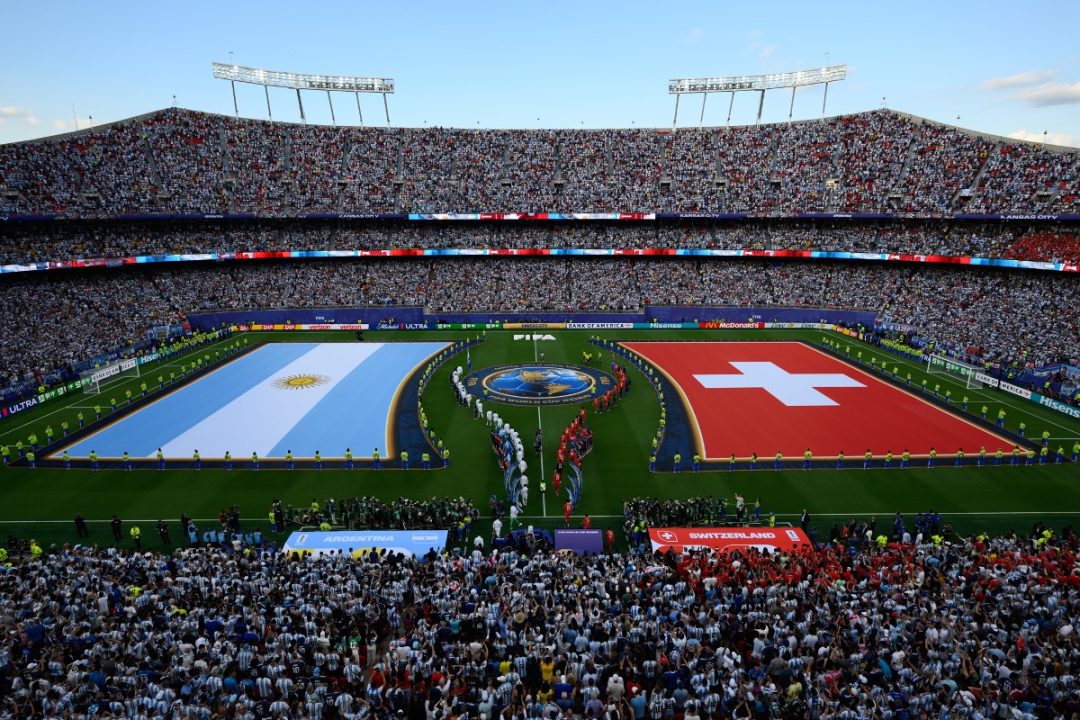
Last weekend, I attended the World Cup quarterfinal match in Kansas City between Argentina and Switzerland. Along with a friend from Argentina, I showed up outside Kansas City Stadium (aka Arrowhead, the Kansas City Chiefs’ home turf), without tickets, to see whether we could get in. Lingering outside the perimeter with thousands of raucous Argentine fans, we soon found some Colombian scalpers trying to unload tickets they had purchased in the vain hope that they, and not the Swiss, would be challenging Lionel Messi’s mighty Albiceleste. After a half-hour of hard bargaining, we managed to get three tickets at something of a discount (less than $1,000 per ticket, significantly less than what the last remaining empty seats, even the nosebleeds, were selling for on FIFA’s website), and made our way — or, more accurately, were swept along by euphoric crowds of Argentines — into the stadium to await the kickoff.
The spectacle that ensued was beyond comparison, a level of pageantry and energy that rivaled or exceeded a Super Bowl. Despite being a rabid Argentina fan myself, I felt a little sorry for the few huddled knots of Swiss fans in a frothing sea of blue and white. The Swiss side fought valiantly, but ultimately to no avail against an Argentine squad with an extraordinary knack for snatching victory from the jaws of defeat.
The American Version
Two games remain in this year’s World Cup, and — for soccer fans, at least — this year’s North American event has more than lived up to its billing. Whereas the last World Cup in 2022 was played exclusively in glitzy stadiums in the Gulf Arab country of Qatar, the 2026 edition has been a sprawling, three-country extravaganza featuring more games than ever before, along with the usual rowdy, jingoistic fan bases and political controversies. The event in Qatar was a lot more subdued, the Qatari government being a typical Middle Eastern police state with very low tolerance for public displays of exuberance. The American version, by contrast, has been chaotic, kinetic, and controversial.
Unfolding against the backdrop of a major war in the Middle East, the event has featured an Iranian squad not permitted to stay or practice in the United States between matches and an Egyptian squad that prayed to Allah to smite the infidels on the opposing side before their match with Argentina. It has furnished Americans with thousands of soul-satisfying videos of happy European and Asian soccer fans reveling in the abundance, freedom, and hospitality of the American heartland. And, of course, it has given the world the usual heartwarming underdog narratives, none more compelling than Cape Verde, the tiny island nation off Africa’s northwest coast that played mighty Spain (one of the two World Cup finalists) to a scoreless tie in their first game, and then took Argentina (the other finalist) to the absolute limit in the first knockout round.
Lionel Messi
But the most compelling story of the tournament — and the one theme in common with the 2022 edition — is the Argentine squad, with its age-defying captain, Lionel Messi. Messi turned 39 during the tournament, a nearly impossible age for an elite soccer player (Pelé retired at 36, well past his prime), and, in apparent defiance of the laws of genetics, is now playing his best soccer ever. This in itself is an extraordinary feat for a man who, already two decades ago, was being acclaimed the greatest player of all time.
Barely five feet seven inches in a sport increasingly dominated by lanky six-footers (think Norwegian sensation Erling Haaland, who is six-feet-five), the man affectionately known to his countrymen as “La Pulga” (“the flea”) is currently tied for the lead for most goals scored in this tournament, and has set a new record for assists. But in addition to his remarkable longevity and athleticism, Messi is acclaimed the world over for his fundamental decency — a humble, God-fearing family man with a modest lifestyle uncorrupted by fame and fortune.
La Scaloneta
Alongside Messi is the other Lionel, Scaloni, the Argentine coach and former player, himself an exemplar of modesty and stoicism in a culture famous for brash exuberance. Scaloni took over management of the Argentine national squad in August 2018 on a temporary basis, with no head coaching experience, and Argentine soccer faithful shook their heads in disbelief. The team was in shambles after an indecorous early exit from that year’s World Cup, and management was willing to try anything to try to recapture the glory days of Diego Maradona and Mario Kempes. As always, the Argentine side was studded with talent, led by Messi, but had become chronic underperformers, both at the World Cup and at the Copa America, where they were losing routinely to the likes of Bolivia and Peru.
But the unassuming Scaloni soon began delivering spectacular results, and in 2021, Argentina won the Copa America — over mighty Brazil, no less — for the first time in decades. By that time, the Argentine fan base had become believers, and a new nickname for the team was coined, alongside the traditional “Albiceleste”: “La Scaloneta,” or Scaloni’s squad.
An Inspiring Comeback
The following year, 2022, was a banner year for La Scaloneta. First came victory over Italy in the Finalissima tournament, and then the biggest sporting event on the planet, the World Cup. After losing the first World Cup match of 2022 to Saudi Arabia, Argentina never looked back, winning a dramatic World Cup final over hugely talented France in what was called the greatest World Cup match ever. Through it all, Messi, then 35, was the leader, scoring goal after goal and willing his country to a first World Cup victory since Maradona’s squad in 1986.
But neither Messi nor La Scaloneta were finished. In 2024, Argentina won its second straight Copa America, and set its sights, once again, on the World Cup. But by 2026, Messi was nearly 40, and a number of other squads — France, Spain, and England, for example — were stocked with younger talent. An Argentine repeat seemed unlikely.
Yet here we are, with Messi and Scaloni’s Argentina back in the World Cup final, having survived grueling knockout games against Cape Verde, Egypt (where they overcame a 2-0 deficit in the final minutes of the match to reel off three quick goals), Switzerland (which was decided in overtime), and England (where, once again, they trailed in the final minutes of the game, only to score twice in quick succession and drive a dagger through the collective heart of English fans). Whether they can beat Spain’s formidable side, which so far has only allowed a single goal, and which made mincemeat of the star-studded French squad in the semifinal, remains to be seen.
Argentine Freedom: More Than Just Soccer
Argentina’s story is about more than just soccer rejuvenation, however. After 80 years of ruinous socialism (also called Peronism and Kirchnerism in the Argentine context), punctuated by an interlude of military dictatorship, the entire country is staging a spectacular economic and political comeback under the leadership of Javier Milei (himself a former lower-tier professional footballer), embracing free-market capitalism and repudiating radical leftism in all of its economic, political, and social dimensions.
Argentina has always been South America’s answer to the United States — free-wheeling, individualistic, multicultural, and built by talented immigrants, with a long tradition of constitutional federalism. And Argentina plays soccer the way they do everything else: unpredictably, creatively, and adaptively, which has so far proven more than a match for monolithic Old World squads that emphasize regimentation and mechanistic caution. It was precisely that approach that allowed England to score first in the semifinal — but also hampered its ability to adapt to ever-protean Argentine playmaking.
In a world where the United States will never realistically challenge the elite soccer powers, Argentina is a more-than-worthy alternative, embodying in every way the brash, self-assured, creative genius typical of a free and independent people.