

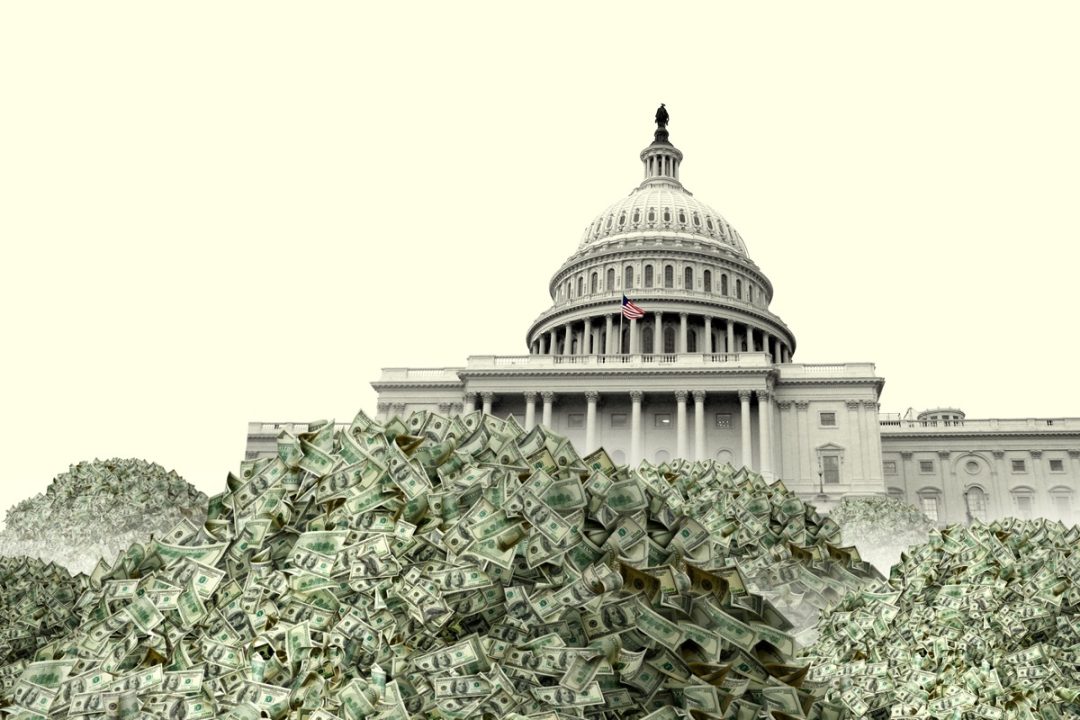
Almost $4T Added to National Debt Since January 2025, $1T Since Iran War Began
U.S. President Donald Trump has added almost $4 trillion to the national debt since he took office in January, when the “stable genius” was sworn in for his second term.
About $1 trillion of that has accumulated since Trump unilaterally declared war on Iran on behalf of Israel.
The whopping bill Trump has left taxpayers with is largely the result of the “Big Beautiful Bill,” as outgoing GOP Representative Thomas Massie (Ky.) warned in a short floor speech before voting no on the bill last year.
The vote cost him Trump’s support, but Massie accurately predicted what would happen.
Trump’s two terms have added about $11 trillion to the national debt, some 30 percent of its nearly $40 trillion total.
The Numbers
The Treasury Department’s “Fiscal Data” website shows just how quickly taxpayers are hemorrhaging money to pay for foreign aid, unconstitutional war, and other “programs” that are routinely defrauded, sometimes with the knowledge of federal lawmakers.
Readers can pick a date at the site and find out what the national debt was, going back to April 1, 1993, when the debt was a mere $4.22 trillion.
On January 21, 2025, the day after Trump was sworn in on the promise of mass deportations, no new foreign wars, and the dawn of a “Golden Age,” the debt was $36.22 trillion.
As of August 5, that figure had risen to $39.83 trillion, a 9.9 percent increase of $3.61 trillion.
And almost 30 percent of that figure has accumulated since February 27, the day before the U.S. attacked Iran. The debt then was $38.77 trillion. Thus, since Trump began the war 160 days ago, the debt has jumped $1.06 trillion — $6.6 billion per day.
On July 1, the national debt was $39.4 trillion, which means the debt has accumulated at a rate of $430 billion daily since then.
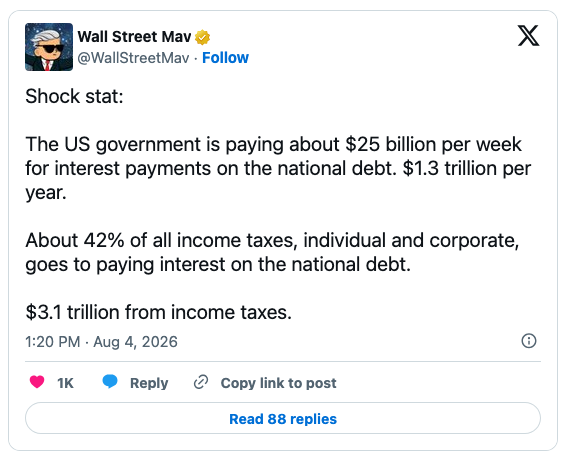
The Wall Street Mav X feed reported on August 4 that interest on the debt is $25 billion weekly, or $1.3 trillion annually:
About 42% of all income taxes, individual and corporate, goes to paying interest on the national debt.
$3.1 trillion from income taxes.
Massie’s Prescience
“I’d love to stand here and tell the American people we can cut your taxes and we can increase spending and everything’s going to be just fine. But I can’t do that, because I’m here to deliver a dose of reality,” Massie warned when he voted against the Big Beautiful Bill:
This bill dramatically increases deficits in the near-term, but promises our government will be fiscally responsible five years from now. Where have we heard that before? … This bill is a debt bomb ticking. … This week … Moody’s downgraded our credit rating, and the bond investors who buy our debt and finance our debt demanded higher interest rates on the 10-year note, 20-year note, and the 30-year note. What does this mean? Very soon the government will be paying $16,000 of interest alone per U.S. family.
Massie predicted $30 trillion of debt in the next 10 years.
“We’re not rearranging deck chairs on the Titanic tonight. We’re putting coal in the boiler and setting a course for the iceberg,” Massie said.
As for the total debt added during Trump’s first failed term, that figure is equally shocking. The debt on January 20, 2017, Inauguration Day, was $19.95 trillion. On January 20, 2021, it was $27.75 trillion.
So Trump added $7.8 trillion during those four years.
Added to the $3.61 trillion in debt accumulated since January 20, 2025, that makes a grand total of $11.41 trillion, meaning Trump is responsible for 28.7 percent of the national debt accumulated by all presidents combined.
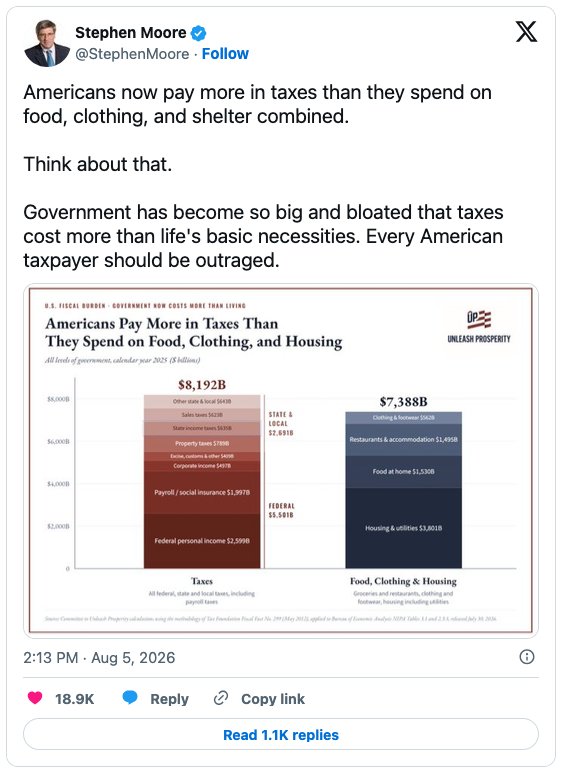
Economist Stephen Moore offered a sobering take on what this irresponsible spending means for Americans.
“Americans now pay more in taxes than they spend on food, clothing, and shelter combined,” he wrote:
Think about that.
Government has become so big and bloated that taxes cost more than life’s basic necessities. Every American taxpayer should be outraged.
War Cost to the Consumer
One expense Trump could have avoided was the war with Iran, which he started on Israeli Prime Minister Benjamin Netanyahu’s orders. Netanyahu lied to Trump about the chances of regime change during a briefing in the White House Situation Room.
Now, the bills are coming due.
As The New American reported on April 30, citing the Iran War Cost Tracker, by then the war had cost $67 billion. The first six days cost $11.3 billion.
The tracker put the war’s cost at $113.3 billion when the first ceasefire was declared.
But the fighting has continued since then, which means Trump has wasted even more money on Netanyahu’s dream of “Greater Israel.”

While The Washington Post published a much lower figure for the cost of the war through June, the newspaper included what the war is costing consumers beyond the taxes they pay.
“Comparing the current war scenario to a counterfactual ‘no-war’ scenario, Brown University’s Climate Solutions Lab put the extra costs paid for gasoline and diesel by all Americans since the start of the war at more than $79.8 billion — or about $609 per U.S. household,” the Post explained:
Their ticker continues to rise.
Mark Zandi, chief economist of Moody’s Analytics, said the typical household will pay $1,000 due to the war — about a third of which is related to the cost of gasoline. His estimate also includes the cost of diesel, which affects anything put on a truck including groceries, jet fuel and higher interest rates. There’s another $250 in taxes for direct military spending, he said.
He didn’t include any confidence effects, he said, adding that consumer sentiment including small business sentiment has been “hit hard.” The $1,000 cost is “on the low side of what we’ve actually paid,” he added.
… There are tax cuts which have offset some of the war costs — but “still the benefit of the tax cut is now in the rear view” as war costs accumulate, Zandi said.